

Head of Investments China


• 市場觀點
China aims to re-ignite domestic economy
China’s 15th five-year plan reiterated the familiar theme of building a modern, high productivity industrial system which is logical given its ongoing technology race with the US. Investors will be heartened by an increased emphasis on invigorating the domestic economy, with policy detail to be revealed by the year-end.
作者


Client Portfolio Manager
概要
- Five-year plan focuses on tech, self-reliance, and domestic consumption
- Implementation plan details could be catalysts into the year-end
- We remain constructive on Chinese equities
China’s fourth plenum and its introduction of the next five-year plan concluded in Beijing on 24 October 2025 to a muted reception by markets, with top policymakers signaling broad continuity. The strategic objective remains industrial and technological self-reliance. The positive outcome for investors was the increased emphasis on stimulating domestic consumption although specific policy details are to come. A resolution to the current trade impasse with the US before 1 November, when penurious US tariffs are scheduled to kick-in, will be required before equities start to reflect any positive sentiment over the five-year plan.
The five-year plan communique reiterated that raising per capita GDP to the level of a “moderately advanced economy level” by doubling the economy’s size between 2020 and 2035 is the ultimate performance target, which implies sustained average growth of around 4-5% over the coming decade. With this in mind the communique said that “economic work as the center” and a tilt to “high quality” growth was the mantra, which should reassure investors that any other political or geopolitical goals will be subordinate to that. Economic reforms are clear and necessary, given continued property market weakness, overinvestment resulting in intense competition and potential misallocation of resources, with a very high domestic savings rate imposing deflationary pressure.

Discover emerging opportunities
For investors focused on long-term investing with real diversification, EM exposure is critical.
Innovation acceleration
Rapid innovation in emerging competitive sectors like AI, Quantum computing, hydrogen energy, nuclear fusion and biomanufacturing was also emphasized. These sectors represent a primary arena of competition with the US, a key undercurrent of the current trade negotiations. From our perspective, this means a fertile future for China’s technology sector. It’s also an opportunity long-term investors should not ignore, especially given valuations remain at a discount to peers in the US and Europe.
獲取最新市場觀點
訂閱我們的電子報,時刻把握投資資訊和專家分析。
Spend don’t save
China’s household savings rate is estimated at around 35 to 40% in 2025, far higher than 15.4% in Europe1 and 4.6% in the US.2 This reflects property market weakness and the perceived inadequacy of social welfare provision. Reform of the transmission mechanism between central and local government expenditure leading to more balanced and efficient public investment is now accepted to be necessary. Policy detail on this will be required to tip this large pool of savings into consumption and asset markets. The fourth plenum communique did mention economic rebalancing and consumption as a policy priority but we will have to wait for specific action and reforms with 2025 GDP growth expected to be in line with the 5% target. As a long-term driver for the economy and Chinese equities, this will be key, especially if trade tensions with the US and the rest of the world cap further export growth.
Conclusion
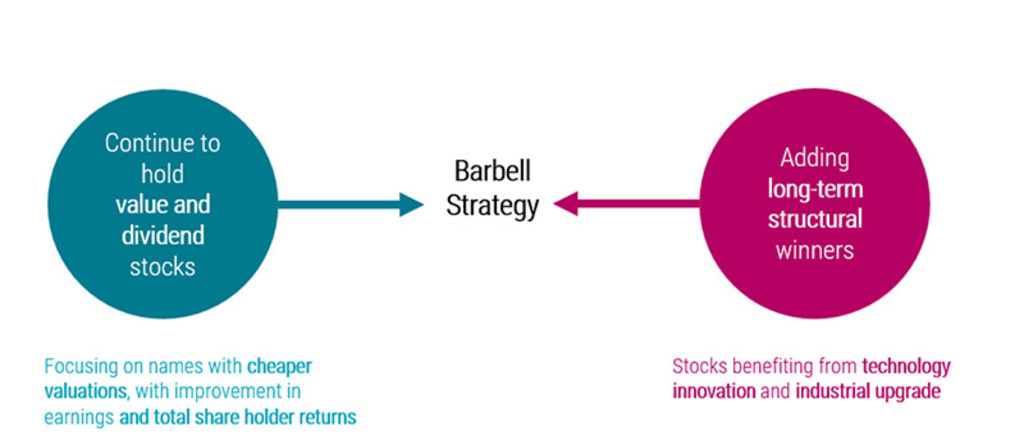
We continue to position our portfolio toward structural winners in technology and innovation, aligning with long-term strategic priorities. Notwithstanding any final resolution to the trade negotiations with the US, earnings revisions are critical to sustaining the current positive market sentiment. Given the persistence of deflationary risks, we will continue to hold value stocks with potential for earnings upgrades and improve total shareholder returns as the other side of our barbell strategy during this period.
Footnotes
1 Eurostat, 2024.
2 St Louis Federal Reserve, August 2025 data.
重要資料
本網站僅供《證券及期貨條例》(香港法例第571章)及其附屬法例所界定之專業投資者瀏覽及使用。 投資涉及風險。過往表現並不代表未來表現。本網站所載資料僅供參考之用,並不構成任何投資建議,亦非作出買賣任何證券或採納任何投資策略之要約或招攬。投資者不應僅憑本網站提供之資料作出投資決定,在作出任何投資決定前,應徵詢獨立意見(包括有關稅務影響之意見)。投資者應確保完全理解投資產品的相關風險,亦應考量自身投資目標及風險承受水平。投資乃閣下之個人決定。除非銷售投資產品的中介人已向閣下告知該投資產品適合閣下,並已解釋其符合閣下投資目標之原因,否則閣下不應投資。請參閱相關發售文件或其他法律文件,以獲取包括風險因素在內的進一步詳情。 本網站由荷寶投資管理香港有限公司發布,該公司受香港證券及期貨事務監察委員會(「證監會」)規管(中央編號:APU851)。本網站未經證監會審閱。 無法保證任何投資產品可實現其投資目標。概不就任何投資產品之表現或投資回報作任何聲明或承諾。投資的價值或會波動。本網站所載過往表現、推算或預測,均不應視作未來表現之保證或指標,且概不提供任何明示或暗示之保證。本網站內容建基於相信為可靠之來源,惟因應資料傳遞技術特性及須採用多項數據來源(包括第三方內容),故概不保證其準確性。所述觀點僅乃截至上述日期,或會隨市況變化而改變,可予更改而毋須另行通知。該等意見可能有別於其他荷寶投資專業人士之意見。因使用本材料或當中所載任何評論、意見或估算而引致之直接、間接或相應損失,荷寶概不承擔法律責任。荷寶並無責任更新本網站或任何網站內容。未經荷寶事先書面許可,不得複製、分發或刊發本網站任何材料。 除非另有說明,資料來源:荷寶。