
Head of Multi Asset & Equity Solutions, Co-Head Investment Solutions


• 月度展望
Tariffs retaliation – the markets bite back
It’s been the expected explosive start to the second Trump presidency, but he will have been reminded of forces more powerful than presidential authority – the markets. And that could serve to neutralize the impact of tariffs and any trade war, says multi-asset investor Colin Graham.
作者

概要
- Tariffs cause US equities, bonds and currency to fall at the same time
- Conversion of dollars held overseas into local assets more likely
- Investors will question the premium now needed to hold US assets
All the major asset classes tanked on the tariffs news, though the biggest shock came with a trillion-dollar sell-off in the US Treasury market – by far the largest bond market in the world. This move by the ‘bond vigilantes’ prompted the White House to water down or postpone much of the tariff plans.
And now the US economy itself is threatened by the self-defeating mantra of trying to correct trade imbalances with taxes on imports that will only dampen consumer demand and import inflation, says Graham, co-head of Robeco Investment Solutions.

The art of the deal?
“From our vantage point, President Trump is not following his own mantra of the art of the deal,” Graham says. “He blinked when the bond vigilantes emerged from hibernation, and is now folding as his bluff was called by friends and foes alike. The climbdown over tariffs will continue, but the negative macro impact on the US will start to emerge.”
“The consumer and manufacturing survey data has been poor, though the actual spending or labor data has yet to be affected. There is evidence that US consumers are pulling spending forward, and that companies have been stockpiling before the tariffs hit.”
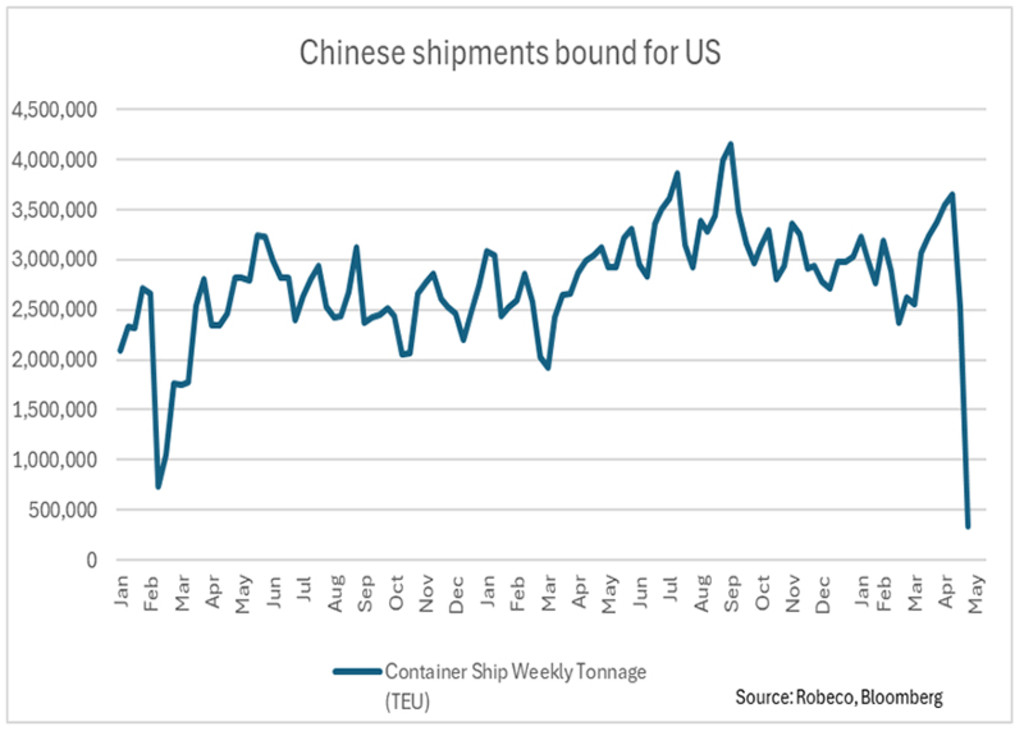
“As a consequence of the tariffs, shipping volumes from China have ground to a halt. The most recent parallels can be drawn with the supply shock of the 2020 pandemic, as goods became scarce and inflation skyrocketed.”
Figure 1: Container ship volumes: shipments bound for the US from China have fallen off a cliff
Source: Robeco, Bloomberg
Upending the world order
The first major casualty of the new regime has been a significant weakening of the US dollar, and its role as the global reserve currency that is normally highly prized by foreigners. Its historic strength has largely allowed the US to fund its huge budget and trade deficits.
“Reversing this system could have dire consequences for the US and global economy,” Graham says. “Since the tariff announcements, the US economic outlook has been universally downgraded, coupled with everyone scrambling to understand the extreme policy uncertainty.”
“Non-US investors are now questioning the required risk premium for holding US assets. This is the USD 32 trillion question (the size of foreign portfolio holdings), which means the retaliation may come from different avenues.”
Reactions of asset classes
This retaliation has major implications for all asset classes, Graham says: “We came into the year with the dollar significantly overvalued compared to history as superior growth, higher interest rates and capital inflows drove it ever higher. Over the longer term, we expect a derating and rebalancing.”
“The downward pressure from a ‘buyer’s strike’ would be extended if investors do not allocate more assets to the US. Meanwhile, the repatriation of export proceeds from the US, allowing local currencies to appreciate against the dollar, means tariff policies are likely to continue to be watered down.”
“We have already seen central banks and individuals increasing dollar diversification through gold and other FX holdings. Going forward, we question whether US interest rate and growth rate dominance over the rest of the world will be enough to retain the attraction of US capital.”
“While the reduction of overweights to US assets by foreigners is a slow burn, this could speed up, as investors and corporates accelerate the de-dollarization process.”
Impact on Treasuries
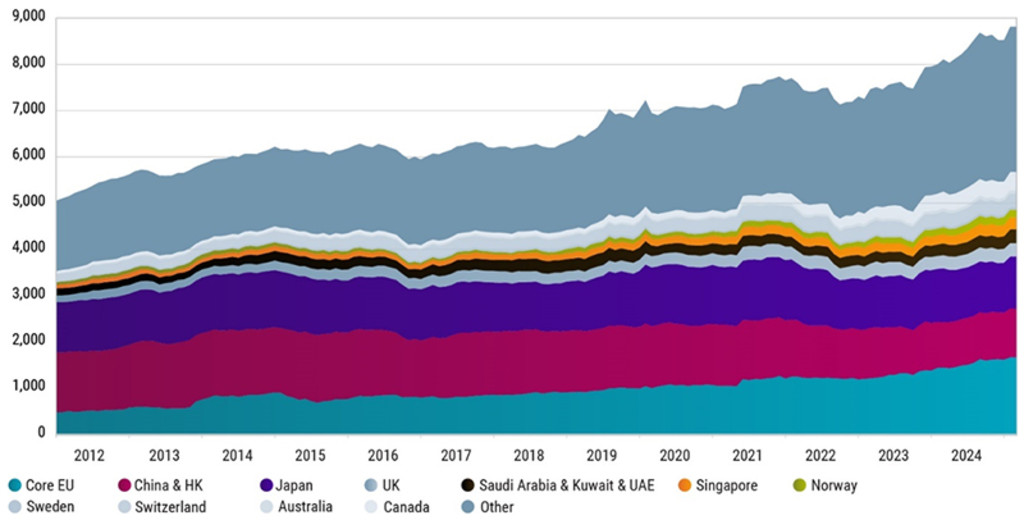
The biggest impact may be seen in US Treasuries, USD 9 trillion of which are owned by overseas actors, including China. The so-called bond vigilantes have been dumping them on the open market, forcing yields up and values down.
Figure 2: Foreign ownership of US Treasuries is huge
Source: US Department of Treasury, Robeco
“A reduction in trade will provide less incentive to hold proceeds in dollars, and the conversion of dollars held overseas into local assets becomes more likely,” Graham says. “China has been increasing its pile of US Treasuries held in the Euroclear system, thereby making it easier to switch to European bonds and avoid driving the renminbi up against the greenback.”
“We remain neutral on the duration of Treasuries as the US economy remains robust, but will be looking to add to holdings if yields rise, because the inflationary impact of the goods shortage is not yet priced in, and the risk (term) premium for holding US Treasuries should be higher.”
Outlook for earnings and equities
There are also implications for equities, not least in how any remaining tariffs cut into company earnings, at a time when many investors believe that the tech-dominated US stock market is overvalued, even after the recent correction.
“Previously, non-US investors had a cushion against any risk-off move lower in equities from a rising US dollar,” Graham says. “In the latest equity sell-off, European investors were hit with the double whammy of declining US equity prices and a falling US dollar.”
“Toward the end of 2025, it will be clearer where the additional costs of tariffs will be borne. We expect to see the cost split between corporate margins and price increases for consumers. This will impact US equity multiples, which are already expensive, and keep consumer inflation sticky.”
Murky guidance
“In this state of the world, the outlook for employment and capital expenditure intentions will significantly impact investors’ expectations. Currently, US employment data is strong, while companies’ earnings guidance has become murky to non-existent.”
“We remain hyper-vigilant on the changing landscape, currently maintaining defensive positions in portfolios.”
獲取最新市場觀點
訂閱我們的電子報,時刻把握投資資訊和專家分析。
重要資料
本網站僅供《證券及期貨條例》(香港法例第571章)及其附屬法例所界定之專業投資者瀏覽及使用。 投資涉及風險。過往表現並不代表未來表現。本網站所載資料僅供參考之用,並不構成任何投資建議,亦非作出買賣任何證券或採納任何投資策略之要約或招攬。投資者不應僅憑本網站提供之資料作出投資決定,在作出任何投資決定前,應徵詢獨立意見(包括有關稅務影響之意見)。投資者應確保完全理解投資產品的相關風險,亦應考量自身投資目標及風險承受水平。投資乃閣下之個人決定。除非銷售投資產品的中介人已向閣下告知該投資產品適合閣下,並已解釋其符合閣下投資目標之原因,否則閣下不應投資。請參閱相關發售文件或其他法律文件,以獲取包括風險因素在內的進一步詳情。 本網站由荷寶投資管理香港有限公司發布,該公司受香港證券及期貨事務監察委員會(「證監會」)規管(中央編號:APU851)。本網站未經證監會審閱。 無法保證任何投資產品可實現其投資目標。概不就任何投資產品之表現或投資回報作任何聲明或承諾。投資的價值或會波動。本網站所載過往表現、推算或預測,均不應視作未來表現之保證或指標,且概不提供任何明示或暗示之保證。本網站內容建基於相信為可靠之來源,惟因應資料傳遞技術特性及須採用多項數據來源(包括第三方內容),故概不保證其準確性。所述觀點僅乃截至上述日期,或會隨市況變化而改變,可予更改而毋須另行通知。該等意見可能有別於其他荷寶投資專業人士之意見。因使用本材料或當中所載任何評論、意見或估算而引致之直接、間接或相應損失,荷寶概不承擔法律責任。荷寶並無責任更新本網站或任何網站內容。未經荷寶事先書面許可,不得複製、分發或刊發本網站任何材料。 除非另有說明,資料來源:荷寶。