

Head of Conservative Equities and Chief Quant Strategist


• 市場觀點
When the equity risk premium fades, alpha shines
Historically, the market (beta) gave great returns just by being in it. But those days may be ending. In a future where the market returns less, investors will need to rely more on alpha – returns from skill and strategy.
作者

概要
- As the equity risk premium fades, alpha becomes a critical return driver
- Quant alpha is robust during low-return markets and economic downturns
- Future low equity returns might shift investors back from passive to active
For the past century, US equities have delivered an average annual return of 10%. The equity risk premium (ERP), in other words, the extra return investors get for investing in stocks over other asset classes, has long been a cornerstone of investing. Historically the ERP has provided a 5% excess return over bonds and 6% over cash. In this framework, alpha – the additional return from fundamental or quantitative active management – was often considered a secondary benefit, contributing only a modest share of total returns even for the best investors.
However, the conditions that fueled this historical ERP are changing. Expanding valuation multiples, strong earnings growth, favorable demographics, and US market dominance in the last decades were the key tailwinds supporting those high equity returns. And today, many of these forces are weakening.
Many investors active today have in fact never experienced negative equity returns, and have grown accustomed to strong performance. However, history tells a different story, with prolonged periods of weak or even negative returns in the 1930s, 1970s, and early 2000s. So, what does a strong 10-year return tell us about the decade to come?
A simple way to assess future equity returns is to examine past equity return patterns. To explore this, we categorized historical 10-year realized equity premiums into three groups – low, medium, and high – and analyzed the returns that followed. Indeed, the data supports the principle of mean reversion: strong equity market returns are often followed by weaker returns, and vice versa.
Figure 1 | Realized and subsequent US 10-year equity premiums
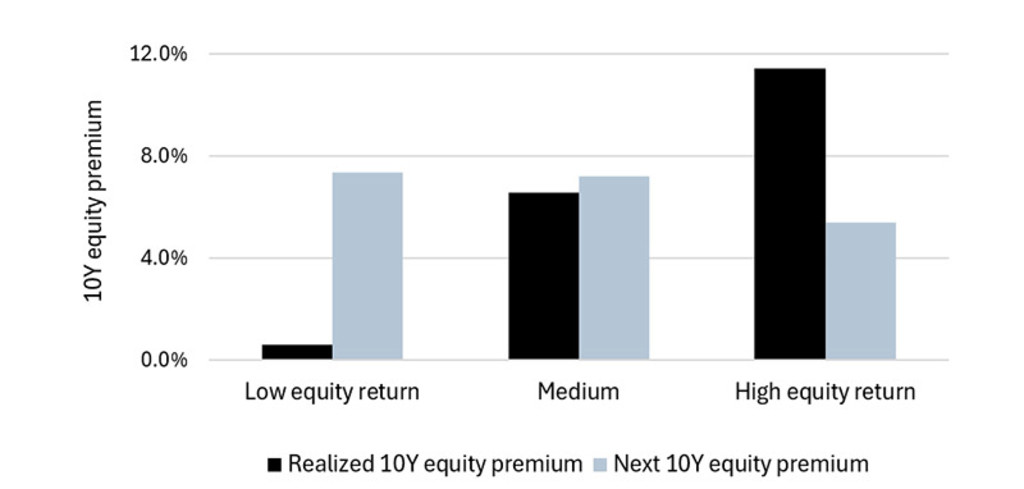
Source: Robeco and Kenneth French Data library. US stock market returns 1926-2024.
探索量化價值
訂閱我們的電子報,獲取尖端的量化策略和見解。
Is the equity risk premium shrinking to zero?
While mean reversion provides a useful framework, it oversimplifies the drivers of future returns. A deeper analysis of historical return decomposition reveals what fueled past performance. Our recent research shows that the recent US equity rally was not only driven by earnings growth but also by a significant expansion in valuation multiples – particularly in large-cap growth stocks. Less recognized is that small caps and low volatility stocks delivered strong fundamentals but remained undervalued.
This raises concerns about the sustainability of future returns, especially as valuations remain historically elevated and the US market now comprises 74% of the total global market capitalization. A more comprehensive approach, rooted in economic first principles, considers the fundamental components of the equity risk premium – dividends, valuation changes, and expected earnings growth – over a 10-year horizon. Robeco’s five-year outlook 2025-2029, which integrates multiple valuation metrics along with growth estimates, projects the US equity premium will be close to zero. However, the global outlook is more favorable – driven by more attractive valuations in Europe and emerging markets, where the global ERP stands at approximately 2%.
Lower equity premium, higher factor premium?
Interestingly, periods of strong equity performance often coincide with lower factor premiums, and vice versa. To explore this relationship, we use the US value and momentum factors as a rough proxy for active quantitative investing, splitting the sample into three segments based on realized 10-year equity premiums.
Figure 2 | Realized US equity premiums
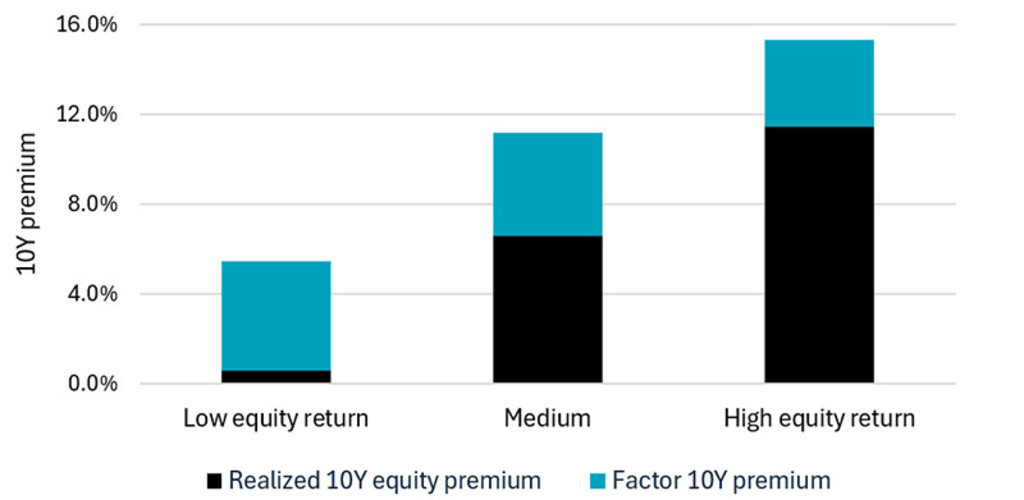
Source: Robeco and Kenneth French Data library. Sample US 1926-2024.This graph is for illustrative purposes only and does not represent an actual product or strategy.
We see that factor premiums remain stable – and even rise slightly – when equity returns are low. Most strikingly, when viewed as a share of total returns, alpha shifts from being a complement to being the dominant source of performance.
Our research on factor investing further supports this asymmetry in alpha. Blitz (2023), for example, finds that factor alphas tend to rise when equity market returns are lower, reinforcing the importance of factors in a low-equity-premium environment. Even if factor alphas remain constant across regimes, their relative contribution to total returns increases when market beta weakens. In such periods, factors like value, low volatility, quality, and momentum offer an alternative, uncorrelated source of alpha.
Beyond beta: Investing in a low ERP world
As traditional sources of return diminish, investors will be forced to seek alternatives, reshaping market dynamics. Strategies that have historically delivered alpha – whether through defensive factors, long-short approaches, or high-active-share investing – may attract substantial capital inflows, as investors seek more adaptive, uncorrelated return streams. This could elevate valuations for assets tied to proven alpha strategies, potentially distorting factor pricing and altering market behavior, reversing the multi-decade trend toward passive investing.
A declining equity risk premium does not signal the end of investing – but it does call for a more active approach. With beta-driven returns under pressure, investors must prioritize alpha. Systematic strategies with clear objectives can help investors to achieve meaningful capital growth using alpha from multiple factors. Robeco’s quant strategies offer a structured approach to navigating this evolving investment landscape.
重要資料
本網站僅供《證券及期貨條例》(香港法例第571章)及其附屬法例所界定之專業投資者瀏覽及使用。 投資涉及風險。過往表現並不代表未來表現。本網站所載資料僅供參考之用,並不構成任何投資建議,亦非作出買賣任何證券或採納任何投資策略之要約或招攬。投資者不應僅憑本網站提供之資料作出投資決定,在作出任何投資決定前,應徵詢獨立意見(包括有關稅務影響之意見)。投資者應確保完全理解投資產品的相關風險,亦應考量自身投資目標及風險承受水平。投資乃閣下之個人決定。除非銷售投資產品的中介人已向閣下告知該投資產品適合閣下,並已解釋其符合閣下投資目標之原因,否則閣下不應投資。請參閱相關發售文件或其他法律文件,以獲取包括風險因素在內的進一步詳情。 本網站由荷寶投資管理香港有限公司發布,該公司受香港證券及期貨事務監察委員會(「證監會」)規管(中央編號:APU851)。本網站未經證監會審閱。 無法保證任何投資產品可實現其投資目標。概不就任何投資產品之表現或投資回報作任何聲明或承諾。投資的價值或會波動。本網站所載過往表現、推算或預測,均不應視作未來表現之保證或指標,且概不提供任何明示或暗示之保證。本網站內容建基於相信為可靠之來源,惟因應資料傳遞技術特性及須採用多項數據來源(包括第三方內容),故概不保證其準確性。所述觀點僅乃截至上述日期,或會隨市況變化而改變,可予更改而毋須另行通知。該等意見可能有別於其他荷寶投資專業人士之意見。因使用本材料或當中所載任何評論、意見或估算而引致之直接、間接或相應損失,荷寶概不承擔法律責任。荷寶並無責任更新本網站或任何網站內容。未經荷寶事先書面許可,不得複製、分發或刊發本網站任何材料。 除非另有說明,資料來源:荷寶。