



• 市場觀點
Moving the needle? Six insights into SDG investing
The UN’s Sustainable Development Goals have taken sustainable investing to the next level – but do they always add value that could not be found elsewhere? Robeco recently updated its proprietary SDG Framework with new research that answers this question.
概要
- SDG scores are better at gauging impact than traditional ESG research
- It doesn’t cost returns and doesn’t have the biases of size or location
- SDG alignment can help avoid future scandals as well as decarbonizing portfolios
The Framework, launched in 2017, is a robust tool that systematically assesses individual companies on their contributions to key targets for the 17 SDGs. These contributions are aggregated into an SDG score, which can be used to construct portfolios that pursue positive impact, avoid negative impact, and support sustainable progress in the economy, society and the natural environment.
Over the years, we have built a strong track record of integrating SDG scores in our investment portfolios, with our dedicated SDG solutions on average nearly doubling in assets under management between 2018 and 2023. For Robeco, SDG investing is no longer a niche practice; ultimately, our goal is to make it the new norm for sustainable investing.
However, investors still ask questions about issues ranging from whether SDG scores do better than ESG analysis or mean lower returns, to whether they have their own biases, or do anything to further the pursuit of net-zero goals. Here we offer six key takeaways from the research conducted for the revised SDG Framework published in September 2024.
It’s important to know whether the SDG Framework works better in capturing companies’ impact on sustainable development than traditional environmental, social and governance (ESG) metrics which can look at similar variables. So, we tested them.1
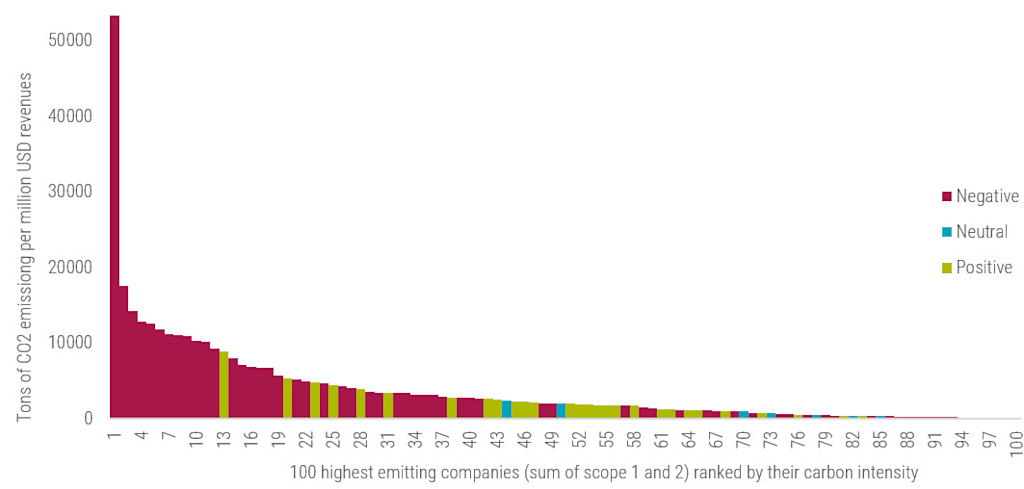
We found that companies that are on asset owners’ exclusion lists, those that breach the EU Taxonomy’s do-no-significant-harm (DNSH) principle, and companies that are among the 100 highest carbon emitters predominantly get negative SDG scores. Conversely, the majority of companies that have significant Taxonomy-aligned revenues or provide solutions in the field of health and well-being, water and sanitation, or sustainable energy, are assigned positive SDG scores.
Meanwhile, none of the ESG ratings studied were found to align with the sustainability preferences of investors, regulators and scientists. ESG ratings are simply not suited to differentiate between companies with positive and negative impacts. This confirms the validity of our SDG scores in capturing real-world impact.
2. The SDG lens does not compromise returns in the long run
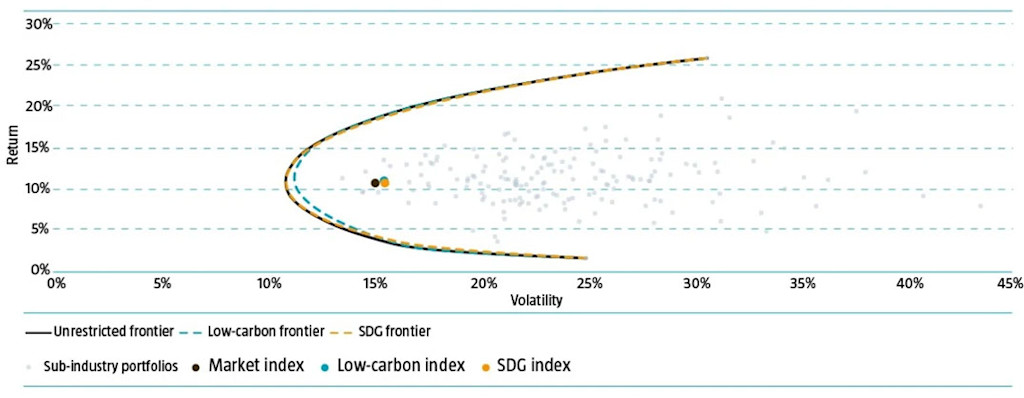
An often-heard concern is that sustainable investing leads to lower returns and less diversification in portfolios. We investigated this notion by running a historical simulation between two portfolios: one that avoids stocks with negative SDG scores and one that is unconstrained.
The findings show that the positive SDG investment approach did not lead to lower returns compared to the market index. In addition, the two portfolios showed highly similar risk levels and the diversification benefits were virtually identical. This suggests that investors can utilize an SDG lens without compromising their financial objectives.
A simulation of the efficient frontier, where return, risk and diversification characteristics are virtually identical for all three passive solutions.
Source: FTSE, MSCI, Robeco
3. Higher scoring companies face fewer scandals
Scandals can lead to loss of stakeholder confidence and may have long-term reputational or financial consequences for companies. A research collaboration between Robeco and the University of Zurich led to a recent article titled ‘Corporate Sustainability and Scandals’, which examined the link between our SDG scores and involvement in future controversies.2
It found that companies with higher SDG scores have a lower probability of being involved in scandals, and if they do become embroiled in one, these are less severe and cover fewer contentious topics. This suggests that our SDG score is a useful tool for sustainability-minded investors who want to avoid negative financial implications stemming from corporate scandals.
4. SDG scores do not exhibit size, location or reporting biases
A criticism of ESG ratings is that companies that are larger in size, are from developed countries, or have more resources for providing sustainability disclosures are assigned better ratings. Our SDG scores were academically tested on whether they exhibit similar biases in a recent paper entitled ‘Sustainability Matters: Company SDG Scores Need Not Have Size, Location, and ESG Disclosure Biases’.3
The findings suggest that this is not the case, meaning SDG-aligned investment portfolios avoid undesirable biases stemming from the way our SDG scores are constructed. This is an important finding considering that investors have more potential to create positive impact by investing in companies that face capital constraints, a situation more common among smaller companies and those operating in emerging markets.
5. The SDGs can form the third dimension of 3D investing
Robeco has long practiced 3D investing, combining the assessment of risk, return, and sustainability as the third dimension. The value added by sustainability was examined in a paper entitled ‘3D Investing: Jointly optimizing return, risk and sustainability’, which used the Robeco SDG scores as the third dimension rather than traditional ESG metrics.4
It found that 3D investing yields higher sustainability metrics and expected returns compared to a 2D model with constraints, such as the use of basic exclusions. A combined strategy, blending a flexible sustainability constraint with integrating sustainability into the optimization process, offers a balance between return, risk and sustainability goals.
6. Integrating the SDGs helps decarbonize portfolios
Finally, a massive challenge – and potential opportunity – in sustainable investing today lies in the transition to achieve net-zero emissions by 2050. Of the 100 companies with the highest greenhouse gas emissions in the MSCI World Index, 63 have a negative SDG score. Furthermore, the 27% of MSCI companies with a negative SDG score are responsible for 72% of all emissions.
Conversely, the 53% of companies with a positive SDG score account for only 21% of the index's emissions. Thus, by increasingly avoiding negative scoring companies, investors will indirectly reduce exposure to high emitting firms, and thereby align with decarbonization objectives. The figure below shows these results.
The SDG scores of top-100 highest emitting MSCI AC World companies (Scope 1 and 2)
Source: Robeco, MSCI.
Conclusion
In summary, we can show that using the SDG Framework in portfolio construction significantly helps toward achieving the SDGs, does not compromise returns, and can help with climate change. Robeco subsequently remains committed to using the Framework not just for SDG investing, but as a metric across its entire range of fundamental equity, fixed income, quant and bespoke sustainability strategies.
And it is an ongoing process at Robeco. As the ‘Investment Engineers’, we continually develop our intellectual property, test it scientifically internally and against academic research, and then customize it for use in investment products.
Footnotes
1ESG to SDG: Do Sustainable Investing Ratings Align with the Sustainability Preferences of Investors, Regulators, and Scientists?
2 Corporate Sustainability and Scandals
3 Sustainability Matters: Company SDG Scores Need Not Have Size, Location, and ESG Disclosure Biases
4 3D Investing: Jointly optimizing return, risk and sustainability’
獲取最新市場觀點
訂閱我們的電子報,時刻把握投資資訊和專家分析。
重要資料
本網站僅供《證券及期貨條例》(香港法例第571章)及其附屬法例所界定之專業投資者瀏覽及使用。 投資涉及風險。過往表現並不代表未來表現。本網站所載資料僅供參考之用,並不構成任何投資建議,亦非作出買賣任何證券或採納任何投資策略之要約或招攬。投資者不應僅憑本網站提供之資料作出投資決定,在作出任何投資決定前,應徵詢獨立意見(包括有關稅務影響之意見)。投資者應確保完全理解投資產品的相關風險,亦應考量自身投資目標及風險承受水平。投資乃閣下之個人決定。除非銷售投資產品的中介人已向閣下告知該投資產品適合閣下,並已解釋其符合閣下投資目標之原因,否則閣下不應投資。請參閱相關發售文件或其他法律文件,以獲取包括風險因素在內的進一步詳情。 本網站由荷寶投資管理香港有限公司發布,該公司受香港證券及期貨事務監察委員會(「證監會」)規管(中央編號:APU851)。本網站未經證監會審閱。 無法保證任何投資產品可實現其投資目標。概不就任何投資產品之表現或投資回報作任何聲明或承諾。投資的價值或會波動。本網站所載過往表現、推算或預測,均不應視作未來表現之保證或指標,且概不提供任何明示或暗示之保證。本網站內容建基於相信為可靠之來源,惟因應資料傳遞技術特性及須採用多項數據來源(包括第三方內容),故概不保證其準確性。所述觀點僅乃截至上述日期,或會隨市況變化而改變,可予更改而毋須另行通知。該等意見可能有別於其他荷寶投資專業人士之意見。因使用本材料或當中所載任何評論、意見或估算而引致之直接、間接或相應損失,荷寶概不承擔法律責任。荷寶並無責任更新本網站或任何網站內容。未經荷寶事先書面許可,不得複製、分發或刊發本網站任何材料。 除非另有說明,資料來源:荷寶。