
Impact Specialist


• 市場觀點
Denmark is the new world leader in sustainability performance
Denmark tops Robeco’s latest country ranking thanks to consistent environmental performance. Hungary’s declining ESG scores creates a cautionary tale for rising populist movements. Analysis finds educational investments are not enough to stave off country ‘brain drain.’ Indonesia wants to join the OECD, but is it ready?
作者
概要
- Consistency is key in Denmark’s rise in the ranks
- The US improves but gains most likely short-lived
- Hungary shows populism can be toxic for investments and growth
Denmark is now the world leader in sustainability performance, according to Robeco’s latest country ranking, which measures 150 countries on material environmental, social, and governance indicators that materially impact economic growth and development.
Though it shot past Finland, Sweden and Norway, its rise is by no means meteoric. For more than a decade, it has consistently ranked in the top five, even besting No. 2 Sweden on environmental scores just last year and receiving the world’s best social score in 2021. But it has never managed to surpass its northern neighbors in performance overall. This year nicely illustrates that though intensity of effort is rewarded by short-term gains, consistency of effort pays off nicely in the long run.
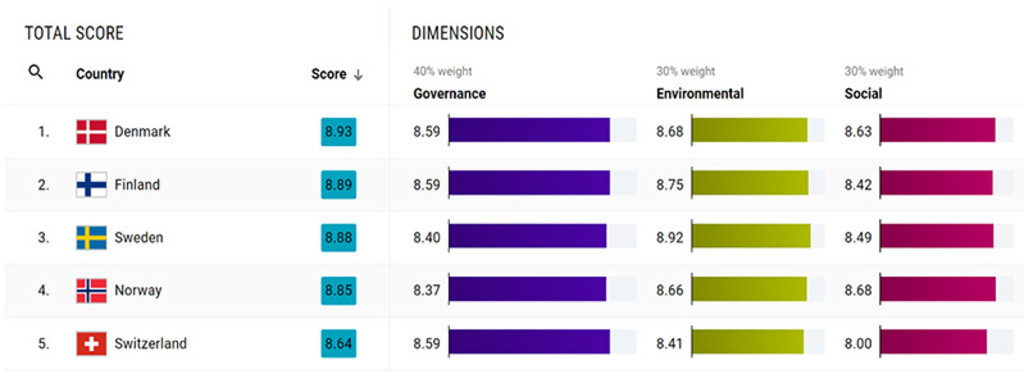
Source: Robeco, October 2024.
Both Finland and Sweden struggled on environmental and social dimensions. In Finland, a right-wing coalition government proposed reforms that would seriously undermine workers’ and civil rights. In Sweden, Tesla’s refusal to collectively bargain with IF Metall – a prominent trade union representing a large portion of the country’s manufacturing sector – threatens workers’ rights and creates a stormy precedent for future labor negotiations. Moreover, decarbonization has slowed in both countries, which has weighed on environmental scores.
Though not in the top ten, the UK rejoined an elite group scoring above 8.00 overall, thanks to stronger environmental and governance scores. The US and Japan, the two largest sovereign debt issuers, slightly improved overall scores, with Japan noteworthy for maintaining its decarbonization trajectory.
Country data is calculated as of end of October, the Trump victory are not reflected in the US’s current ESG score. As with most international observers, a dial back of climate and environmental policies, social protections such as affordable health insurance, reproductive services, and minority rights is expected. This will undoubtedly weigh on US performance across all ESG dimensions in the coming years.
ESG’s biggest movers
Kazakhstan, Côte d’Ivoire and Guatemala registered some of the largest gains. Kazakhstan noticeably improved GHG intensities and political stability while the Côte d’Ivoire made advances in environmental and labor rights.
Figure 2 – Countries with the largest performance improvements
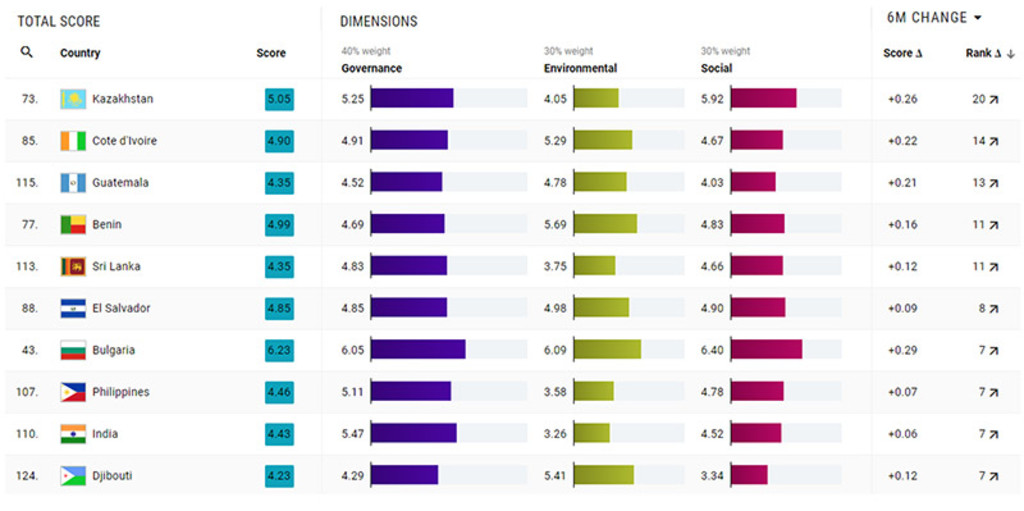
Source: Robeco, October 2024.
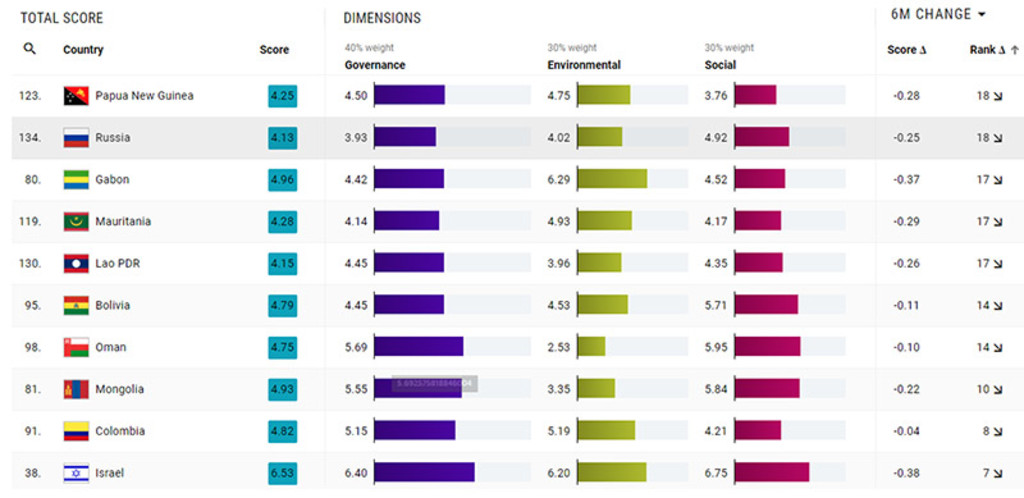
Conversely, weaker labor and higher carbon emissions drove large declines for Russia, Papua New Guinea, Gabon, Mauritania, and Laos.
Figure 3 – Countries with the largest performance declines
Source: Robeco, October 2024.
Populism in Hungary – a cautionary tale
Populist themes of anti-immigrant, anti-climate, and anti-establishment sentiments marked national elections across Eastern and Western Europe this year. Hungary is a striking example of how unchecked populism not only stifles dissent but also economic growth and foreign investment.
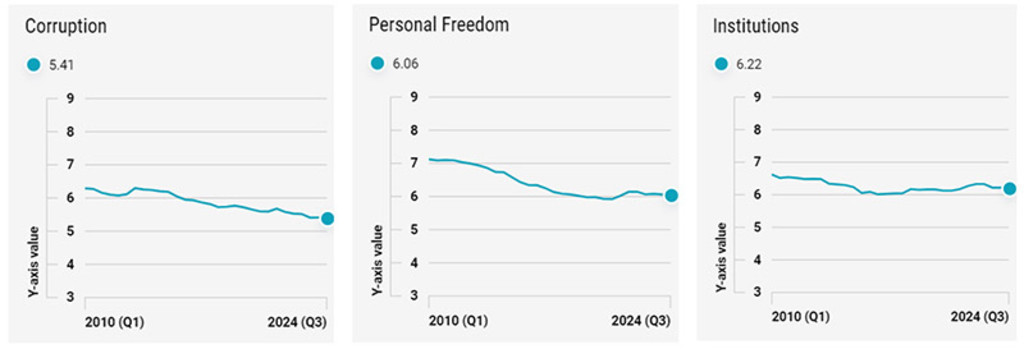
Since taking power in 2010, Viktor Orbán has undermined judicial independence, suppressed the media, and restricted the rights and voice of civil organizations – all reflected in Hungary’s deteriorating performance on key governance indicators (Figure 4). Consequently, investor confidence in its sovereign bonds suffered, indicated by high credit default spreads (CDS) between Hungary and EU peers.
了解最新的可持續性市場觀點
訂閱我們的電子報,探索塑造可持續投資的趨勢。
Figure 4 – More corruption, less freedom and weakened institutions under Orbán
Source: Robeco, October 2024.
To regain credibility and fight inflation, its central bank has aggressively hiked interest rates. Consequently, its bond yields have risen but this has also strained public finances and borrowing costs for businesses and citizens and impeding growth. Despite hikes, CDS spreads remain high. Over time, this can trigger a vicious cycle of economic stress, social unrest and political instability. It’s a cautionary tale for EU countries and would be members should closely heed.
For sovereign debt investors, this political trend demands a more nuanced approach to risk assessment, taking into account the complex interplay between politics, governance, and economic stability. As Europe continues to navigate this shifting political landscape, the importance of robust governance as a foundation for economic stability cannot be overstated.
Indonesia’s OECD bid
Indonesia wants to be the first Southeast Asian country to join the OECD. Its bid signals a strong desire to be an economic engine in the region and escape the middle income trap that has restrained the region’s economic growth.
OECD membership has its privileges including access to foreign investment and improved trade conditions. In return, countries must commit to defending human rights, the rule of law, transparency, and free-market principles – the same factors measured in Robeco’s Country ESG Framework. Based on our assessment, Indonesia’s chances appear slim. It scores poorly on corruption (115 out of 180 countries) and faces allegations of serious human rights abuses according to international activists.
Figure 5 – Indonesia’s ESG report card shows mixed progress on key ‘S’ and ‘G’ factors
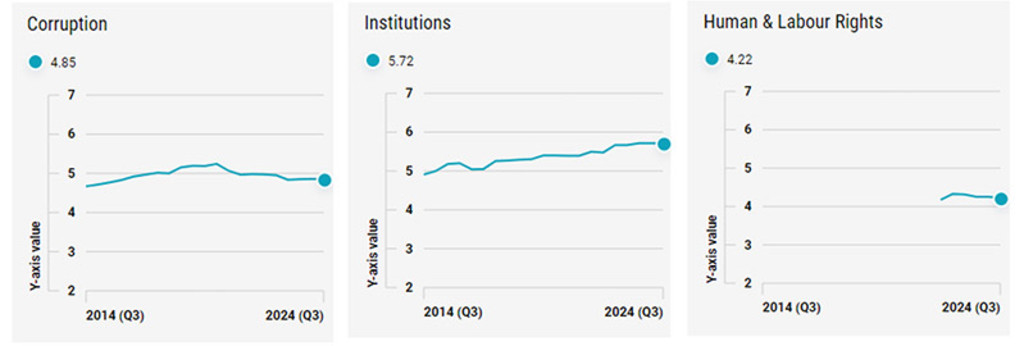
Source: Robeco, October 2024. Note: The scoring methodology for the Human and Labor Rights criterion changed in 2022, complicating historic score comparisons.
Moreover, it will need to significantly strengthen its climate policies, digital infrastructure for local enterprises, and institutional capacity. We see Indonesia’s interest as a good signal that it’s ready to take positive action, which should still boost investor confidence and kickstart investments into critical areas that support future growth.
Spotlight on education
A strong education system is essential for economic growth and prosperity, but it’s not enough. But as Albania and Taiwan can attest, without strong employment prospects or living conditions, even countries with high educational attainment will experience brain drain. According to the Human Flight and Brain Drain Index, currently, Jamaica, Ukraine and Samoa are most vulnerable to human flight while Australia, Sweden and Norway are the least.
And once started, the cycle is hard to escape. A poor employment outlook begets more emigration, further depleting the country’s human capital and hindering its economic development and job creation. While it’s easier for high-income countries, other income cohorts are making strides through policy reforms. For example, Qatar, Belize and India created tax incentives for companies hiring local talent, prioritized R&D to stimulate demand for high-skilled jobs, and invested in healthcare, housing, and public services to boost residents’ quality of life.
Robeco measures this complex interplay between health, education and prosperity via several data sources. When combined these determine a country’s performance on human development, which is reflected in the overall social score.
Conclusion
The latest rankings highlight the pivotal role of political leadership in shaping ESG performance and investment risks. That’s one reason why governance is so heavily weighted in Robeco’s country framework – even slight changes can alter a country’s trajectory. Moreover, academic research finds that country’s ESG scores are linked with higher investor confidence. That makes continually assessing ESG performance essential — not just to gauge current conditions, but to anticipate future trends, potential risks, and emerging opportunities.
重要資料
本網站僅供《證券及期貨條例》(香港法例第571章)及其附屬法例所界定之專業投資者瀏覽及使用。 投資涉及風險。過往表現並不代表未來表現。本網站所載資料僅供參考之用,並不構成任何投資建議,亦非作出買賣任何證券或採納任何投資策略之要約或招攬。投資者不應僅憑本網站提供之資料作出投資決定,在作出任何投資決定前,應徵詢獨立意見(包括有關稅務影響之意見)。投資者應確保完全理解投資產品的相關風險,亦應考量自身投資目標及風險承受水平。投資乃閣下之個人決定。除非銷售投資產品的中介人已向閣下告知該投資產品適合閣下,並已解釋其符合閣下投資目標之原因,否則閣下不應投資。請參閱相關發售文件或其他法律文件,以獲取包括風險因素在內的進一步詳情。 本網站由荷寶投資管理香港有限公司發布,該公司受香港證券及期貨事務監察委員會(「證監會」)規管(中央編號:APU851)。本網站未經證監會審閱。 無法保證任何投資產品可實現其投資目標。概不就任何投資產品之表現或投資回報作任何聲明或承諾。投資的價值或會波動。本網站所載過往表現、推算或預測,均不應視作未來表現之保證或指標,且概不提供任何明示或暗示之保證。本網站內容建基於相信為可靠之來源,惟因應資料傳遞技術特性及須採用多項數據來源(包括第三方內容),故概不保證其準確性。所述觀點僅乃截至上述日期,或會隨市況變化而改變,可予更改而毋須另行通知。該等意見可能有別於其他荷寶投資專業人士之意見。因使用本材料或當中所載任何評論、意見或估算而引致之直接、間接或相應損失,荷寶概不承擔法律責任。荷寶並無責任更新本網站或任何網站內容。未經荷寶事先書面許可,不得複製、分發或刊發本網站任何材料。 除非另有說明,資料來源:荷寶。