


Client Portfolio Manager


• 市場觀點
What does it take to excel in credit investing?
One of the primary tasks of fixed income investors is to identify securities that appear undervalued relative to their intrinsic value – a concept often referred to as the Value factor. This can be monetized through either quantitative or fundamental investment approaches, with the latter being the focus here.

概要
- Monetizing the value factor through a contrarian investment approach
- Top-down macro and credit research underpins our beta policy
- In-depth company research supports our bottom-up risk-taking
So, how can investors best leverage the value factor to consistently deliver outperformance across the market cycles?
The answer lies in embracing a contrarian investment approach. Credit markets are often shaped by behavioral biases, leading to periods of over- and undervaluation. Investors frequently overreact to market or macroeconomic events, driven by home-market preferences and a stronger emotional response to losses than to equivalent gains. This fear-driven selling, often at any price, exposes market inefficiencies – and it is within these inefficiencies that contrarian investors can uncover compelling value opportunities.
When seeking alpha, we avoid following the herd. We have been employing a contrarian investment strategy for the past 15 years, supported by comprehensive top-down macro research and in-depth company analysis. Our ability to add credit risk in volatile, cheapening markets, while reducing exposure in markets that are expensive, has been crucial in achieving consistent outperformance throughout different market cycles.
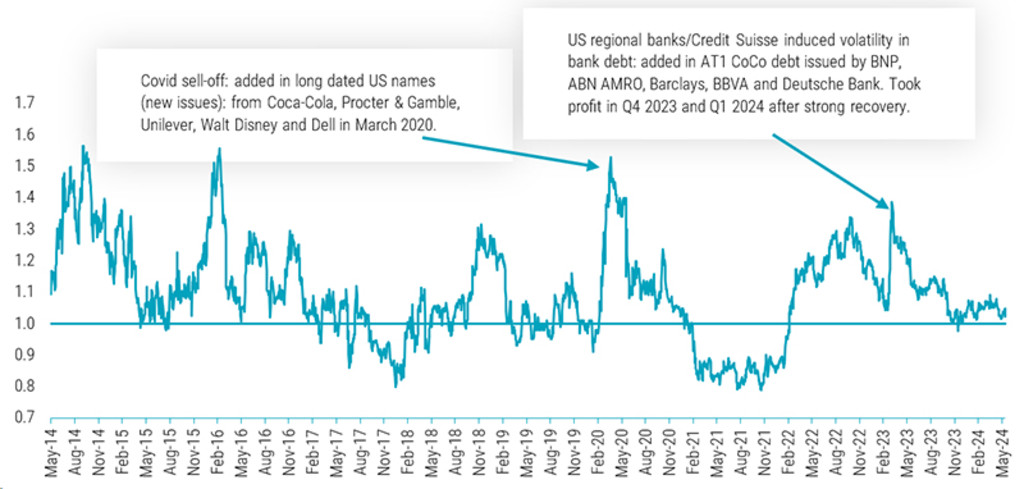
The chart below illustrates our top-down risk (beta) positioning in our global investment grade credit strategy over the last decade. A beta above 1 indicates that the portfolio holds more credit risk, measured by duration times spread (DTS), compared to the broader market. Conversely, a beta below 1 signifies that the portfolio carries less credit risk than the broader market.
Figure 1: Historical beta for Robeco Global Credits strategy: Adding risk when markets are weak, selling risk when markets are strong.
Source: Robeco, Bloomberg, May 2024. Past performance is no guarantee of future results. The value of your investments may fluctuate. Returns gross of fees, based on gross asset value. If the currency in which the past performance is displayed differs from the currency of the country in which you reside, then you should be aware that due to exchange rate fluctuations the performance shown may increase or decrease if converted into your local currency. Performance since inception is as of the first full month. Periods shorter than one year are not annualized. Values and returns indicated here are before cost; the performance data does not take account of the commissions and costs incurred on the issue and redemption of units.
With a long-standing tradition of applying contrarian strategies to uncover opportunities in credit markets, the following two examples illustrate how value was effectively harnessed during periods of market disruption.
Capitalizing on the pandemic market dislocation
When the Covid-19 pandemic struck at the start of 2020, governments responded by locking down economies, and financial markets reacted sharply, causing equity and corporate bond prices to plummet. Using the Credit Quarterly Outlook as a starting point we began to identify value opportunities in global credit markets. Given the commitment of governments and central banks to support the economy through financial aid measures and easing monetary conditions, we were confident that larger, well-managed investment-grade companies could withstand prolonged lockdowns.
Consequently, we started investing in high-quality corporate debt in the US and Europe. As a result, the beta of the portfolio increased from below 1 at the start of the year to 1.5 by the end of March 2020. Following the initial shock and subsequent interventions to support the economy and markets, we observed a significant rebound in financial markets, and the corporate bonds we acquired performed exceptionally well. As these corporate bond holdings reverted to normal or fair value, we took profits and reduced our positions. Then, the portfolio’s beta was brought back to below 1.
Rebounding from the 2023 bank debt selloff
In March 2023, following a series of failures among US regional banks and the forced rescue merger of Credit Suisse with UBS, subordinated debt (AT1 CoCo) was completely written down. The market reacted sharply, placing pressure on bank debt, in particular AT1 CoCos. In line with our contrarian investment strategy, we started adding risk to larger, well-diversified European banks, where our bottom-up credit analysis indicated no fundamental concerns and bond valuations became very attractive. We avoided troubled US or European banks, focusing instead on larger, stable institutions. Following the initial shock, once it was clear that the larger diversified banks were not affected, we observed a strong rebound in the prices of bank debt, benefiting our performance. As our holdings in AT1 debt from these large, diversified banks outperformed the market, we gradually took profits.
Opportunities in every market
Being contrarian goes both ways. When credit markets or segments in the credit markets trade weak, we are actively looking to add risk in undervalued corporate bonds. However, when markets appear to have priced in all the good news and become complacent, we take risk off the table and wait for better value opportunities.
This contrarian approach is deeply embedded in our investment strategy, extending beyond portfolio-level risk adjustments to individual securities. If corporate bonds weaken due to market overreactions, such as profit warnings, we view this as a potential buying opportunity – provided our credit research confirms they are not value traps. Similarly, when corporate bond prices become overinflated due to excessive optimism, we reduce exposure.
By diligently applying this approach daily, alongside strong risk management, we aim to deliver consistent outperformance through market cycles while maintaining controlled risk.
獲取最新市場觀點
訂閱我們的電子報,時刻把握投資資訊和專家分析。
重要資料
本網站僅供《證券及期貨條例》(香港法例第571章)及其附屬法例所界定之專業投資者瀏覽及使用。 投資涉及風險。過往表現並不代表未來表現。本網站所載資料僅供參考之用,並不構成任何投資建議,亦非作出買賣任何證券或採納任何投資策略之要約或招攬。投資者不應僅憑本網站提供之資料作出投資決定,在作出任何投資決定前,應徵詢獨立意見(包括有關稅務影響之意見)。投資者應確保完全理解投資產品的相關風險,亦應考量自身投資目標及風險承受水平。投資乃閣下之個人決定。除非銷售投資產品的中介人已向閣下告知該投資產品適合閣下,並已解釋其符合閣下投資目標之原因,否則閣下不應投資。請參閱相關發售文件或其他法律文件,以獲取包括風險因素在內的進一步詳情。 本網站由荷寶投資管理香港有限公司發布,該公司受香港證券及期貨事務監察委員會(「證監會」)規管(中央編號:APU851)。本網站未經證監會審閱。 無法保證任何投資產品可實現其投資目標。概不就任何投資產品之表現或投資回報作任何聲明或承諾。投資的價值或會波動。本網站所載過往表現、推算或預測,均不應視作未來表現之保證或指標,且概不提供任何明示或暗示之保證。本網站內容建基於相信為可靠之來源,惟因應資料傳遞技術特性及須採用多項數據來源(包括第三方內容),故概不保證其準確性。所述觀點僅乃截至上述日期,或會隨市況變化而改變,可予更改而毋須另行通知。該等意見可能有別於其他荷寶投資專業人士之意見。因使用本材料或當中所載任何評論、意見或估算而引致之直接、間接或相應損失,荷寶概不承擔法律責任。荷寶並無責任更新本網站或任何網站內容。未經荷寶事先書面許可,不得複製、分發或刊發本網站任何材料。 除非另有說明,資料來源:荷寶。