




Researcher


• 市場觀點
Quant Chart: Constructing corporate bond portfolios - mixed or integrated factor approach?
New research by Robeco Quant Fixed Income researchers Joris Blonk and Philip Messow1 compares two well-known methodologies used to construct corporate bond factor portfolios – the integrated approach and the mixed approach. We find that an integrated approach leads to higher and more robust information ratios across different spread and interest rate environments. Value traps in particular are to blame for the difference in performance between the two approaches.

When constructing a multi-factor portfolio, we can choose between two approaches. The first approach invests in several portfolios each formed on a single factor: the ‘mixed’ approach. The second constructs a portfolio using a multi-factor signal: the ‘integrated’ approach. To explore which approach is best, our new research builds on previous work done in the equity market2 and compares portfolios based on information ratios (IRs). This measures the stability of portfolio outperformance, where the higher the value the more stable the outperformance. 3
But in what way exactly do the two approaches lead to different portfolios? Let’s consider a two-factor example, taking value and momentum. A mixed approach would first construct a value portfolio and a momentum portfolio separately, and then invest in both. Therefore, a bond could be included that scored well on value, but poorly on momentum.
The integrated approach, on the other hand, first calculates a multi-factor score and then constructs a single portfolio based on that score. It therefore favors bonds that score at least moderately positively on both factors.

Active Quant: finding alpha with confidence
Blending data-driven insights, risk control and quant expertise to pursue reliable returns.
Data and methodology
Our study evaluates the mixed and integrated approaches in the USD corporate bond market from 1994 to 2022. Looking first at the factor portfolios for these approaches in high yield, we see that both result in a positive IR above 1. Note that in periods of rising/falling interest rates or credit spreads, both approaches result in higher returns than the market. This indicates that multi-factor investing in credits is in any case found to be a robust strategy in different market environments, including the rising interest rates of recent years.
Figure 1: IR of value-momentum corporate bond portfolios in high yield market environments
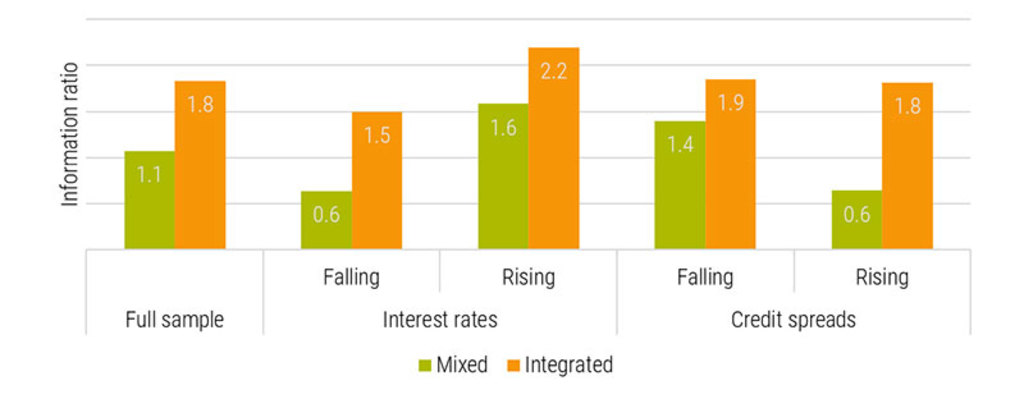
Source: Robeco. * Backtest of combination of value and momentum strategies: ‘Mixed’ averages the positions of two univariate value and momentum long portfolios and ‘Integrated’ creates a long portfolio of an equal-weighted value and momentum signal. Portfolios are matched to have comparable factor exposure. The investable universe contains only USD bonds in Bloomberg US High Yield and Bloomberg US Aggregate Corporate indices respectively. One-month holding period and sample period 1994-2022. Sub-periods are defined by monthly changes in the 10y US treasury yield and index spread.
However, how bonds are selected matters and leads to a higher IR for the integrated approach across all market environments, i.e. more stable outperformance. By taking a closer look at the different bonds that each strategy buys, we find that bonds with offsetting factor exposures contribute to the lower performance of the mixed portfolios. Value traps in particular stand out, meaning bonds that look cheap but score poorly on momentum. In other words, they look like an attractive investment from a value perspective, but from a momentum perspective may deteriorate in credit quality. Note while these value traps can be bought under the mixed portfolio approach, the integrated approach would have likely ruled them out.
We find very similar results for investment grade (results are available in the paper). Both strategies have a positive information ratio in any market environment and the integrated approach outperforms its mixed counterpart. The latter faces its toughest challenge in rising spread environments, such as during the 2008-2009 global financial crisis when it experienced a large drawdown as a result of selecting some of the abovementioned value traps.
獲取最新市場觀點
訂閱我們的電子報,時刻把握投資資訊和專家分析。
Conclusion
The existence of value traps in the corporate bond market highlights the importance of risk control in factor investing. This can be done either directly by improving the value factor, for example by using machine learning techniques as highlighted in our article ‘How machine learning enhances value investing in credits’, or through an integrated multi-factor portfolio construction approach as highlighted in our recent research.
Footnotes
1 Blonk and Messow (2024), ‘How to Construct a Long-Only Multifactor Credit Portfolio?’ Available at SSRN: https://ssrn.com/abstract=4775767
2 A large literature of papers on equity factor portfolio construction is available, for example: Blitz and Vidojevic (2018) or Ghayur et al. (2018)
3 The IR is calculated by dividing the outperformance by tracking error.
重要資料
本網站僅供《證券及期貨條例》(香港法例第571章)及其附屬法例所界定之專業投資者瀏覽及使用。 投資涉及風險。過往表現並不代表未來表現。本網站所載資料僅供參考之用,並不構成任何投資建議,亦非作出買賣任何證券或採納任何投資策略之要約或招攬。投資者不應僅憑本網站提供之資料作出投資決定,在作出任何投資決定前,應徵詢獨立意見(包括有關稅務影響之意見)。投資者應確保完全理解投資產品的相關風險,亦應考量自身投資目標及風險承受水平。投資乃閣下之個人決定。除非銷售投資產品的中介人已向閣下告知該投資產品適合閣下,並已解釋其符合閣下投資目標之原因,否則閣下不應投資。請參閱相關發售文件或其他法律文件,以獲取包括風險因素在內的進一步詳情。 本網站由荷寶投資管理香港有限公司發布,該公司受香港證券及期貨事務監察委員會(「證監會」)規管(中央編號:APU851)。本網站未經證監會審閱。 無法保證任何投資產品可實現其投資目標。概不就任何投資產品之表現或投資回報作任何聲明或承諾。投資的價值或會波動。本網站所載過往表現、推算或預測,均不應視作未來表現之保證或指標,且概不提供任何明示或暗示之保證。本網站內容建基於相信為可靠之來源,惟因應資料傳遞技術特性及須採用多項數據來源(包括第三方內容),故概不保證其準確性。所述觀點僅乃截至上述日期,或會隨市況變化而改變,可予更改而毋須另行通知。該等意見可能有別於其他荷寶投資專業人士之意見。因使用本材料或當中所載任何評論、意見或估算而引致之直接、間接或相應損失,荷寶概不承擔法律責任。荷寶並無責任更新本網站或任何網站內容。未經荷寶事先書面許可,不得複製、分發或刊發本網站任何材料。 除非另有說明,資料來源:荷寶。