

Portfolio Manager


• 市場觀點
The stars align for European equities
Europe’s stock markets have lived in the shadow of the US since the financial crisis, leaving valuations languishing. This means great companies, with global reach and strong competitive positions, are underowned creating a clear opportunity for long-term investors.
作者


Client Portfolio Manager
概要
- Historic valuation discount to US creates window of opportunity for rerating
- Europe provides a deep pool of sustainable and differentiated business models
- Stock picking is key amid macroeconomic uncertainty
Europe has had a strong start to 2024 with the MSCI Europe Index gaining 9.05%1 by the end of June, driven by solid earnings and expected interest rate cuts. Despite this, the US S&P 500 outperformed with a 19.03%2 gain due to its tech sector dominance. As global investors assess their level of exposure to the technology sector, this could offer a unique opportunity for European stocks.
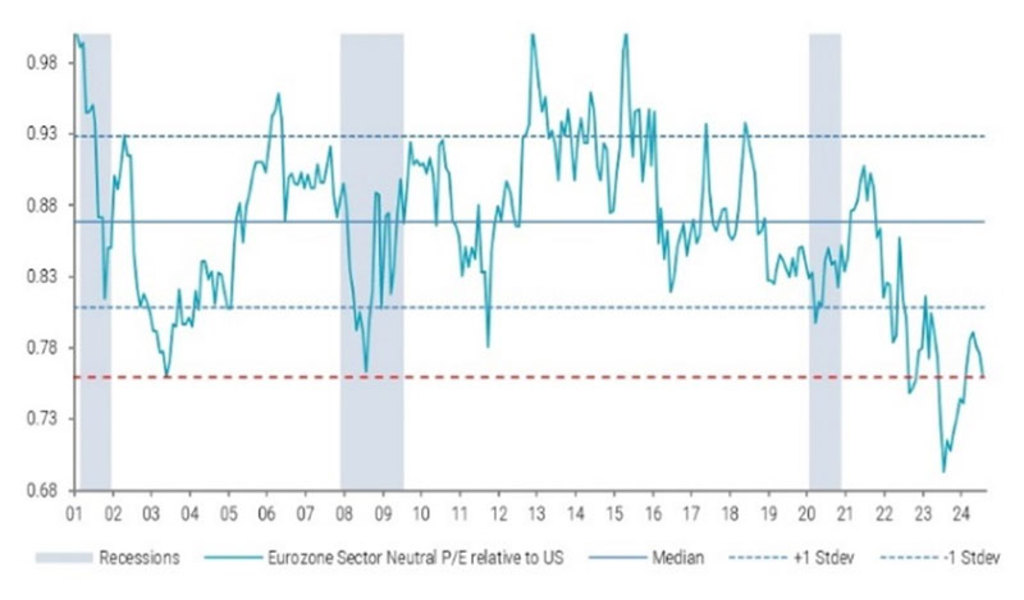
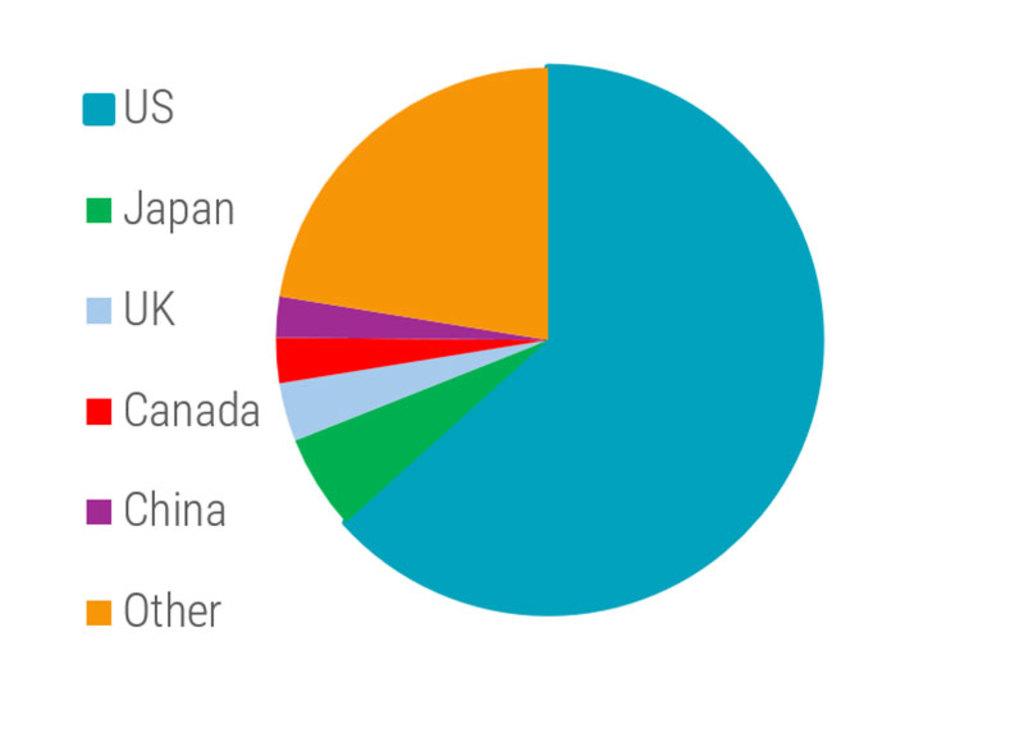
The MSCI Eurozone sector neutral P/E discount relative to the US (see Figure 1) is near the largest pre-COVID, on par with the dotcom, GFC and Euro crisis extremes despite the buybacks yield having moved closer to the US, and dividend yields remaining double the US3. Measured by the MSCI ACWI (see Figure 2) the US weighting in the index, which includes 99% of the world’s investable stocks, was 62.6% in March 2024 up from 49.5% ten years earlier, mostly at the expense of Europe. The near historic valuation discount versus the US, coupled with investors being underweight the region, provides a firm floor for European equities.
Figure 1: Eurozone valuations remain near historic lows relative to US
Source: J.P.Morgan Global Equity Strategy
Figure 2: MSCI ACWI geographical weighting
Source: MSCI, as of 31 March 2024
A modest reversion to the mean could imply relative outperformance for European stocks, even if underlying market trends remain difficult in the short term.
GDP growth isn’t a good proxy for equity market performance
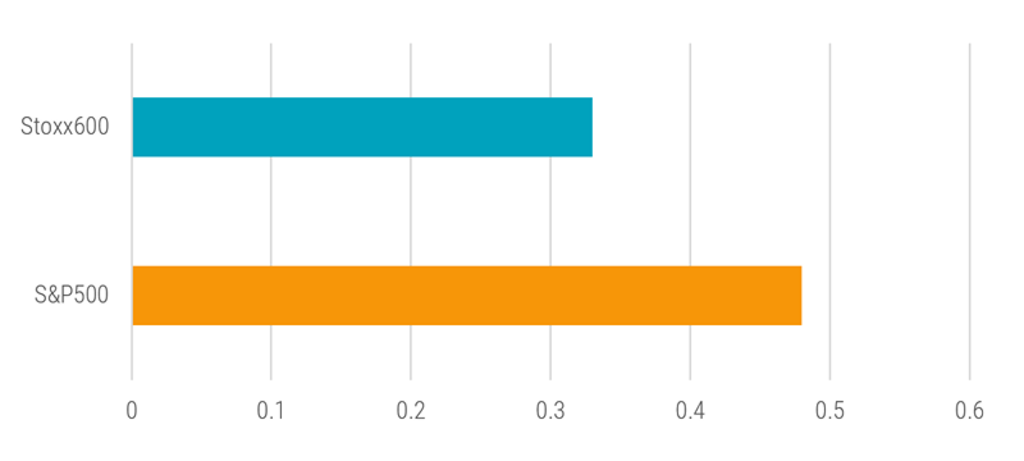
Forecasts for Europe’s GDP growth in the coming years are consistent; growth will likely trail the US and emerging markets. For example, the IMF forecasts 2025 euro-area growth at 1.5% compared to the US at 1.9% and the world at 3.2%4. Should this matter to equity investors? Not that much, as equity markets are not very correlated with economic growth, with Europe especially showing a very weak relationship (see Figure 3).
Figure 3: Correlation of real GDP and Europe, US equity index performance
Source: Deutsche Bank, based on quarterly data (yoy) from 2001 to 2023, total return.
The other major factor that explains why equities are relatively indifferent to the growth outlook is that Europe’s best companies derive revenues from all over the world. For example, Deutsche Bank estimates that of Germany’s DAX 40 index, only 18% of revenues come from Germany compared to 22% from the US, and 15% from China. Overall 60% of MSCI Europe’s revenues come from outside the Eurozone. Of course, this makes some political or macroeconomic issues, like EU trade relations with China, very important for specific stocks, but that can be taken into account in fundamental analysis rather than from a top-down perspective. Moreover, geographic revenue diversification is a very much a feature, not a bug, for investors seeking exposure to global growth without country or region-specific risk.
Europe’s best companies possess unique and irreplaceable competitive advantages
Deep pool of differentiated business models in Europe
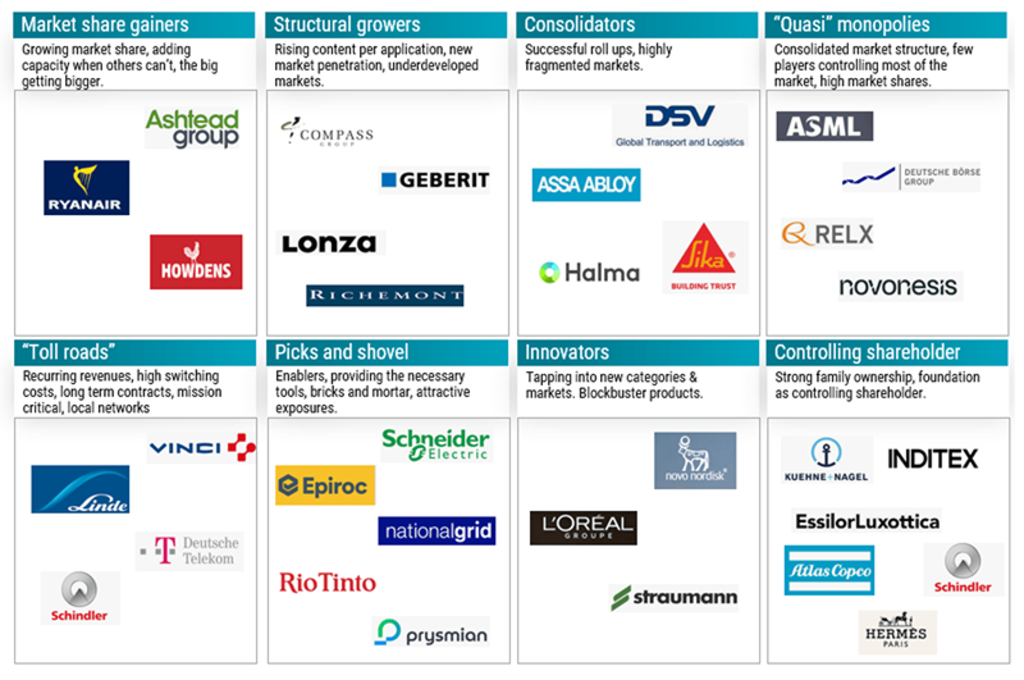
Europe is home to numerous companies with well recognized global brands spanning various industries. Some of these companies possess unique and irreplaceable competitive advantages, allowing them to either capture more market share through value-enhancing acquisitions, or expand in markets with low penetration, growing their total addressable market (see Figure 4 below). Many of these firms are large and continuing to grow internationally while others are national champions serving a local niche. The aggregated average annualized return of the group of stocks in Figure 4 has been approximately three times that of the MSCI Europe and approximately two times that of the S&P 500 over the last two decades.
The Robeco Sustainable European Stars strategy consciously invests in opportunities from various industries and does not get overly concentrated in any particular one, no matter how popular it might be at a time when everything looks rosy. The strategy looks to identify companies with a sustainable pathway to growth rather than focusing purely on a ‘high’ growth number. The team likes differentiated business models that are resilient, that can thrive through an entire business cycle, and can take advantage of downturns to come out stronger, or can mitigate pressures by having a solid foundation. In addition, Robeco’s sustainable investment team helps identify companies where management is aligned with broader targets through proper incentives, corporate governance and product focus. In the long run markets reward strong business models and sustainable growth over an entire cycle.
Figure 4: Diverse business models with examples
Source: Robeco Schweiz AG. The companies are listed for illustrative purposes only and are not necessarily components of the Robeco Sustainable European Stars strategy. This is not a buy, sell or hold recommendation for any particular security. No representation is made that these examples are past or current recommendations, that they should be bought or sold, nor whether they were successful or not.
Through the cycle, staying invested pays
Given the ongoing uncertainty in the economic outlook across many countries, market participants are concentrating on potential short-term market drawdowns. However, we believe this focus is misguided and amounts to little more than noise. The true value emerges when looking through an entire business cycle. This is where some of the great returns have been generated in the past.
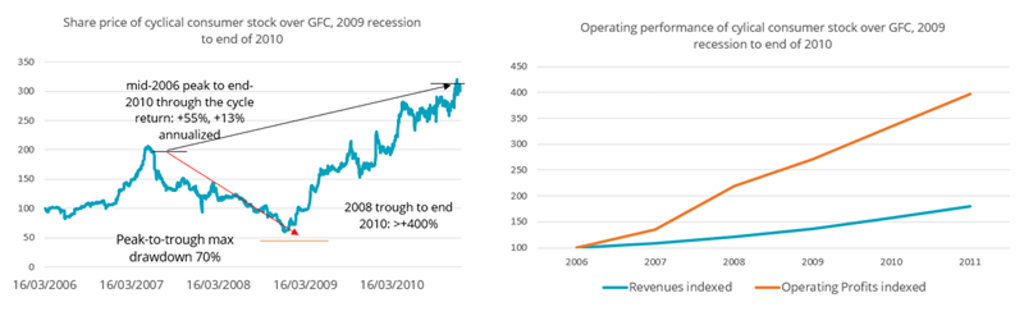
In Figure 5 below we show the share price development of an unnamed cyclical consumer stock from 2006 to the end of 2010. As one would expect, the share price drastically increased up to the peak of the bull market in June 2007. As the cycle rolled over, so did the share price which contracted by a massive 70% from that point to the end of 2008. The market is driven by fear and greed, and share price movements most of the time go beyond anything justified by underlying fundamentals.
Share prices often fail to reflect longer-term views on revenues and earnings. This company’s revenue went on to almost double from its 2006 base until 2011, and its operating profit went up four-fold. Thus, from that 2008 bottom, the shares recovered by a substantial 400% as the market realized its longer-term, structural profit potential. Even measured from the absolute bull market peak in June 2007 to the end of 2010, a medium-term three-and-a-half-year horizon, the share price increased by 55%, a 13% CAGR, through a financial crisis and a recession.
Figure 5: Does the cycle matter to growing, high-quality companies?
Source: Bloomberg
What this means is that where we see structural growth opportunities, robust balance sheets, good market positions, defendable or even expanding profitability, cash generation and reasonable valuations, forward expected returns can still be attractive, even facing an uncertain economic outlook and the risk of a market drawdown.
Durable quality will outperform the broad market
The Robeco Sustainable European Stars strategy is a high-conviction portfolio which aims to make investments in companies with sustainable, differentiated business models taking a full-cycle view. This multifaceted definition ensures that companies are not only growing but doing so sustainably and profitably through an entire cycle. The strategy is grounded in several key principles:
High-return businesses: Prioritizing companies that consistently create value.
Efficient capital allocation: Ensuring growth reinvestment and cash distributions are optimized.
Moats and niche dominance: Focusing on businesses with strong competitive advantages and unique assets.
Durability of business models: Assessing the long-term viability and adaptability of business models.
Full-cycle return potential: Recognizing the importance of returns throughout economic cycles.
An approach that invests in businesses with durable quality and focuses on expected returns (valuation) and attractive risk-to-reward opportunities on a longer-term basis compared to the broad market can be a powerful tool for achieving attractive returns.
Footnotes
1 MSCI Europe Index. All figures in EUR. Data end of June 2024.
2 Bloomberg, total return numbers. All figures in EUR. Data end of June 2024.
3 J.P.Morgan Global Equity Strategy
4 IMF World Economic Outlook Database, April 2024.
獲取最新市場觀點
訂閱我們的電子報,時刻把握投資資訊和專家分析。
重要資料
本網站僅供《證券及期貨條例》(香港法例第571章)及其附屬法例所界定之專業投資者瀏覽及使用。 投資涉及風險。過往表現並不代表未來表現。本網站所載資料僅供參考之用,並不構成任何投資建議,亦非作出買賣任何證券或採納任何投資策略之要約或招攬。投資者不應僅憑本網站提供之資料作出投資決定,在作出任何投資決定前,應徵詢獨立意見(包括有關稅務影響之意見)。投資者應確保完全理解投資產品的相關風險,亦應考量自身投資目標及風險承受水平。投資乃閣下之個人決定。除非銷售投資產品的中介人已向閣下告知該投資產品適合閣下,並已解釋其符合閣下投資目標之原因,否則閣下不應投資。請參閱相關發售文件或其他法律文件,以獲取包括風險因素在內的進一步詳情。 本網站由荷寶投資管理香港有限公司發布,該公司受香港證券及期貨事務監察委員會(「證監會」)規管(中央編號:APU851)。本網站未經證監會審閱。 無法保證任何投資產品可實現其投資目標。概不就任何投資產品之表現或投資回報作任何聲明或承諾。投資的價值或會波動。本網站所載過往表現、推算或預測,均不應視作未來表現之保證或指標,且概不提供任何明示或暗示之保證。本網站內容建基於相信為可靠之來源,惟因應資料傳遞技術特性及須採用多項數據來源(包括第三方內容),故概不保證其準確性。所述觀點僅乃截至上述日期,或會隨市況變化而改變,可予更改而毋須另行通知。該等意見可能有別於其他荷寶投資專業人士之意見。因使用本材料或當中所載任何評論、意見或估算而引致之直接、間接或相應損失,荷寶概不承擔法律責任。荷寶並無責任更新本網站或任何網站內容。未經荷寶事先書面許可,不得複製、分發或刊發本網站任何材料。 除非另有說明,資料來源:荷寶。