
Portfolio Manager


• 市場觀點
Unraveling the Korea discount
Policies to unlock value in the stock market are likely to be popular and help mitigate a future pension system crunch in the thriving, but rapidly-aging, north Asian economy.
作者




Client Portfolio Manager
概要
- Japan success brings persistent Korea valuation discount into focus
- South Korea resolved to act on governance with elections looming
- Action will unlock value and underpin investor confidence in this key EM economy
The Korean stock market discount phenomenon is characterized by Korean-listed companies trading at a consistent discount to international counterparts. The disparity exists even when the earnings per share (EPS) and book value per share (BPS) of these companies are comparable.
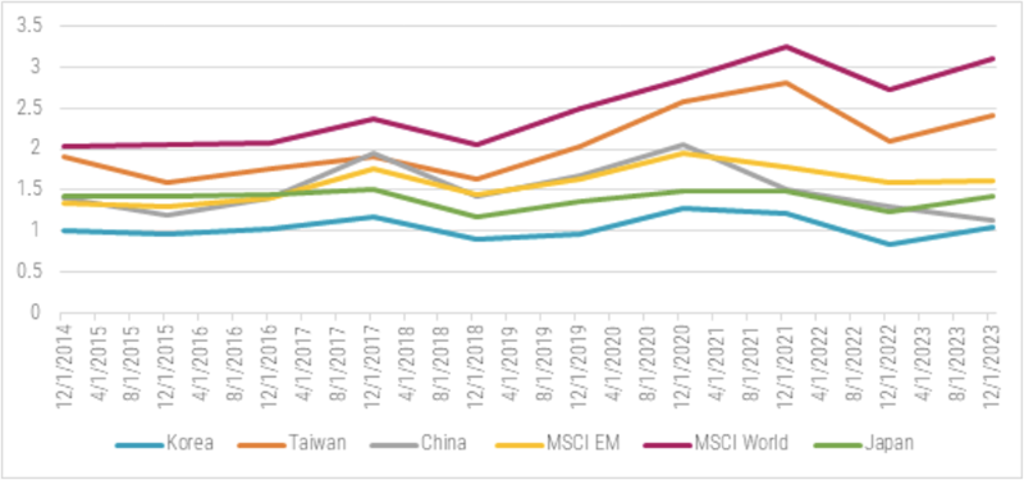
A comparison of the price-to-book ratio (PBR) across different regions, including Korea, offers insight into the reality of this issue.
Figure 1: PBR - Korea vs peers and indices
Source: Bloomberg, MSCI, 1 January 2024.
Between 2014 and 2023, the PBR of Korean companies was merely 58% of the average of advanced countries’ indices and 34% of the emerging markets’ average illustrating the existence of the Korea discount.1 At the end of 2023, the MSCI Korea Index traded at a PBR of 1.1 times, in contrast to the MSCI Taiwan Index at 2.4 times and the MSCI Japan Index at 1.4 times. Korea has also traded at a P/E discount. Between 2014 and 2023, the MSCI Korea Index’s average P/E ratio was 12.2, according to Bloomberg, a 19% discount to Taiwan and a 28% discount to Japan over the same period.

Why you should increase allocation to EM in 2024
On-demand webinar
Korea discount explanations
The frequently cited reason for the ‘Korea discount’ is geopolitical risk. However, this perspective seems incredible. According to Global Firepower, South Korea ranks fifth in military strength in the world, and is a key ally of the number one ranked US. Moreover Taiwan, widely considered as militarily vulnerable as South Korea, doesn’t seem to be subject to the same discount.
The role of ‘Chaebol’ firms, such as Samsung, LG, and Hyundai, in contributing to the Korea discount is also debated. These firms are predominantly managed by families across generations, raising concerns about family-centric governance and minority shareholder expropriation risks. Historically, numerous Chaebol family heads have faced legal challenges related to succession issues. However, research indicates that since 2007, the discount applied to Chaebol firms has been significantly lower compared to other Korean companies.2
What, then, are the real reasons behind the Korea discount? Empirical research by the KCMI3 sheds light on this. Analyzing data from 45 major stock markets, they identified key factors such as low shareholder return policies (including dividends and buybacks), a low return on equity (ROE), and limited growth potential. At a seminar in November 2022, the Financial Services Commission, Korea Exchange, and Capital Research presented data showing South Korea’s dividend payout ratio in 2021 was 19%, the lowest among its global counterparts. Taiwan, by comparison, had a much higher rate of 55%, followed by the UK at 48%, Germany at 41%, France at 39%, and the US at 37%. China also surpassed South Korea, with a dividend payout ratio of 35%.
The ‘Value-Up’ proposal and other solutions
To enhance shareholder returns in Korean companies, various strategies are under consideration. The Korean financial regulator is evaluating a proposal to identify and challenge companies with a PBR of less than one. Known as the Value-Up proposal, key elements will include the publication of investment metrics like PBR and ROE for listed companies. Additionally, these companies will be recommended to disclose their plans for improving corporate value. This approach mirrors the Tokyo Stock Exchange’s April 2023 initiative, which subsequently contributed to the Nikkei 225 index reaching a new record high.
President Yoon has taken a proactive stance on stock market issues, advocating for a short-selling ban and emphasizing the need for societal consensus to reduce the burden of excessive inheritance taxation in Korea, which significantly affects business decision-making. In Korea, inheritance taxes, ranging from 50% to 60%, significantly affect Chaebol families, eroding their ownership stakes over generations and influencing their preference for maintaining control, rather than maximizing shareholder value.
Problematic demographics
With this April’s general election for the National Assembly, Korea’s legislative body, the issue of the Korean discount might become a significant agenda item. Approximately 12 million stock investors, about a quarter of the electorate, could influence this focus. The reform of the national pension system is also intricately linked to this issue. With Korea’s birth rate being one of the lowest among OECD countries, there is an urgent need for society to consider reforms aimed at ensuring the sustainability of the pension system. Improving the performance of the Korean equity market is one of the key issues under consideration for this reform.
The South Korean financial authorities have introduced the concept of implementing the Value-Up program but have clarified that its enforcement will not be mandatory. The policy to increase shareholder returns in South Korea seems to be led by the private sector, primarily composed of academia and financial market stakeholders. On 6 February, Chairman Rhee of South Korea’s Corporate Governance Forum sent an open letter to the government’s financial authorities titled, ‘Without ending the Korea discount, there is no future for youth.’4 In this letter, he cited Hyundai Motor, Samsung Electronics, LG Electronics, LG Chem, and KB Financial as prime examples of companies affected by the Korea discount. As the title of Chairman Rhee’s letter suggests, Korean society appears to agree that without financial market reform, there is no future for the younger generation.
We believe that South Korean society will embrace a long-term roadmap to resolve the Korea discount and make consistent efforts toward this goal. Robeco’s fundamental emerging markets equities strategies are all currently overweight Korea, which is a stable and attractive economy exposed to key investment themes including green energy, tech and AI. We expect the steps taken to eliminate the Korea discount to also vindicate our overweight positioning.
Footnotes
1Bloomberg L.P.(2024), MSCI indexes annual valuation data, between 2014 to 2023, Bloomberg Professional, [Accessed February 7, 2024].
2R Ducret, D Isakov, 2020, The Korea Discount and Chaebols, Pacific Basin Finance Journal
3J.S. Kim, S.H. Kang, 2023, Analysis of the Causes of the Korea Discount, Korea Capital Market Institute
4Namuh Rhee, Feb 2023, Without ending the Korea Discount, the youth has no future, Korea Corporate Governance Forum
重要資料
本網站僅供《證券及期貨條例》(香港法例第571章)及其附屬法例所界定之專業投資者瀏覽及使用。 投資涉及風險。過往表現並不代表未來表現。本網站所載資料僅供參考之用,並不構成任何投資建議,亦非作出買賣任何證券或採納任何投資策略之要約或招攬。投資者不應僅憑本網站提供之資料作出投資決定,在作出任何投資決定前,應徵詢獨立意見(包括有關稅務影響之意見)。投資者應確保完全理解投資產品的相關風險,亦應考量自身投資目標及風險承受水平。投資乃閣下之個人決定。除非銷售投資產品的中介人已向閣下告知該投資產品適合閣下,並已解釋其符合閣下投資目標之原因,否則閣下不應投資。請參閱相關發售文件或其他法律文件,以獲取包括風險因素在內的進一步詳情。 本網站由荷寶投資管理香港有限公司發布,該公司受香港證券及期貨事務監察委員會(「證監會」)規管(中央編號:APU851)。本網站未經證監會審閱。 無法保證任何投資產品可實現其投資目標。概不就任何投資產品之表現或投資回報作任何聲明或承諾。投資的價值或會波動。本網站所載過往表現、推算或預測,均不應視作未來表現之保證或指標,且概不提供任何明示或暗示之保證。本網站內容建基於相信為可靠之來源,惟因應資料傳遞技術特性及須採用多項數據來源(包括第三方內容),故概不保證其準確性。所述觀點僅乃截至上述日期,或會隨市況變化而改變,可予更改而毋須另行通知。該等意見可能有別於其他荷寶投資專業人士之意見。因使用本材料或當中所載任何評論、意見或估算而引致之直接、間接或相應損失,荷寶概不承擔法律責任。荷寶並無責任更新本網站或任何網站內容。未經荷寶事先書面許可,不得複製、分發或刊發本網站任何材料。 除非另有說明,資料來源:荷寶。