

Head of Investments China


• 市場觀點
China needs fiscal firepower to spark equity revival
More aggressive fiscal expansion to offset continued property market weakness is needed after CEWC signals a pro-growth bias for 2024
作者


Client Portfolio Manager
概要
- China’s Central Economic Work Conference (CEWC) foreshadows ambitious 2024 growth target
- Fiscal boost is the key to offset negative wealth effect from property market
- Policy announcements will provide a catalyst for beaten-down equities
We are constructive on Chinese equities in the coming year. Some investors might think that going long China equities now feels like a brave move given the deeply negative investor sentiment in 2023 but this is where we need to be clear-sighted. Earnings revisions are still being subdued by the weak and bumpy macroeconomic recovery, but this is likely to change when the explicitly pro-growth fiscal policy starts taking effect in 2024.
Growth focus at the CEWC
The 2023 CEWC which took place on 11 and 12 December has set the scene for policy focused on supporting growth in 2024. The adoption of the mantra ‘pursuing stability through growth’ was new and represents a firm indication that China’s 2024 growth target to be set at an ambitious 5%, matching the 2023 target despite the less favorable base effects. The detail will have to wait until the new year but the acknowledgement of “a lack of effective demand” in state media1 was a clear sign that there is a need for action to offset the drag from the property sector.
So far, a piecemeal easing of monetary policy, relaxation to regulation and quiet words with bankers have not been able to revive the property market with house and apartment prices still falling during Q4 2023. This in turn is having a negative wealth effect and undermining consumer confidence, leaving the economy struggling for momentum. Against this backdrop, and despite global equities rallying through November, China equities slid to their lowest levels since November 2022, completely wiping out the post-pandemic recovery trade. Valuations are now at a deep discount to other emerging markets, never mind the US. Given the high quality and long term growth prospects of many companies in the China universe, especially in technology self-sufficiency, industrial upgrade, energy transition and healthcare, this discount won’t persist for long in our view.
Fiscal policy still to be unleashed
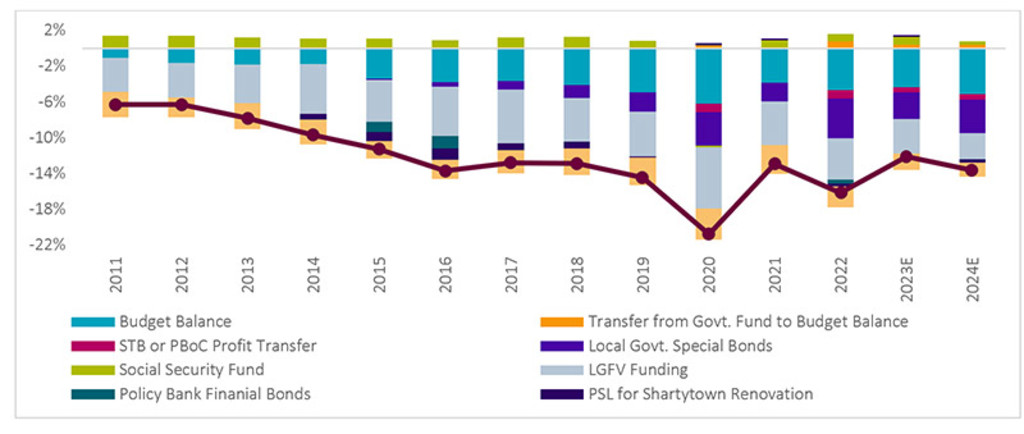
With monetary policy already accommodative, it’s logical to anticipate a more expansive fiscal policy to support growth and enable the GDP target to be achieved. This will include renewed public spending on social housing and infrastructure. The China bond market’s sanguine response to the Moody’s downgrade of its outlook for Chinese sovereign bonds shows it’s ready to absorb an expected rise in bond issuance. Consequently, a significant expansion of central government spending, channelled via local government, is very likely and will be positive for China equities.
Figure 1: Fiscal expansion will be key in 2024
Source: Morgan Stanley Research, December 2023
Global flows likely to reverse in China’s favor
We anticipate the global macroeconomic environment to help China’s policymakers with Fed rate cuts reducing pressure on the CNY and promoting investment flows away from the US. US treasury yields have had a negative correlation with Chinese equity market performance over the last seven years. That will be important, given global asset allocation to China has been at very low levels with USD 100 billion withdrawn from China in 2023. There could also be a reaction from domestic investors with institutional investors including insurance companies starting to rebuild positions. Valuations are now at historic trough levels and retail investors are capitulating.
Figure 2: US Treasury yields have been negatively correlated with China equity market performance
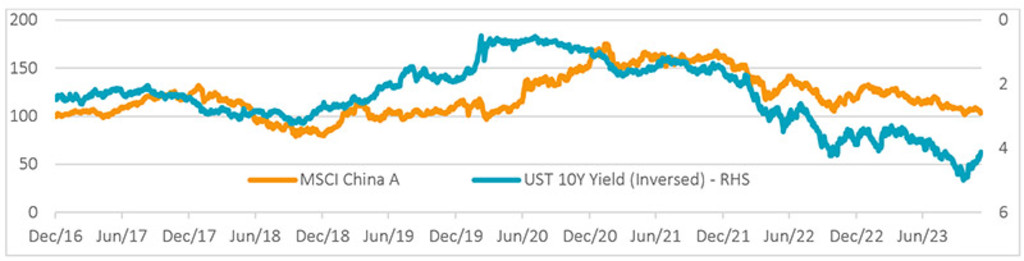
Source: Bloomberg, MSCI, Morgan Stanley Research; data coverage from January 1, 2017 to December 7, 2023. Note: RHS axis refers to MSCI China A performance indexed to 100 as of Jan 1, 2017 while LHS axis refers to US 10Y treasury yields (%) inversed.
獲取最新市場觀點
訂閱我們的電子報,時刻把握投資資訊和專家分析。
Contrarian thinking
Rather than seeing this as a crisis, we continue to take a constructive view that this is a long term buying opportunity for active investors with local market knowledge seeking exposure to some of the world’s best companies. In our China strategies we are employing a barbell strategy focusing on value with cyclical upside as well as structural growth.
Footnote
1 ‘Signal from the Central Economic Work Conference is enlightening’ - Global Times, 13 December, 2023
重要資料
本網站僅供《證券及期貨條例》(香港法例第571章)及其附屬法例所界定之專業投資者瀏覽及使用。 投資涉及風險。過往表現並不代表未來表現。本網站所載資料僅供參考之用,並不構成任何投資建議,亦非作出買賣任何證券或採納任何投資策略之要約或招攬。投資者不應僅憑本網站提供之資料作出投資決定,在作出任何投資決定前,應徵詢獨立意見(包括有關稅務影響之意見)。投資者應確保完全理解投資產品的相關風險,亦應考量自身投資目標及風險承受水平。投資乃閣下之個人決定。除非銷售投資產品的中介人已向閣下告知該投資產品適合閣下,並已解釋其符合閣下投資目標之原因,否則閣下不應投資。請參閱相關發售文件或其他法律文件,以獲取包括風險因素在內的進一步詳情。 本網站由荷寶投資管理香港有限公司發布,該公司受香港證券及期貨事務監察委員會(「證監會」)規管(中央編號:APU851)。本網站未經證監會審閱。 無法保證任何投資產品可實現其投資目標。概不就任何投資產品之表現或投資回報作任何聲明或承諾。投資的價值或會波動。本網站所載過往表現、推算或預測,均不應視作未來表現之保證或指標,且概不提供任何明示或暗示之保證。本網站內容建基於相信為可靠之來源,惟因應資料傳遞技術特性及須採用多項數據來源(包括第三方內容),故概不保證其準確性。所述觀點僅乃截至上述日期,或會隨市況變化而改變,可予更改而毋須另行通知。該等意見可能有別於其他荷寶投資專業人士之意見。因使用本材料或當中所載任何評論、意見或估算而引致之直接、間接或相應損失,荷寶概不承擔法律責任。荷寶並無責任更新本網站或任何網站內容。未經荷寶事先書面許可,不得複製、分發或刊發本網站任何材料。 除非另有說明,資料來源:荷寶。