

Portfolio Manager and Technology Analyst



• 市場觀點
Finding value within long-term thematic trends
It’s been man overboard for thematic investing as the style went out of favor in 2022. Steadying the ship means following the underlying trends that support key themes such as digital transformation and the green transition, says analyst Daniel Ernst.
作者

概要
- Growth-orientated themes were hard hit as monetary tightening kicked in
- Megatrends of innovation, demographics and preserving the Earth are intact
- Climate change presents huge opportunities in transformative technologies
No trend remained on dry land as thematic investing suffered its ‘annus horribilis’ and all but capsized in 2022. After rising eight-fold over five years and throughout 2021, the total value of thematically orientated assets under management tumbled by nearly a third.
Growth-orientated themes were particularly hard hit. After delivering annualized returns of 14.3% in the ten years leading up to and during 2021, the MSCI All World Growth Index fell 29.7% in 2022. In comparison, the MSCI Value Index generated 6.7% annualized returns in the ten years through 2021 and fell 8.8% in 2022. Sorting through this wreckage, we find that the fundamentals for broad structural themes across digital innovations, shifting demographics and the green transition remain buoyant.
So, what happened? Three key factors contributed to the steep correction. Firstly, valuations were high, as illustrated by the MSCI All World Growth index which started the year at 34 times forward earnings against a pre-Covid average of 21x. Secondly, after expanding 35% year on year in 2021, forward earnings growth estimates for the MSCI All World Growth index fell to 14% in 2022.
Thirdly, monetary policy began to shift from exceptional easing to aggressive tightening, with the Federal Reserve raising the benchmark interest rate seven times from near zero to more than 4% by the end of the year. In hindsight, the results were predictable – valuation multiples collapsed.
A dramatic shift in the narrative around underlying structural drivers also contributed to the pressures. The imbalanced view that Covid had permanently altered how people work and live, quickly shifted towards a consensus that everything would ‘return to normal’. Key trends, from e-commerce to software’s transition to the cloud, were all called into question as economies reopened and digital service growth slowed.
Consequently, the correction in 2022 impacted every major theme, from cyber security to clean energy, as shown in the chart below:
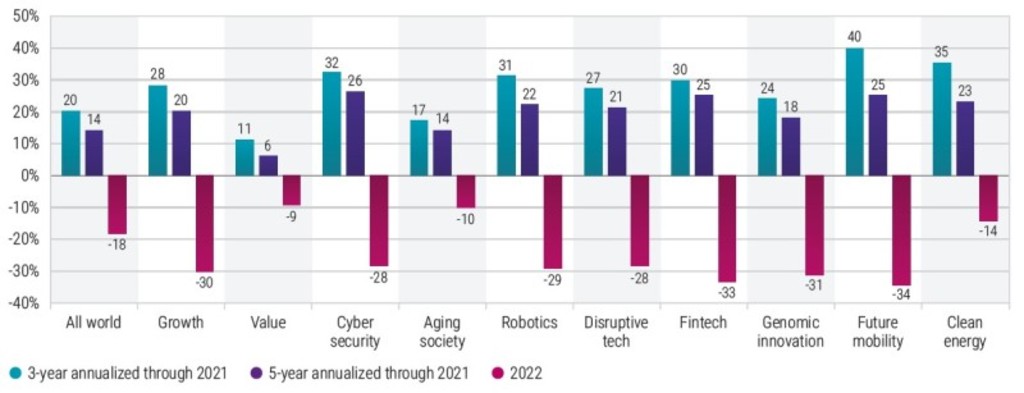
Thematic and style index performance. Source: Bloomberg, MSCI
A world of constant change
The impact of the kind of structural change as seen with Covid is rarely limited to any one sector or place, especially in the age of globalization. This is clearly the case with climate change, as the emissions from one country can spread across borders, and the most acute effects are unpredictable and seemingly disconnected. As a result, a systems-level approach is required to build solutions and identify structural winners.
For example, electric vehicles are comprised of a complex array of disciplines including chemistry, metallurgy, semiconductors, software, robotics and supply chain management. Finding the expertise to assemble and scale those disparate technologies, within the confines of profitable established business models, has proven a challenge for incumbents and entrants alike.
And while the impacts of structural changes and transformative shifts are broadly felt, there are typically few beneficiaries. Research showed that a typical stock listed in the US from 1926 to 2019 had a buy-and-hold return of minus 2.8% over its entire lifetime. Furthermore, out of 25,000 stocks listed between 1973 and 2020 in the US, just 13% achieved a return of 25 times the initial outlay over almost half a century.
And the market is becoming increasingly narrow. Another study examining the returns of 64,000 global stocks found that the top performing 2.4% of companies accounted for all of the USD 75.7 trillion in wealth creation between 1990 and 2020, led by the big tech companies.
Well-supported themes
Then there is the issue of looking at trends as a means of predicting the future, particularly given the new dominance of tech. While thematic portfolios can include an allocation to earlier stage ideas, the largest and most profitable opportunities often reside within trends that are already set in motion.
This can be seen in the three megatrends of transformative technologies, changing socio-demographics and the imperative to preserve the Earth as our planet faces unprecedented threats from global warming and biodiversity loss. All remain firmly intact, even if they themselves are subject to change from within.
For example, digital services – a sector that thrived during the pandemic – was among the hardest hit in the 2022 correction, and its growth slowed markedly as economies reopened. This led to a swift shift in the narrative from ‘everything has changed’ to ‘it’s all going back to normal.’ Covid winners were thrown into the bin like yesterday’s dot coms.
What to make of e-commerce
E-commerce is another shifting sand. In the years preceding Covid, e-commerce sales in the US expanded at a constant rate, reaching 11.1% of retail sales by the fourth quarter of 2019. During the pandemic, the share of e-commerce jumped to 16.4% of retail during the second quarter of 2020. As restrictions eased, e-commerce sales decelerated, and its share of retail revenue fell.
However, in subsequent quarters, share gains resumed, and in the first quarter of 2023, e-commerce accounted for 15.1% of retail sales, a level well above the linear regression forecast based on pre-pandemic data. This is shown in the chart below, where there is a clear mismatch in the Covid era:
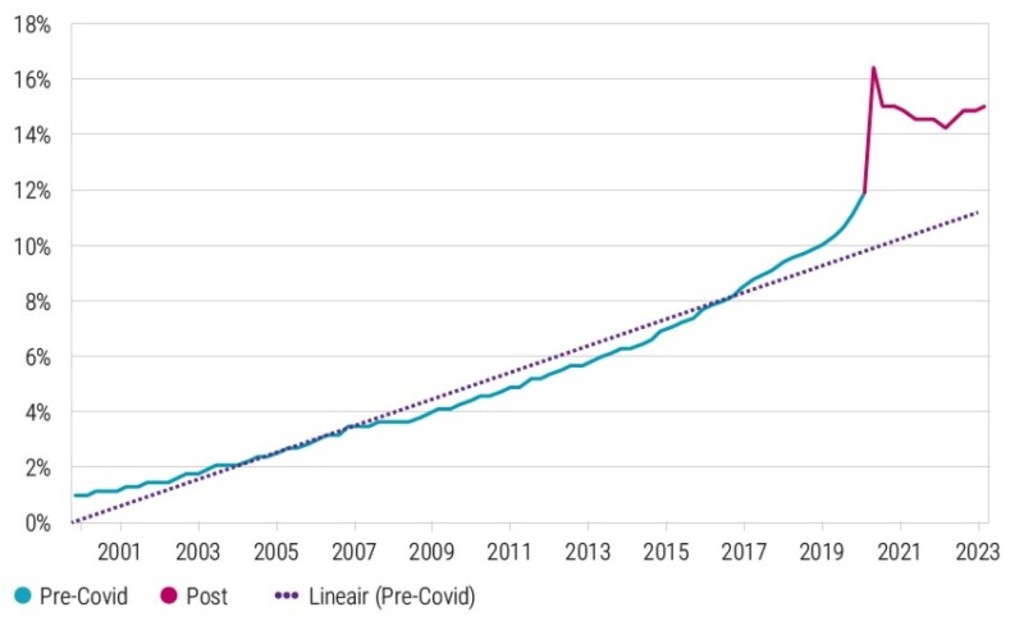
US e-commerce sales as a percentage of total retail sales. Source: US Department of Commerce, May 2023
India as a sub-theme
Shifting global demographics also create opportunities and challenges across a broad range of sectors including energy, health care, nutrition, materials, security and supply chains. Diverging trends among countries will drive an important demographic milestone in 2023 as India is expected to surpass China in population, reaching nearly 1.43 billion people, and with a rising (and higher spending) middle class.
Notably, over the last ten years, the number of people in India without electricity has decreased from almost 300 million to just 30 million. Over that same period, the number of internet users has increased from 125 million to more than 800 million and the number of mobile cellular subscriptions rose from 900 million to 1.2 billion. Interestingly, while many of the west’s largest technology and internet companies are led by chief executive officers of Indian descent, the country has produced few global enterprises.
獲取最新市場觀點
訂閱我們的電子報,時刻把握投資資訊和專家分析。
Climate change doesn’t change
Then there is the battle against climate change. Electric vehicles and renewable energy sources are increasingly, not only the most climate-friendly options, but the most economical. Battery-powered electric vehicles sales are soaring, while the average price of utility scale solar and wind power generation is 39% less expensive than gas and 67% cheaper than coal.
So, with these drivers intact, we remain optimistic that the fundamental shifts that power the three overarching megatrends will continue to drive future returns. Thematic investing continues to seek innovative and profitable businesses to address these disruptive forces and build value over the long term. We had a rough year, but the future is yet to come.
This article is an excerpt of a special topic in our five-year outlook.
重要資料
本網站僅供《證券及期貨條例》(香港法例第571章)及其附屬法例所界定之專業投資者瀏覽及使用。 投資涉及風險。過往表現並不代表未來表現。本網站所載資料僅供參考之用,並不構成任何投資建議,亦非作出買賣任何證券或採納任何投資策略之要約或招攬。投資者不應僅憑本網站提供之資料作出投資決定,在作出任何投資決定前,應徵詢獨立意見(包括有關稅務影響之意見)。投資者應確保完全理解投資產品的相關風險,亦應考量自身投資目標及風險承受水平。投資乃閣下之個人決定。除非銷售投資產品的中介人已向閣下告知該投資產品適合閣下,並已解釋其符合閣下投資目標之原因,否則閣下不應投資。請參閱相關發售文件或其他法律文件,以獲取包括風險因素在內的進一步詳情。 本網站由荷寶投資管理香港有限公司發布,該公司受香港證券及期貨事務監察委員會(「證監會」)規管(中央編號:APU851)。本網站未經證監會審閱。 無法保證任何投資產品可實現其投資目標。概不就任何投資產品之表現或投資回報作任何聲明或承諾。投資的價值或會波動。本網站所載過往表現、推算或預測,均不應視作未來表現之保證或指標,且概不提供任何明示或暗示之保證。本網站內容建基於相信為可靠之來源,惟因應資料傳遞技術特性及須採用多項數據來源(包括第三方內容),故概不保證其準確性。所述觀點僅乃截至上述日期,或會隨市況變化而改變,可予更改而毋須另行通知。該等意見可能有別於其他荷寶投資專業人士之意見。因使用本材料或當中所載任何評論、意見或估算而引致之直接、間接或相應損失,荷寶概不承擔法律責任。荷寶並無責任更新本網站或任何網站內容。未經荷寶事先書面許可,不得複製、分發或刊發本網站任何材料。 除非另有說明,資料來源:荷寶。