Researcher
獲取最新市場觀點
訂閱我們的電子報,時刻把握投資資訊和專家分析。






As the end of Q2 2023 earnings season approaches, it’s crucial for investors to utilize earnings calls for in-depth insights. More than just a source of numerical data, these calls provide a narrative around financial performance, revealing strategies, risks, opportunities, and market dynamics. C-suite executives provide context to the financial numbers and elaborate on key decisions, while the question and answer sessions can reveal unreported details. Hence, earnings calls are a powerful tool for a comprehensive understanding of a company’s financial outlook alongside public accounting data.




However, unlike accounting or market data, earnings call transcripts are full of natural language and present unstructured data. This is where Natural Language Processing (NLP) becomes crucial in extracting meaningful insights from earnings calls. NLP can help decode complex financial language, identify sentiment, and highlight key themes discussed during the call.
Historically, word count methods, i.e., “Bag of Words,” have long been a widely used technique for analyzing text data. However, it comes with its limitations and shortcomings. For example, information about the relationship between words within a document is lost. Using more modern NLP inference, making use of the embeddings of textual data, context can be taken into account.
To show an example, in 2021, an analyst at a NVIDIA earnings call stated:
I think that there’s like four or five of the big currencies are going to move or at least they’re moving or they’re on a path to move from proof-of-work to proof-of-stake
Despite the term “blockchain” not being directly mentioned, the embeddings of the sentence help identify the reference to blockchain technology.
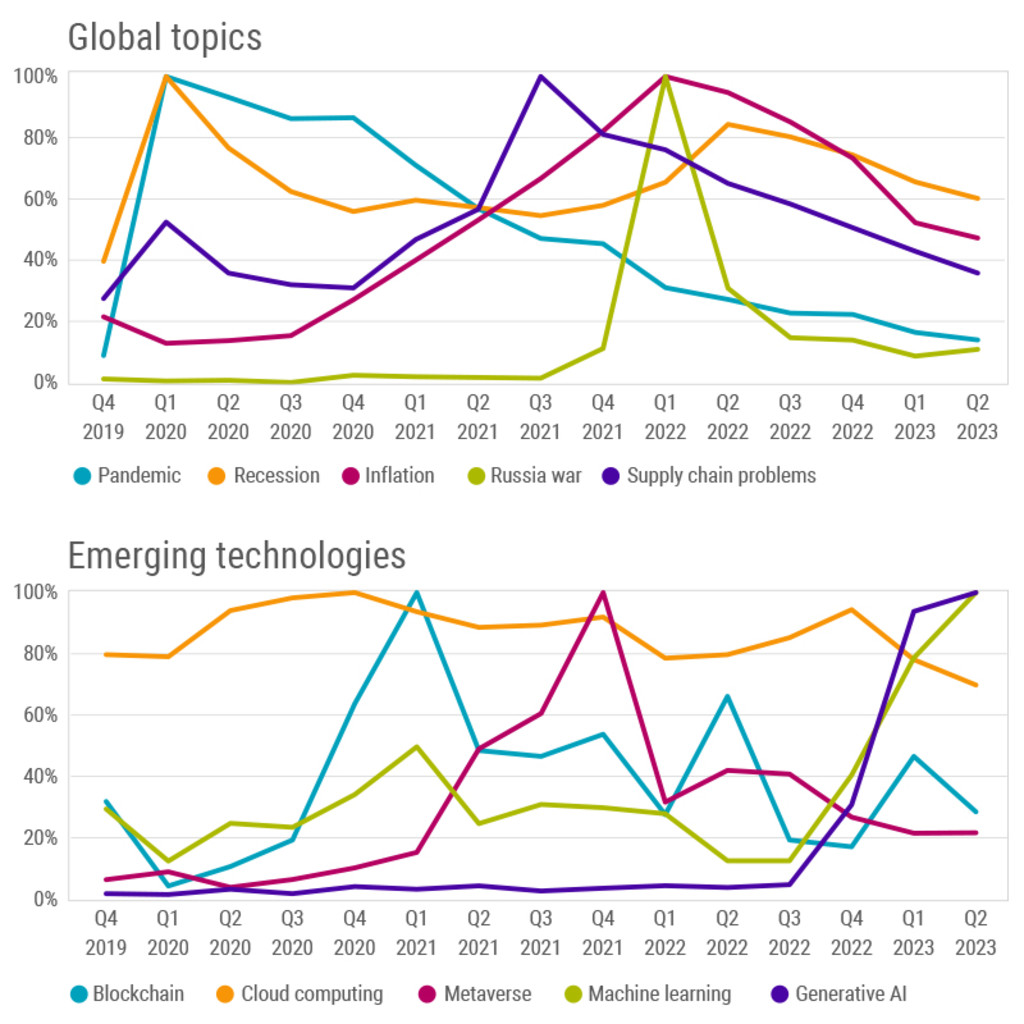
Source: Robeco, FactSet. The figure shows the intensity of how various topics have been discussed in earnings call conferences over the last 15 quarters. The upper chart illustrates the intensity of selected global topics, while the lower chart shows the intensity of emerging technologies. For each company and quarter, the portion of sentences about a specific topic is computed and averaged over all earning calls within that quarter. Subsequently, each topic’s intensity is normalized such that the peak is represented as 100%. The analysis includes all constituents of the S&P 500, and the sample period ends on August 4, 2023, with 81% of the S&P 500 constituents already having their Q2 2023 earnings call conferences.
Using NLP techniques, we can infer which macro trends analysts and companies discuss during earning calls conferences. The upper chart in Figure 1 reveals that at the beginning of 2020, unsurprisingly, “pandemic” and ”recession” were the dominating topics. In the final quarter of 2021, supply chain problems dominated the C-suite’s minds, followed by concerns over the Russia-Ukraine conflict and inflation during the first quarter of 2022.
Even more fascinating, NLP can also be employed to identify emerging technologies, as shown in the lower chart in Figure 1. While cloud computing remains a consistent topic of discussion, we also observe some other topics rise and fall. For instance, blockchain was the trending topic during the third quarter of 2020 until the first quarter of 2021, while it was the metaverse in the last quarter of 2021. These peaks coincide with the Bitcoin rally from October 2020 until March 2021 and Facebook’s renaming to Meta in October 2021. In the current Q2 2023 earnings season, machine learning, especially generative AI, is the hot topic, continuing the trend that started in the final quarter of 2022.
The analysis above showcases the application of NLP for dynamic theme detection using earnings calls. To explore how such tools might be used for dynamic quantitative theme investing, we invite you to contact your Robeco sales representative.
訂閱我們的電子報,時刻把握投資資訊和專家分析。
本網站僅供《證券及期貨條例》(香港法例第571章)及其附屬法例所界定之專業投資者瀏覽及使用。 投資涉及風險。過往表現並不代表未來表現。本網站所載資料僅供參考之用,並不構成任何投資建議,亦非作出買賣任何證券或採納任何投資策略之要約或招攬。投資者不應僅憑本網站提供之資料作出投資決定,在作出任何投資決定前,應徵詢獨立意見(包括有關稅務影響之意見)。投資者應確保完全理解投資產品的相關風險,亦應考量自身投資目標及風險承受水平。投資乃閣下之個人決定。除非銷售投資產品的中介人已向閣下告知該投資產品適合閣下,並已解釋其符合閣下投資目標之原因,否則閣下不應投資。請參閱相關發售文件或其他法律文件,以獲取包括風險因素在內的進一步詳情。 本網站由荷寶投資管理香港有限公司發布,該公司受香港證券及期貨事務監察委員會(「證監會」)規管(中央編號:APU851)。本網站未經證監會審閱。 無法保證任何投資產品可實現其投資目標。概不就任何投資產品之表現或投資回報作任何聲明或承諾。投資的價值或會波動。本網站所載過往表現、推算或預測,均不應視作未來表現之保證或指標,且概不提供任何明示或暗示之保證。本網站內容建基於相信為可靠之來源,惟因應資料傳遞技術特性及須採用多項數據來源(包括第三方內容),故概不保證其準確性。所述觀點僅乃截至上述日期,或會隨市況變化而改變,可予更改而毋須另行通知。該等意見可能有別於其他荷寶投資專業人士之意見。因使用本材料或當中所載任何評論、意見或估算而引致之直接、間接或相應損失,荷寶概不承擔法律責任。荷寶並無責任更新本網站或任何網站內容。未經荷寶事先書面許可,不得複製、分發或刊發本網站任何材料。 除非另有說明,資料來源:荷寶。
警告 — 有不法分子在網站及社交媒體上冒用荷寳 了解更多