
Co-Portfolio Manager

• 市場觀點
Electric vehicle adoption accelerating as costs fall
Internal analysis substantiates that electric vehicle (EVs) have reached a critical inflection point. In many markets, total cost of ownership is now lower than petrol-burning vehicles (ICEs). Moreover, recent disruption in energy prices makes EVs even more attractive.
作者

概要
- EVs are no longer out of reach for the average consumer
- Commodity price hikes more keenly felt in ICE cars
- Performance features gives EVs an edge in future new car purchases
Replacing petrol-powered cars with electric ones is a critical part of decarbonizing transport towards net zero targets by 2050. Yet, electric vehicles are considered by many as a luxury gadget, out of reach for the average new car buyer. Using real-world total cost of ownership (TCO) scenarios, we demonstrate that EV costs have fallen enough to reach a critical inflection point for mass adoption.
TCO calculations can be revealing as the cost of a car at purchase represents around half of its TCO. Beyond that, energy and ongoing maintenance costs dominate. This is where the TCO shifts in favor of EVs. Thanks to the simpler nature of an electric powertrain, EVs have fewer parts and are easier to maintain compared to ICEs. Moreover, the availability of renewable electricity, either from an at-home solar installation or from the grid, mean EV energy costs are modest, whereas they remain high for combustion cars. In fact, with incentives, the cheapest car to own in Europe is now an EV.
In France, a blue-collar worker commuting 100 km a day round-trip, was best served by an EV. Despite a higher initial sticker price, the low cost of charging at home or work made the EV immediately competitive based on operating costs. Similar results were found for an economy-car consumer in Italy, though EV-ICE price parity was reached slightly further out due to other cost differences.1
Though incentives such as purchase subsidies and road tax exemptions lower the TCO for EVs at the outset, their costs to governments are high and they will eventually fade. In some markets they are already unnecessary for EVs to reach cost parity. Switzerland, for example, is subsidy-free. There, a young, suburban family can already have a fully electric SUV at virtually the same price as the petrol-burning version; and over time the EV’s TCO is lower (See Figure 1).2
Urban settings offered more challenges. Our UK and German scenarios considered young professionals living in flats in second-tier cities. In both cases, use of street parking and public chargers are the norm. Charging in public is more expensive relative to home installations, which lowered the EVs immediate operating cost advantage. However, after five years, electric charging is cheaper than petrol fueling, making EVs more attractive for urbanites.3
Cheap petrol and attractively priced SUVs made the US market the only scenario where the TCO for EVs failed to beat their ICE counterparts. EV retail prices will need to fall further to offset the low cost of ICEs in local US markets.
The cheapest car to own in Europe is now an EV
Figure 1 | EVs – a clear winner in time
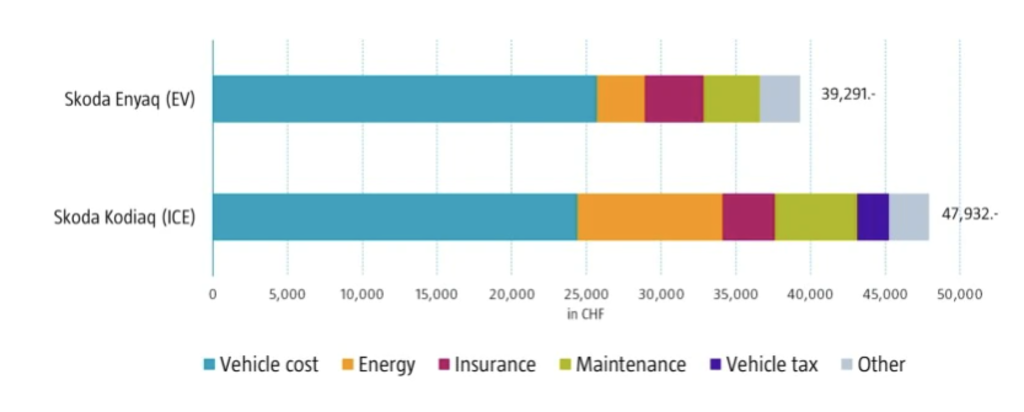
The table displays the cost components of owning a typical SUV in Switzerland over six years. Costs in CHF. ICE refers to internal combustion engine. See Knowledge Box below for further cost details.
Source: Robeco. Data as of 2021.
The impact of war and supply disruptions
Our TCO analysis was done using 2021 prices but war in Ukraine has increased the price of many commodities, notably crude oil and nickel. Neither dramatically alters our findings. In fact, it only increases the attractiveness of EVs. Petrol prices in the markets we considered have appreciated considerably, while electricity prices have remained stable. In markets where electricity is produced without burning fossil fuels (i.e., nuclear, hydropower, wind, solar) prices are virtually unchanged. Where oil and natural gas are used, electricity prices have risen, but less than petrol.
The price of nickel, a key component in EV batteries, is also rising. However, battery manufacturers typically secure supplies and prices via long-term contracts, which means there should be minimal impact in the short term. Even if nickel prices remain elevated and filter through to higher EV prices, cheaper operating costs over a vehicle’s lifetime would still outweigh upfront cost increases.
EVs gaining momentum in Europe and globally
The TCO scenarios presented are another example of how maturing technologies are driving down costs in automotive markets. It also clearly indicates that European markets have reached an inflection point for EV adoption, reflected in the building sales momentum. In 2019, EVs represented 3% of car sales in Europe. In 2021, that jumped to around 17% (See Figure 2).
More importantly, reaching this inflection point is what matters as once an EV is cheaper to own, it can compete on other features including driving performance, reliability, comfort, and convenience, in addition to being cleaner for the environment. Moreover, increases in charging infrastructure and EV driving distances are reducing consumer range anxiety.
EV sales are gaining traction as both newcomers and legacy car makers invest in EV production capacity and release new models. We estimate that this transformation in the industry will result in EVs representing half of all new cars sold globally in 2030.
Major European markets have reached an inflection point for EV adoption
Figure 2 | EV share of new car sales
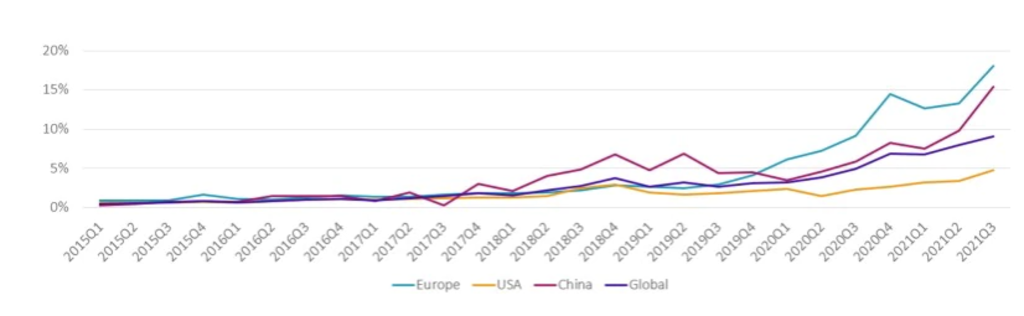
Source: BloombergNEF for EV numbers. Bloomberg for full passenger car market numbers
‘Smart’ investments in electric vehicles
The electrification of transportation not only benefits the environment, but also consumers’ wallets. As existing car manufacturers shift production to EVs, and new manufacturers enter the market, the adoption of EVs will continue to increase. These are structural growth drivers for companies in the supply chain.
The Smart Mobility strategy invests in companies along the entire EV value chain, from manufacturers designing, assembling and marketing the vehicles which consumers want, to companies providing advanced semiconductors which allow for greater energy efficiency and vehicle intelligence, all the way through to companies which test components such that they can deliver the reliability and safety which vehicles demand.
Our total cost of ownership scenarios are present-day indicators of an industry in rapid transition, as it moves away from a fossil-fuelled past and embraces a low-emission future.
Footnotes
1In France and Italy, the Dacia Sandero (an ICE) was compared to the Dacia Spring Electric (an EV).
2In the US and Switzerland, the Skoda Kodiaq (an ICE) was compared to its EV alternative, the Skoda Enyaq.
3In the UK and Germany, the Volkswagen Golf (an ICE) was compared to the Volkswagen ID3 (an EV).
了解最新的可持續性市場觀點
訂閱我們的電子報,探索塑造可持續投資的趨勢。
重要資料
本網站僅供《證券及期貨條例》(香港法例第571章)及其附屬法例所界定之專業投資者瀏覽及使用。 投資涉及風險。過往表現並不代表未來表現。本網站所載資料僅供參考之用,並不構成任何投資建議,亦非作出買賣任何證券或採納任何投資策略之要約或招攬。投資者不應僅憑本網站提供之資料作出投資決定,在作出任何投資決定前,應徵詢獨立意見(包括有關稅務影響之意見)。投資者應確保完全理解投資產品的相關風險,亦應考量自身投資目標及風險承受水平。投資乃閣下之個人決定。除非銷售投資產品的中介人已向閣下告知該投資產品適合閣下,並已解釋其符合閣下投資目標之原因,否則閣下不應投資。請參閱相關發售文件或其他法律文件,以獲取包括風險因素在內的進一步詳情。 本網站由荷寶投資管理香港有限公司發布,該公司受香港證券及期貨事務監察委員會(「證監會」)規管(中央編號:APU851)。本網站未經證監會審閱。 無法保證任何投資產品可實現其投資目標。概不就任何投資產品之表現或投資回報作任何聲明或承諾。投資的價值或會波動。本網站所載過往表現、推算或預測,均不應視作未來表現之保證或指標,且概不提供任何明示或暗示之保證。本網站內容建基於相信為可靠之來源,惟因應資料傳遞技術特性及須採用多項數據來源(包括第三方內容),故概不保證其準確性。所述觀點僅乃截至上述日期,或會隨市況變化而改變,可予更改而毋須另行通知。該等意見可能有別於其他荷寶投資專業人士之意見。因使用本材料或當中所載任何評論、意見或估算而引致之直接、間接或相應損失,荷寶概不承擔法律責任。荷寶並無責任更新本網站或任何網站內容。未經荷寶事先書面許可,不得複製、分發或刊發本網站任何材料。 除非另有說明,資料來源:荷寶。