



Our proprietary SDG Framework is a tool that systematically evaluates companies based on the contributions they can make to the 17 UN Sustainable Development Goals. A company’s overall performance across relevant SDGs aggregates into an overall company SDG score. The scores are used to construct portfolios that aim to make a positive contribution to the goals.
How we use the SDG Framework
The SDG Framework assesses whether companies are supporting or harming a transition to more sustainable societies. This assessment serves to screen companies on their suitability for inclusion in equity and credits investment funds based on their contributions to the goals.
Companies are assessed on a scale ranging from -3 (highly negative contributions) through 0 (neutral) to +3 (highly positive). They are evaluated on each of the individual goals and given a total score that is indicative of their overall impact on the SDGs.
The framework asks three questions when making these assessments:
What does the company produce?
How does it go about producing it?
Has it been involved in any controversies?
The Robeco SDG Framework
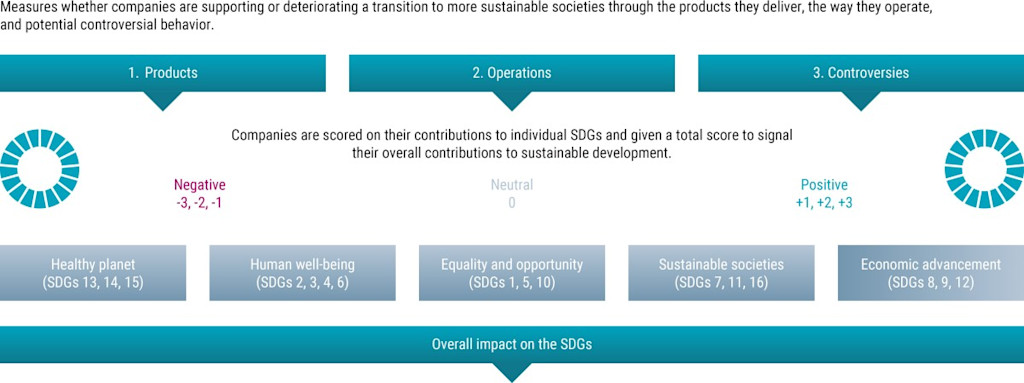
With these scores, we are able to integrate the SDGs into investment strategies. We can avoid companies with negative scores to ensure that no substantial harm to sustainability objectives is caused by our investments, or we can only allocate to the leaders.
Our SDG Framework proved to be so successful in assessing sustainability that it is now used across most of Robeco’s mainstream equity and fixed income strategies as a core sustainability component. It’s also used in the multi-asset range of funds as it can encompass both the equity and credit asset classes.
An invaluable aid
In its seven years of use, we have found the Framework an invaluable aid in assessing a true level of sustainability that ESG ratings alone cannot cover. This is partly because a company could have a high ESG rating but a low SDG score. A tobacco company with low carbon emissions, good labor relations and excellent governance, for example, could get a high ESG rating. But its product is harmful for health and so it would generate a low SDG score. The issue is more fully addressed in two recent insights on the issue. 1
And since the transition to a low-carbon world is becoming increasingly important, the SDG Framework can help assess a company’s preparedness, particularly scrutinizing whether companies provide solutions for tackling climate change, halting biodiversity loss, or improving people’s health and well-being.
All companies in our investment universe are now covered by the SDG Framework, making it an invaluable research tool for Robeco’s analysts and portfolio managers. Many other asset managers use ESG scoring in the investment process, and some look at contributions to the SDGs – but there are few who can do both with their own research tools.
1 See Measuring sustainability performance: comparing an SDG score with ESG ratings and Do ESG ratings align with popular thematic impact funds?