


Client Portfolio Manager

• Vision
How dynamic high yield responds when spreads widen
High yield offers attractive income, but how can investors stay invested if tight spreads widen? Dynamic high yield uses market signals to adjust risk as conditions change.
Auteurs

Ward Poirters

Portfolio Manager
Résumé
- Dynamic high yield has shown resilience in past periods of spread widening
- Its systematic process adjusts exposure as signals strengthen or weaken
- Its portfolio structure allows it to reposition quickly
Investors are facing no shortage of reasons for concern. Geopolitical tensions, energy-price risks and uncertainty over central bank policy continue to cloud the outlook. Although spreads have widened in recent weeks, they remain close to historically tight levels.
This suggests that investors are still demanding relatively little extra compensation for taking credit risk. For investors who want to keep earning income from high yield, this creates a challenge: staying invested while managing the risk of a market reversal.
A high yield bond usually pays more interest than a government bond because there is more risk that the company borrowing the money will struggle to repay it. The spread is that extra yield. If a government bond yields 3% and a high yield bond yields 6%, the spread is three percentage points.
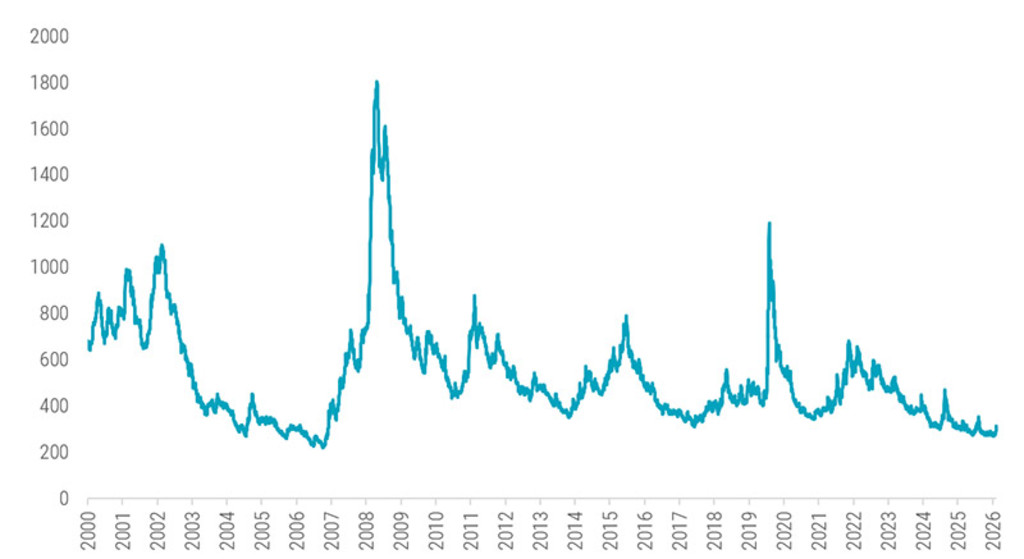
Today, spreads are tight, meaning investors receive relatively little extra yield for taking additional company risk. If confidence in companies weakens, investors may demand more compensation. Spreads then widen, and the prices of existing high yield bonds generally fall. Figure 1 puts today’s position in context: spreads rose sharply during past periods of concern, but are now near the low end of the range shown.
Figure 1 - How the spread on high yield bonds has changed over time
Past performance is no guarantee of future results. The value of your investments may fluctuate.
Source: Bloomberg Global High Yield Index, until the end of September 2026.
Why stay invested in high yield?
Despite tight credit spreads, high yield continues to offer attractive income, with yields around levels not seen for more than two decades. Those yields provide a stronger starting point for returns. The income earned can also help offset some decline in bond prices. Fundamentals across the asset class remain relatively strong. The high yield market has become higher-quality over time, with BB-rated bonds now representing a record share of both the US and European markets.1
When conditions become less supportive, the strategy can reduce exposure; when they improve, it can increase exposure again
High yield can also add diversification to a broader bond portfolio because it behaves differently from more interest-rate-sensitive bonds. Attractive income, relatively solid fundamentals and diversification therefore continue to make a case for staying invested. But tight spreads mean investors also need to be prepared if market conditions worsen. This is where a more flexible approach can help.
Quoi de neuf dans les crédits ?
Gardez une longueur d'avance avec notre newsletter sur les derniers développements en matière d'investissement crédit.
How does dynamic high yield operate in difficult markets?
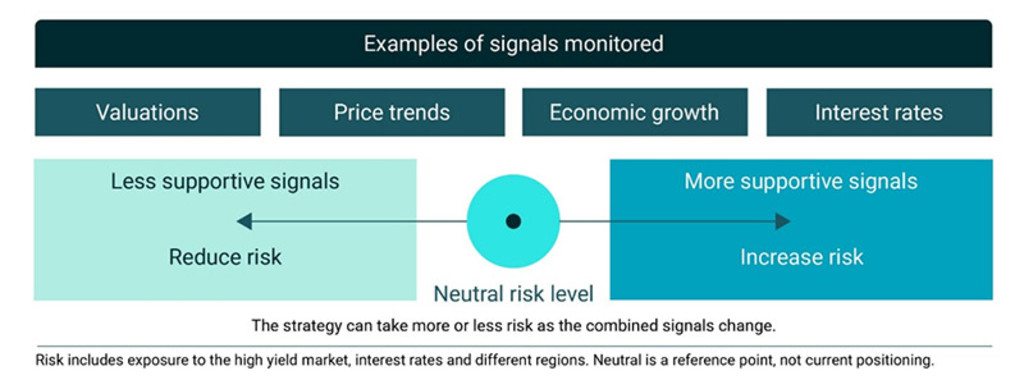
Traditional high yield strategies generally stay invested so they can earn income and benefit when the market rises. But that also leaves them exposed when high yield bonds fall in value. Dynamic high yield has a different approach: it can adjust how much high yield risk it takes. It does this by monitoring signals such as the extra yield bonds offer, price trends, economic growth and interest rates.
These signals are combined systematically to determine the strategy's level of high yield exposure. When conditions become less supportive, the strategy can reduce exposure to help limit downside risk. But the flexibility also works in the other direction: when conditions are more favorable, it can increase exposure above its neutral level to capture more of the income and return potential available from high yield.
Figure 2 - Market signals guide high yield risk exposure – the aim is not to predict every market turning point perfectly, but to adapt as conditions change
Source: Robeco, October 2026.
Why consider dynamic high yield today?
Today's combination of attractive yields and tight spreads makes flexibility particularly relevant. Dynamic high yield seeks to capture that income while adjusting risk as conditions change. This allows investors to remain in the asset class without having to decide for themselves when to exit or re-enter the market.
Footnote
1Source: KKR, August 2026. BB-rated bonds account for approximately 57% of the US high yield market and 68% of the European high yield market, both record levels.
QI Dynamic High Yield EH EUR
- Performance 3y (30-9)
- 7,46%
- morningstar (30-9)
- SFDR (30-9)
- Article 6
- Paiement de dividendes (30-9)
- Yes
- Valeur liquidative (28-10)
- 82,29
Les performances passées ne préjugent pas des performances futures et ne sont pas constantes dans le temps.Annualisé (pour les périodes supérieures à un an). Les performances s'entendent nettes de frais et en fonction des prix de transaction.