

Global Head of Fundamental Equity


• Quarterly outlook
Crisis rhymes but no repeat: equity markets left finely balanced
As volatility increases after the inflation fight destabilizes the banking sector, we continue to recommend exposure to a diversified portfolio of quality stocks and an increased allocation to emerging markets.
Authors




Head of Emerging Markets team
Summary
- Echoes of 2008 but the policymaker and regulator response is faster and more decisive
- Quality remains the focus, enabling us to stay invested and capture upside when it comes
- Emerging markets to outperform as dollar weakens and China recovery gathers pace
The 22 March 2023 decision by the Federal Reserve to raise its policy rate only 25 bps sets the scene for a much-anticipated rate hike pause later in the year. After three weeks of US banking sector stumbles the Fed’s room to hike is now limited and Fed chairman Powell’s relatively dovish post-meeting comments reflect that. We don’t believe this is a repeat of the crisis of 2008, with policymakers acting much faster to address stability issues, but volatility is here to stay as the global economy continues to adjust to a higher inflation, higher interest rate environment.
Within this environment we believe there are excellent opportunities for long-term equity investors but that doesn’t include just buying and holding the index. The strange juxtaposition of headlines about US authorities considering how to insure all US bank deposits1, with ‘Biggest Fear for Trillion-Dollar Funds Is Missing Next Rally’2 shows that this is an uncertain and potentially treacherous time where active strategies will prevail over passive.
Recent data points from around the world show inflation still isn’t dampening down enough to allow policymakers to turn decisively dovish. Inflation data has surprised on the upside recently, notably in the UK, Switzerland and Singapore, while in Europe the ECB remains hawkish3 with eurozone CPI inflation sticky around 8.5%. The trend in the US is more helpful with producer prices falling 0.1% month on month in February, helping firm projections that a peak policy rate level is in sight. In addition, in conjunction with other central banks the Fed has eased dollar liquidity considerably4 to take pressure off the banking sector, partially reversing its quantitative tightening program. These indications and actions are now supporting equity markets.
Increasing dollar liquidity will only work if it more than offsets the tightening of financial conditions caused by bouts of deposit flight, and reduced inter-bank trust. Stress in the commercial real estate market5 is also likely to complicate efforts to move beyond the current scrutiny of US banks. As a result, based on the experience of 2008, the Fed is likely to remain generous in its liquidity provision until sentiment is normalized. In addition, if the problem at mid-size banks is due to concentrated long treasuries exposure as at SVB, then declining yields will help solve that. Either way, a more accomodative monetary environment is likely to manifest itself through the year to try and stop credit being squeezed which will offer some support for equities, even if the economy slows.
Developed market economic data belie recession fears
Macro indicators are still proving resilient in developed markets despite the difficult environment and ongoing pessimism from some analysts. That Europe survived the winter without energy-related disruption has helped, and kept Germany in positive growth, while eurozone PMI surprised on the upside in March coming in at 54.1. In the US retail sales weakened in February after strong data in December and January, and weekly unemployment claims are still showing the labor market is relatively tight. Japan is also set up for growth in 2023 with recent inflation data encouraging the belief that the BoJ will finally exit its zero interest rate policy.
Get the latest insights
Subscribe to our newsletter for investment updates and expert analysis.
Nevertheless, emerging markets remain much better placed than developed markets
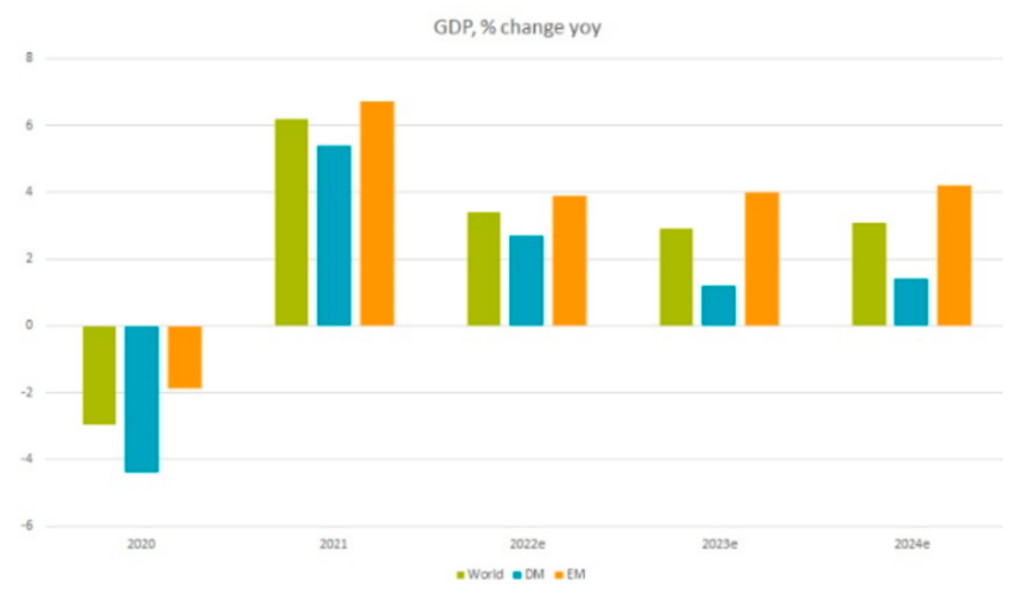
Despite a rather tepid market reaction to China’s conservative GDP growth forecast of 5%, data is moving in the right direction with consumption and fixed asset investment both looking good in January and February. Add a weakening US dollar and the ingredients for EM outperformance are in place. The banking crisis manifesting in the US and Switzerland has seen Chinese equities, led by the financial sector, rally, supporting this thesis. The more general macroeconomic positive for EM is that inflation just hasn’t embedded itself in the same way as in the developed world. Some of the largest emerging economies like Brazil and India are at a different stage in the credit cycle, and are benefiting from some one-off deflationary anchors, including cheap Russian oil in India’s case. All this will add up to faster growth for EM compared to DM.
Figure 1 – GDP expectations in EM are much more positive
Source: IMF, January 2023
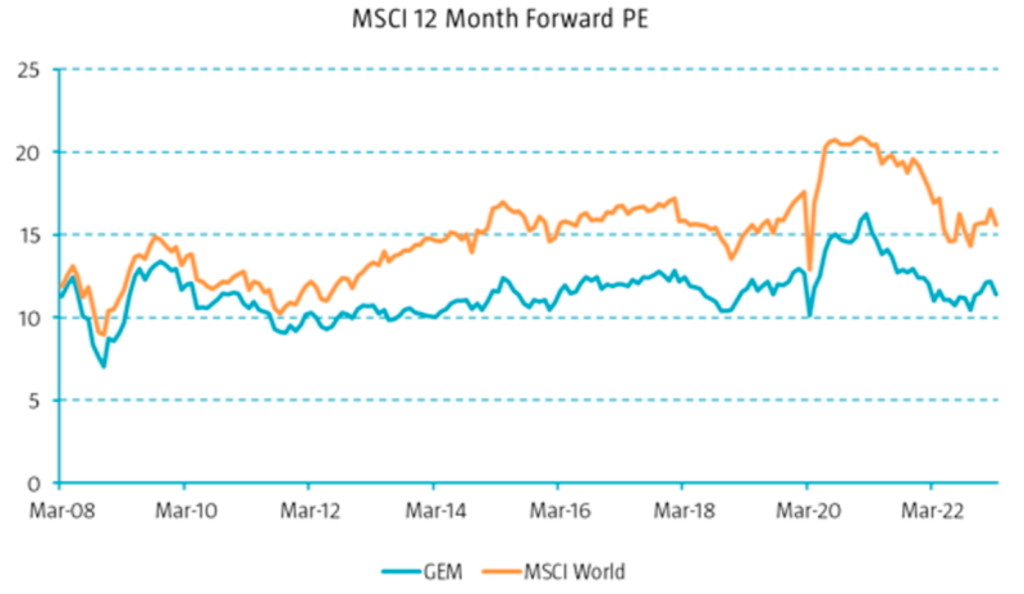
In addition, valuation metrics hit extremes in 2022 with EM trading at a 30% discount to DM. This gap has narrowed slightly but remains unjustified in our view.
Figure 2: Valuation gap DM vs EM
Source: IBES, Robeco, March 2023
Quality focus will capture upside when it comes
Economic data is resilient and monetary policy will turn supportive, but there is still a coalesence of different risks to equities, including still high inflation, ongoing recession fears, banking troubles, and signs of stress in the commercial real estate market. Quality names have outperformed in early 2023 after lagging in 2022, and we believe focusing on quality in an equity portfolio is the best way to navigate this turbulence.
By quality, Robeco means a high return on invested capital (ROIC) with clear reinvestment opportunities, high free cash flow generation and a discount to intrinsic value. Screening for companies that offer a macro shield in downturns, but will also capture upside when it comes, enables us to stay invested.
Footnotes
1 https://www.bloomberg.com/news/articles/2023-03-22/can-us-guarantee-all-bank-deposits-why-fdic-is-considering-raising-the-limit?srnd=premium-europe
2 https://www.bloomberg.com/news/articles/2023-03-21/markets-investors-jpmorgan-look-beyond-recession-to-rally-that-follows
3 https://www.bloomberg.com/news/articles/2023-03-22/ecb-officials-viewing-inflation-threat-feel-vindicated-on-hike
4 https://edition.cnn.com/2023/03/19/economy/central-banks-fed-dollar-liquidity/index.html
5 https://markets.businessinsider.com/news/stocks/commercial-real-estate-debt-regional-banks-risk-stock-market-cre-2023-3
Download the publication
Important information
THIS WEBSITE IS SOLELY INTENDED FOR PROFESSIONAL INVESTORS, WHICH HAS THE MEANING ASCRIBED TO IT IN THE SECURITIES AND FUTURES ORDINANCE (CAP. 571 OF THE LAWS OF HONG KONG) AND ITS SUBSIDIARY LEGISLATION. Investment involves risks. Past performance is not indicative of future performance. The information contained in this website is provided for reference only and does not constitute investment advice or an offer or solicitation to buy or sell in any securities or to adopt any investment strategy. Investors should not base their investment decisions solely on the information provided on this website and are advised to seek independent advice (including advice on tax implications) before making any investment decisions. Investors should ensure they fully understand the risks associated with the investment products and should also consider their own investment objectives and risk tolerance level. The investment decision is yours. You should not invest unless the intermediary who sells you the investment products has advised you that it is suitable for you and has explained how it is consistent with your investment objectives. Please refer to the relevant offering documents or other legal documents for further details including the risk factors. This website is published by Robeco Hong Kong Limited which is regulated by the Hong Kong Securities and Futures Commission (“SFC”) (CE No. APU851). This website has not been reviewed by the SFC. No assurance can be given that the investment objective of any investment products will be achieved. No representation or promise as to the performance of any investment products or the return on an investment is made. The value of investments may fluctuate. Past performance, projections, or forecasts included in this website should not be regarded as guarantees or indications of future performance, and no express or implied warranty is provided. The contents of this website are based on sources believed to be reliable, but due to the nature of information delivery technology and the necessity of using multiple data sources, including third party content, their accuracy is not guaranteed. The opinions expressed are as of the date shown above and may change as market conditions evolve, and are subject to change without notice. These opinions may differ from those of other Robeco investment professionals. Robeco accepts no liability for any direct, indirect, or consequential loss arising from the use of this material or any comments, opinions, or estimates contained herein. Robeco has no duty to update this website or any website content. Materials on this website may not be reproduced, distributed, or published without prior written permission from Robeco. Unless otherwise specified, Source: Robeco.