


Portfolio Manager

• 市場觀點
Emerging markets: Real tech revenue, macro resilience and attractive valuations
The final quarter of 2026 has been volatile but the fundamental drivers for emerging markets are intact as we look forward to 2027.
作者

概要
- AI investment boom is set to continue
- China, India and Brazil have the potential to surprise in 2027
- Emerging markets’ macroeconomic fundamentals are solid
Returns can vary widely across emerging markets countries and sectors, and 2026 has been no exception: technology companies in Taiwan and South Korea delivered strong returns, while equities in China and India lagged. We expect similarly wide differences in returns in 2027. So where do we see the best opportunities?
We know that the hardware on which AI runs is predominantly manufactured by emerging market companies, including producers of the most advanced semiconductors. Information technology now accounts for more than 40% of the MSCI Emerging Markets Index,1 making it the largest sector.
Developed markets are spending, while emerging market companies are generating revenue
Concerns have recently grown about the sustainability of AI investment amid rising financing costs and uncertainty over monetizing AI models. Hardware manufacturing remains cyclical, but we believe the current investment supercycle has further to run:
AI adoption is likely to remain strong. Many individuals and businesses are only beginning to adapt, as AI evolves from an advanced search tool into wider use of AI agents across business processes and daily life.
Supply can only adapt gradually. It takes several years to build semiconductor fabs, and there are significant supply bottlenecks for crucial equipment.
We therefore expect the technology investment cycle to continue for the next couple of years. For most EM tech companies, this translates into tangible revenue. Developed markets are spending, while emerging market companies are supplying the hardware and generating revenue. One striking example is South Korean semiconductor giant Samsung Electronics, which is now neck and neck with Nvidia as the world’s most profitable company.2,3
That said, valuations and their implied growth rates still matter. Valuations differ considerably across the sector. For the largest Korean tech companies, valuations remain low, while high growth expectations appear to be priced into the shares of many Taiwanese technology companies. We therefore favor selective exposure to the technology segments offering the most attractive valuations.
China and India: Growth at more attractive valuations
A substantial investable universe remains outside technology, particularly in China and India. Both markets lagged the benchmark in 2026, although their economies continue to grow. India, in particular, continues to record GDP growth above 7%. China faces greater challenges from a contracting property market and slowing economic growth. Nevertheless, exports remain strong, the country leads in several emerging industries, and Chinese households have scope to increase spending when confidence improves. Valuations in both markets have become more attractive, leaving greater scope for positive surprises. The markets may have lagged, but they should not be ignored.
Korea’s Corporate Value-up Program
Korean tech giants are dominating headlines in 2026, but investment opportunities in Korea extend well beyond technology. These include domestic sectors such as banking and telecommunications, alongside leading exporters in autos, defense, batteries and electrical equipment. Many are high-quality companies trading at what we believe are attractive valuations. To narrow these valuation discounts relative to global peers, the government launched its Corporate Value-up Program in 2024. Steps have been taken to improve corporate governance standards and to incentivize companies to act more in the interests of minority shareholders. These efforts are bearing fruit through rising dividends and increased share buybacks. For 2027, we expect this trend to continue and the valuation discount to narrow further.
Fiscal policy and interest rates at the forefront in Brazil
An important country to watch is Brazil. President Luiz Inácio Lula da Silva won reelection in October 2026 and will begin a new term in 2027. Fiscal policy in Lula’s next term will be crucial for markets. Without fiscal discipline, Brazil’s high real interest rates are unlikely to fall, as the central bank will be focused on keeping inflation under control. Fiscal prudence would also serve the government’s interests: lower rates would reduce debt-servicing costs and ease fiscal pressure. With market expectations subdued, there is scope for positive surprises if the Lula administration takes sufficient action to calm market fears.
Stronger macroeconomic fundamentals and attractive valuations
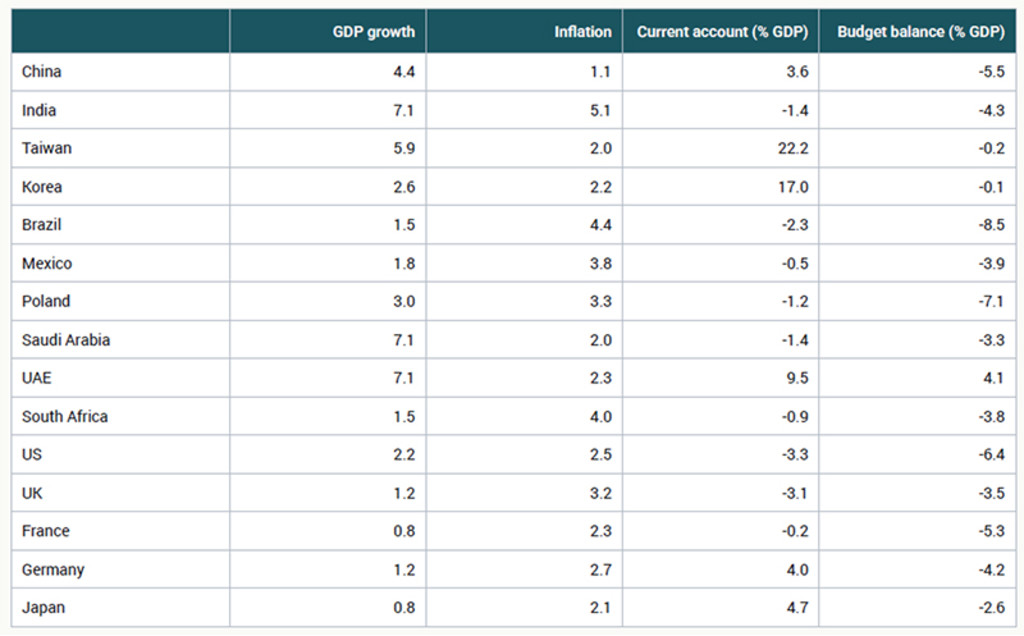
Looking at emerging markets overall, investors remain concerned that higher global interest rates could undermine their performance. Although higher rates pose a risk to global equities, we believe emerging markets are better positioned than during the 2013 “taper tantrum”. Inflation is relatively low, many central banks have maintained prudent monetary policies, current accounts are broadly balanced, and fiscal deficits are now mostly financed domestically.
Table 1: Bloomberg consensus estimates 2027 – higher growth and moderate risk for EM
Source: Bloomberg4, Robeco, as of 9 November 2026.
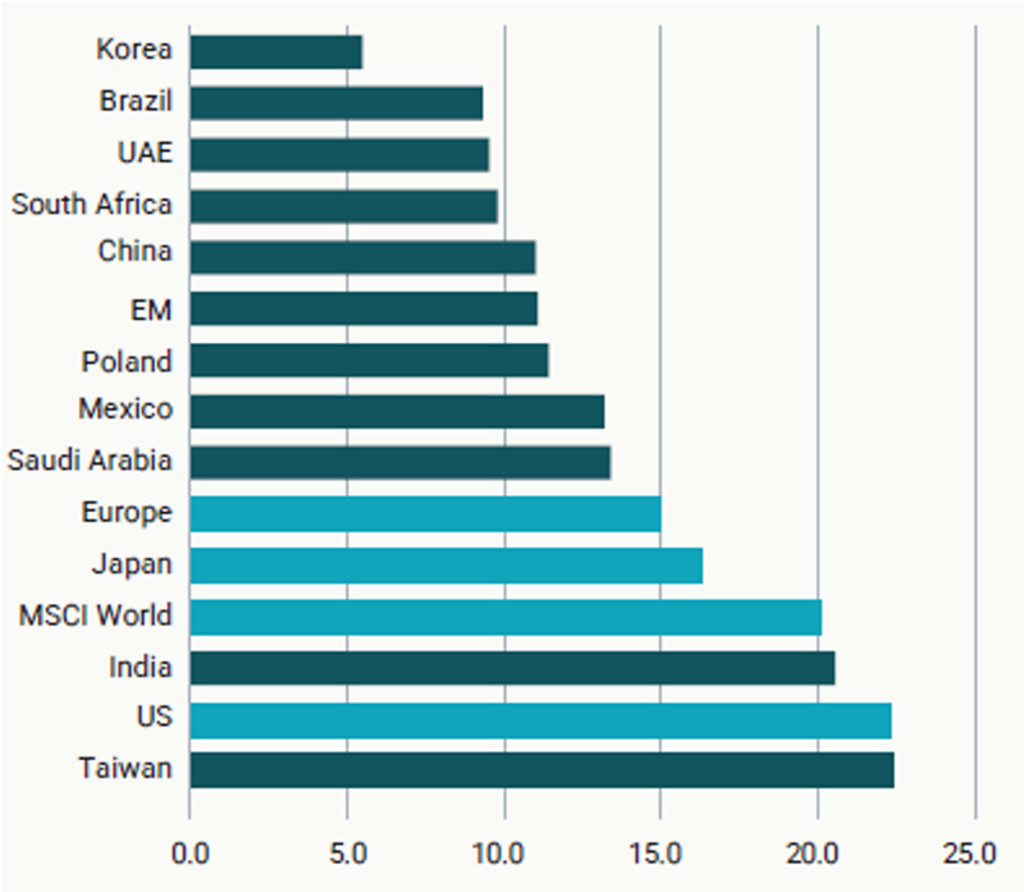
Emerging market valuations also remain attractive. On forward earnings multiples, emerging markets now trade at more than a 40% discount to developed markets. Within emerging markets, Taiwan and India remain relatively expensive, while China, Korea and Brazil trade at more attractive valuations, as do several smaller markets.
Figure 1: 2026 PE Ratios: Emerging markets are significantly cheaper
Source: MSCI, I/B/E/S, FactSet, Robeco, as of October 2026.
In conclusion
Emerging markets offer a dynamic investment environment where we see various good opportunities.5 The AI investment cycle is likely to continue giving real revenues for the emerging markets tech companies, yet equity performance will also depend on relative value and embedded expectations. We are positive on the outlook for Korea, both for technology companies and for non-tech sectors. Valuations have also become more attractive in China, Brazil and India, creating greater scope for positive surprises. Finally, we believe emerging market economies are more resilient than in the past, even if global interest rates continue to rise.
This article was originally published as a special feature in our 2027 Investment Outlook.
Footnotes
1Source: MSCI. The MSCI information may only be used for your internal use, may not be reproduced or redisseminated in any form and may not be used as a basis for or a component of any financial instruments or products or indices. None of the MSCI information is intended to constitute investment advice or a recommendation to make (or refrain from making) any kind of investment decision and may not be relied on as such. Historical data and analysis should not be taken as an indication or guarantee of any future performance analysis, forecast or prediction. The MSCI information is provided on an "as is" basis and the user of this information assumes the entire risk of any use made of this information. MSCI, each of its affiliates and each other person involved in or related to compiling, computing or creating any MSCI information (collectively, the "MSCI Parties") expressly disclaims all warranties (including, without limitation, any warranties of originality, accuracy, completeness, timeliness, non-infringement, merchantability and fitness for a particular purpose) with respect to this information. Without limiting any of the foregoing, in no event shall any MSCI Party have any liability for any direct, indirect, special, incidental, punitive, consequential (including, without limitation, lost profits) or any other damages. (www.msci.com)
2The companies shown on this page are for illustrative purposes only. No inference can be made on the future development of the company. This is not a buy, sell, or hold recommendation.
3Bloomberg consensus estimates for net income for 2026 are USD 229 billion for Nvidia and USD 228 billion for Samsung Electronics
4The following are trademarks and service marks of Bloomberg Finance L.P., a Delaware limited partnership, or its subsidiaries: BLOOMBERG, BLOOMBERG ANYWHERE, BLOOMBERG MARKETS, BLOOMBERG NEWS, BLOOMBERG PROFESSIONAL, BLOOMBERG TERMINAL and BLOOMBERG.COM: Absence of any trademark or service mark from this list does not waive Bloomberg's intellectual property rights in that name, mark or logo. All rights reserved.
5Investing in financial instruments carries risks, including potential loss of your invested capital. Investors may not get back the amount originally invested. Assess your financial situation and risk tolerance carefully and seek independent advice if needed.

The forces beneath the surface
2027 Investment outlook
重要資料
本網站僅供《證券及期貨條例》(香港法例第571章)及其附屬法例所界定之專業投資者瀏覽及使用。 投資涉及風險。過往表現並不代表未來表現。本網站所載資料僅供參考之用,並不構成任何投資建議,亦非作出買賣任何證券或採納任何投資策略之要約或招攬。投資者不應僅憑本網站提供之資料作出投資決定,在作出任何投資決定前,應徵詢獨立意見(包括有關稅務影響之意見)。投資者應確保完全理解投資產品的相關風險,亦應考量自身投資目標及風險承受水平。投資乃閣下之個人決定。除非銷售投資產品的中介人已向閣下告知該投資產品適合閣下,並已解釋其符合閣下投資目標之原因,否則閣下不應投資。請參閱相關發售文件或其他法律文件,以獲取包括風險因素在內的進一步詳情。 本網站由荷寶投資管理香港有限公司發布,該公司受香港證券及期貨事務監察委員會(「證監會」)規管(中央編號:APU851)。本網站未經證監會審閱。 無法保證任何投資產品可實現其投資目標。概不就任何投資產品之表現或投資回報作任何聲明或承諾。投資的價值或會波動。本網站所載過往表現、推算或預測,均不應視作未來表現之保證或指標,且概不提供任何明示或暗示之保證。本網站內容建基於相信為可靠之來源,惟因應資料傳遞技術特性及須採用多項數據來源(包括第三方內容),故概不保證其準確性。所述觀點僅乃截至上述日期,或會隨市況變化而改變,可予更改而毋須另行通知。該等意見可能有別於其他荷寶投資專業人士之意見。因使用本材料或當中所載任何評論、意見或估算而引致之直接、間接或相應損失,荷寶概不承擔法律責任。荷寶並無責任更新本網站或任何網站內容。未經荷寶事先書面許可,不得複製、分發或刊發本網站任何材料。 除非另有說明,資料來源:荷寶。