

Portfolio Manager


• 市場觀點
Diversify your portfolio with Asia-Pacific equities
US markets have made up all the ground lost after the 2 April ‘reciprocal’ tariff announcement, but trade disruption combined with geopolitical tension are here to stay. This period of calm offers investors a clear opportunity to diversify equity exposure into Asia-Pacific, the world’s engine of growth.
作者


Client Portfolio Manager
概要
- Asia-Pacific equity inflows have turned positive in the trade turmoil
- Asian economies will be cushioned by monetary easing and stimulus
- Solid fundamentals and a big valuation discount provide a good starting point
A month is a long time in equity markets. Since 9 April when President Trump announced a 90-day pause in his plan to impose ‘reciprocal’ tariffs on the rest of the world, the S&P 500 has rallied hard. The 90-day détente between the US and China, announced on 12 May, and soft US inflation data on 13 May solidified the US market gains, putting talks of a rotation from US assets on to the back burner.
Given the US’s trading framework agreement with the UK and its 90-day détente with China still imply much higher tariffs levels, we think the euphoria may be premature. The negative impact of Trump’s trade policies will hit the US the hardest and that is not yet reflected in economic data. In previous cycles equity market weakness has translated to US dollar strength in a ‘flight-to-safety’ but that appears to have changed in this cycle with the dollar proving vulnerable to swings in market confidence. Moreover, the US fiscal position is likely to only worsen, with Trump certain to plough revenues from tariffs into tax cuts, and that will be dollar-negative. Global investors remain very overweight US equities and we believe there will be a gradual move to increase allocations to other regions, and especially Asia-Pacific.
Asia-Pacific starting to get inflows
Investors remain very underweight Asia-Pacific equities which is more a reflection of the past decade of US dominance than Asia’s economic fundamentals. However in recent weeks there has been a nascent change in trend with April 2025 inflows into Asia equity ETFs at USD 33.31 billion exceeding those into both US (USD 31.0 billion) and European (USD 9.1 billion) equivalents, indicating the region is a destination for those seeking to diversify. Japan is seen as a particularly attractive market for the ‘de-dollarization’ trade, attracting USD 57 billion into equities and bonds, the biggest monthly inflows since records began.2
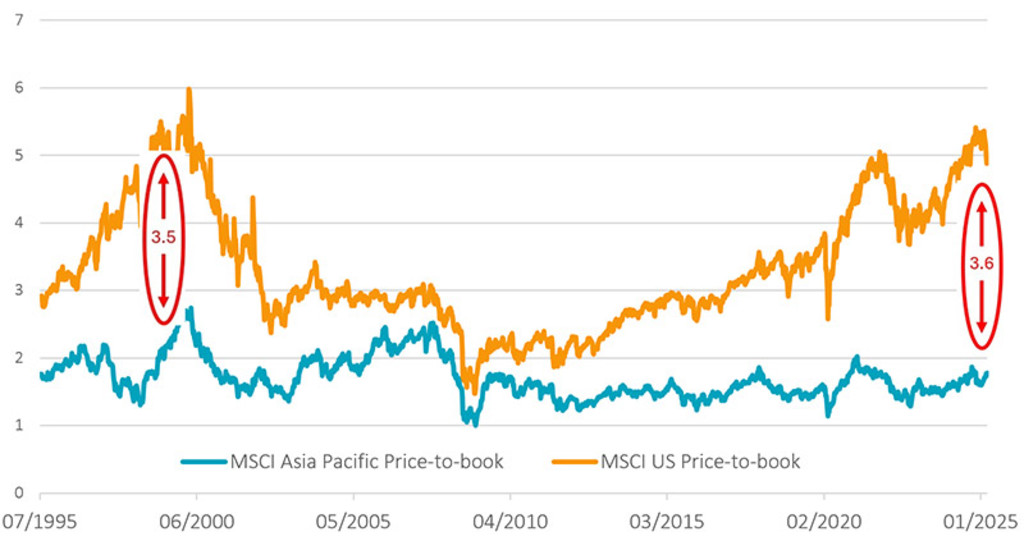
Asia-Pacific equity valuations are close to trough levels compared to the US. On that basis, even given the US tariff headwinds, there is significant value to unlock. For an Asia-Pacific strategy focused on value like ours, this makes the region a target-rich stock-picking environment.
Figure 1: Asian stocks are trading at a deep discount to the US, and history
Source: MSCI, Bloomberg, data to 2 May 2025
Pressure on to reduce US tariffs
Asia-Pacific economies are very exposed to global trade flows with major export economies like Japan, Korea and Taiwan potentially facing very high tariff levels (24%, 26% and 32%, respectively) unless they can agree a framework for reductions by early July when the 90-day reciprocal tariff pause expires. Emerging export-driven economies are in the same boat, with Vietnam (46%), Indonesia (32%), and Thailand (37%) all seeking to negotiate.
Given the détente with China, the Trump administration’s desire to be seen to do deals, and geopolitical leverage via longstanding security ties, we expect the tariff levels to trend toward the baseline 10% Trump originally set. The net effect on trans-Pacific trade will be negative, and economically this is means 2025 Asia-Pacific GDP growth estimations at around 3.7%3 at the start of the year could be difficult to achieve, but growth will still be much higher than projections for the US and Europe.
For the region, the most immediate countervailing policy response will be fiscal expansion in key economies including China, India and Indonesia. Moreover, inflation is already trending lower across the region giving central banks room to ease policy more, especially if the USD weakens further.
Positive Asia fundamentals will attract long-term investors
For investors seeking long-term diversification from an overweight position in US equities, Asia-Pacific equities have a compelling investment thesis. An Asia-Pacific portfolio gives exposure to developed markets like Australia and Singapore as well as emerging markets like Indonesia and India across all sectors from commodities and industrials to technology, financials and consumer discretionary.
Industrial powerhouses
We believe exposure to the North Asian industrial economies of China, South Korea, Taiwan and Japan is essential, with world-class companies and an increased focus on shareholder value. Japan remains the Robeco Asia-Pacific Equities strategy’s largest overweight. Reasonable valuations, increased shareholder returns, governance reform, and structural reform are all reasons to remain positive on the country. South Korea’s ‘value up’ initiative is at an earlier stage but should have a similar impact on corporate governance there.
Confidence in China’s international competitiveness and continued ability to innovate was boosted in January 2025 by the release of the DeepSeek Large Language Model (LLM), which was developed at lower cost than similar LLMs from the US. China is already capitalizing on advantages like rapid adoption of new technologies, a vast domestic market, and an unrivaled manufacturing base, to lead in key industries including electric vehicles and renewable energy. In these markets where you potentially have declining populations, Robeco’s Asia-Pacific Equities strategy focuses on optimizing capital and investing selectively, where the return on invested or the marginal return on invested capital is high.
新興市場的新機會
訂閱我們的電子報,深入了解新興市場投資機會。
Dynamic emerging economies
In the emerging markets of Southeast Asia where the population is rising, increasing technology adoption and mass consumption are underpinning domestic-driven growth to complement traditional strength in commodities and manufacturing. Recent weakness due to fears over the impact of US tariffs is providing good entry points for long-term opportunities that fit into our value-driven investment process. In contrast, India equities are richly valued compared to Asian peers so we are being very selective and remain underweight the country. Nevertheless, India is building on its economic momentum by extending its manufacturing base, with trade deals with the UK, and perhaps later in the year with the US, helping. From the market peak in 2024 Indian equities have underperformed Asian peers. Combined with the recent tension with Pakistan, this has brought valuations to more reasonable levels, so we are now gradually increasing our India exposure.
Valuation gap will close
Our conviction is that the enormous valuation gap between Asia-Pacific and the US will narrow in 2025 and beyond. It is crucial to focus on the fundamentals and take advantage of the volatility to identify medium-term alpha opportunities. We believe an active approach with a tested stock selection process is the best way to build and hold long-term exposure to Asia-Pacific equities.
Footnotes
1 Source: Bloomberg – May 12 2025
2 Foreigners snap up $57bn in Japan assets in ‘liberation day’ rush – FT – 14 May 2025
3 Moody’s Analytics 2025 Macro Outlook – November 2024
重要資料
本網站僅供《證券及期貨條例》(香港法例第571章)及其附屬法例所界定之專業投資者瀏覽及使用。 投資涉及風險。過往表現並不代表未來表現。本網站所載資料僅供參考之用,並不構成任何投資建議,亦非作出買賣任何證券或採納任何投資策略之要約或招攬。投資者不應僅憑本網站提供之資料作出投資決定,在作出任何投資決定前,應徵詢獨立意見(包括有關稅務影響之意見)。投資者應確保完全理解投資產品的相關風險,亦應考量自身投資目標及風險承受水平。投資乃閣下之個人決定。除非銷售投資產品的中介人已向閣下告知該投資產品適合閣下,並已解釋其符合閣下投資目標之原因,否則閣下不應投資。請參閱相關發售文件或其他法律文件,以獲取包括風險因素在內的進一步詳情。 本網站由荷寶投資管理香港有限公司發布,該公司受香港證券及期貨事務監察委員會(「證監會」)規管(中央編號:APU851)。本網站未經證監會審閱。 無法保證任何投資產品可實現其投資目標。概不就任何投資產品之表現或投資回報作任何聲明或承諾。投資的價值或會波動。本網站所載過往表現、推算或預測,均不應視作未來表現之保證或指標,且概不提供任何明示或暗示之保證。本網站內容建基於相信為可靠之來源,惟因應資料傳遞技術特性及須採用多項數據來源(包括第三方內容),故概不保證其準確性。所述觀點僅乃截至上述日期,或會隨市況變化而改變,可予更改而毋須另行通知。該等意見可能有別於其他荷寶投資專業人士之意見。因使用本材料或當中所載任何評論、意見或估算而引致之直接、間接或相應損失,荷寶概不承擔法律責任。荷寶並無責任更新本網站或任何網站內容。未經荷寶事先書面許可,不得複製、分發或刊發本網站任何材料。 除非另有說明,資料來源:荷寶。