Strategist
獲取最新市場觀點
訂閱我們的電子報,時刻把握投資資訊和專家分析。




Uncertainty about the global inflationary consequences of the trade policies of the new US administration is high.





Against this backdrop we expect the key central banks to remain on separate lanes when it comes to their monetary policy settings in the months ahead.
The Federal Reserve seems to have adopted a wait-and-see stance as inflation remains above target and labor market conditions solid. But with the policy stance still viewed as restrictive, it retains an easing bias. Accordingly, and given the risk of a renewed rise in unemployment, our central scenario sees the Fed resume the descent back to ‘neutral’ by mid-year. The risk case is that imposed tariffs ignite inflation expectations, in which case a more prolonged pause beckons (the odds of the next move being a hike seem muted in our view).
Meanwhile, the ECB is sticking to a 25 bps per meeting cutting pace. And any tariffs imposed on Europe, on balance, will likely reinforce its ambitions to bring the depo rate back to 2% or below.
Elsewhere, the PBoC, despite earlier hints at further rate and RRR cuts, has steered money market rates higher to rein in the bond rally. In our view, the pledged easing will still be delivered, but timing remains uncertain and is being complicated by the tariff tussle between the US and China. Bucking the direction of travel of other DM central banks, the BoJ remains on a gradual hiking path – as Governor Ueda’s recent comments demonstrate –and is expected to deliver two additional 25 bps rate increases this year.
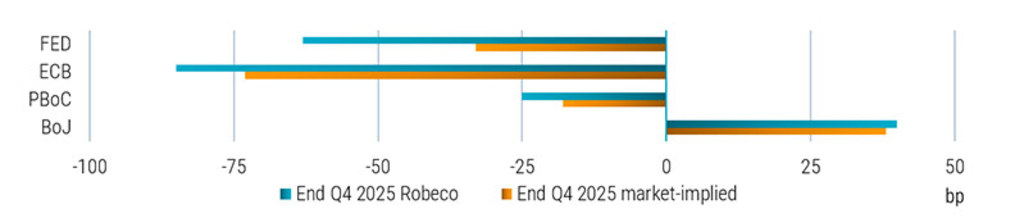
Source: Bloomberg, Robeco, based on money market futures and forwards, 20 February 2025
訂閱我們的電子報,時刻把握投資資訊和專家分析。
本網站僅供《證券及期貨條例》(香港法例第571章)及其附屬法例所界定之專業投資者瀏覽及使用。 投資涉及風險。過往表現並不代表未來表現。本網站所載資料僅供參考之用,並不構成任何投資建議,亦非作出買賣任何證券或採納任何投資策略之要約或招攬。投資者不應僅憑本網站提供之資料作出投資決定,在作出任何投資決定前,應徵詢獨立意見(包括有關稅務影響之意見)。投資者應確保完全理解投資產品的相關風險,亦應考量自身投資目標及風險承受水平。投資乃閣下之個人決定。除非銷售投資產品的中介人已向閣下告知該投資產品適合閣下,並已解釋其符合閣下投資目標之原因,否則閣下不應投資。請參閱相關發售文件或其他法律文件,以獲取包括風險因素在內的進一步詳情。 本網站由荷寶投資管理香港有限公司發布,該公司受香港證券及期貨事務監察委員會(「證監會」)規管(中央編號:APU851)。本網站未經證監會審閱。 無法保證任何投資產品可實現其投資目標。概不就任何投資產品之表現或投資回報作任何聲明或承諾。投資的價值或會波動。本網站所載過往表現、推算或預測,均不應視作未來表現之保證或指標,且概不提供任何明示或暗示之保證。本網站內容建基於相信為可靠之來源,惟因應資料傳遞技術特性及須採用多項數據來源(包括第三方內容),故概不保證其準確性。所述觀點僅乃截至上述日期,或會隨市況變化而改變,可予更改而毋須另行通知。該等意見可能有別於其他荷寶投資專業人士之意見。因使用本材料或當中所載任何評論、意見或估算而引致之直接、間接或相應損失,荷寶概不承擔法律責任。荷寶並無責任更新本網站或任何網站內容。未經荷寶事先書面許可,不得複製、分發或刊發本網站任何材料。 除非另有說明,資料來源:荷寶。
警告 — 有不法分子在網站及社交媒體上冒用荷寳 了解更多