

Client Portfolio Manager
• 市場觀點
Asia’s sustainability drive is accelerating
The megashift toward sustainable economies and lifestyles is top of mind for political and business leaders in Asia, with COP28 proving the region is now setting the pace for the energy transition.
作者


Portfolio Manager
概要
- COP28 confirmed China and India are calibrating the speed of transition from fossil fuels‘
- Value Up’ initiatives spreading from Tokyo to Seoul could see magnifying effect throughout emerging Asia
- Trough valuations mean 2024 will be a pivotal year to position in sustainable Asia ex-Japan opportunities
A select group of stocks in Asia with strong business models and positive earnings outlooks as Asian countries re-tool for a sustainable future are now available at trough valuations. This narrative goes beyond the energy transition to encompass how life will be lived in the coming decades as Asia emerges as the dominant economic continent globally. Key themes that focus more on Asia’s growing wealth include healthy living and financial inclusion, underpinned by technology.
As a result, we believe Asia is well positioned to capture the next wave of technology advancement and we find attractively valued exposures throughout the supply chain in the region. We also find the trend toward healthy living in Asia offers exciting long-term winners that will grow with an increasing awareness and demand of a sustainable lifestyle. Financial inclusion and growth of wealth in Asia will drive profits to the best positioned financials companies in the coming decade, whether it is insurance, retail banking or fintech.
COP followed China and India approach to net zero
The headline at COP28 in Dubai in December 2023 was an agreement to transition away from fossil fuels, plus global targets to triple the capacity of renewable energy like wind and solar power, and to double the rate of energy efficiency improvements, both by 2030. This fits right in with China’s existing roadmap which commits to peak CO₂ emissions by 2030 and net-zero emissions by 2060, and it is likely to easily achieve its contribution to the targets to increase renewables, based on the current 5-year plan. China’s State-Owned-Enterprises, which account for more than half of the country’s GDP, are also embracing the transition, helping China achieve its goals and providing capital for innovation that will also benefit private sector players.
For example, our portfolio holding China Yangtze Power built pumped energy storage on its current hydro power stations in Jiangsu with peak adjustment power of 200 MW and 400 MWh storage capacity, which supports 2000 MW of solar projects in the region. More projects are under construction, such as a 1.4 GW storage project in Gansu. Similarly, India will appreciate the flexibility in the COP agreement, allowing it to continue to use fossil fuels in the short-to-medium term to support its rapid growth and fund its own energy transition.
The proactive stance toward sustainability across corporate Asia is being reflected in capital raising. Issuance of sustainable bonds in the Asia-Pacific region in the first nine months of 2023 grew 17% to USD 172 billion year on year, outpacing the 4% growth recorded globally, according to MSCI. We have also increased our exposure to renewable utilities in the Asian region where attractive valuations allow us, and believe the region’s lead in the development and production of these technologies will only increase as this decade progresses.
Technology at the centre of Asia’s sustainable economic ambitions
Beyond energy supply, the core of Asia’s sustainability drive is technology and some of the largest holdings in our strategy are the enablers and realizers of artificial intelligence (AI), robotics, automation, and the Internet of Things. These technologies are key to improved energy and resource use efficiency in traditional sectors like transport, manufacturing, finance, healthcare and agriculture. Enablers include global leading companies in processing and memory semiconductor design and manufacturing in Taiwan and South Korea.
We also like some of China’s internet titans which hold the same scale and leadership advantages as US peers, but trade at much lower valuations. Application of AI in content creation will accelerate revenue growth while keeping cost on par in for example gaming and TV productions, benefiting players with strong content franchise. We remain positive on this sector as beneficiaries of AI and as content exporters.
Financial inclusion is accelerating Asia’s growth and brings societal benefits
Technology is also driving one of our key themes, financial inclusion. While the Sustainable Asian Stars strategy has the largest country exposure to North Asian powers China, Korea and Taiwan, financial inclusion is focused on the growing middle class in countries like India and Indonesia, where the increased availability of digital financial services is both driving innovation, and helping traditional banks, insurers and finance companies grow their customer universe. This is a virtuous circle as it brings more of the population into the organized economy, with obvious societal and macroeconomic benefits. The challenge of financial inclusion has morphed into a value-generating opportunity, a clear example of how sustainable investing in Asia can both capture financial returns and drive change. We like financials with a prudent capital buffer, attractive valuations and structural growth potential in the region.
Asia leads in smart mobility
The recent confirmation that China’s BYD overtook Tesla as the world’s largest EV producer was no surprise, and confirms the region has an unassailable lead in the EV supply chain including batteries. We are skewed towards Korean companies in this area due to their reduced geopolitical risks, despite richer valuations.
‘Value Up’ to improve corporate governance and narrow valuation discount
Corporate governance has long been considered as a major reason for Asian stocks trading at a discount to their developed market peers, but there is a mindset change for Asian regulators and corporates already underway. At a historic moment when the Nikkei reached new record highs after three decades in the doldrums, the Tokyo Stock Exchange’s initiative to push better balance sheet management is echoing across Asia. Following President Yoon’s comment for the need to reduce the ‘Korea Discount’, in January 2024, the Korean financials regulator disclosed that it is evaluating regulatory actions against companies that are trading at below 1.0x price-to-book ratio. Korean financials and conglomerate shares rallied following this announcement.
Acknowledging the cyclical nature of Korean earnings and the time it takes for the society to change their views on shareholder returns, there are companies very well positioned to lead the ‘Value Up’ initiative in Korea. China States Council and SASAC (State own Assets Supervision and Administration Commission) also announced in January 2024 that it would promote the inclusion of market value into the KPIs of Chinese SOEs. Self-help stories such as balance sheet value un-locking and improving shareholder returns through dividend and share buybacks enhance alpha, and represent another reason why sustainable investors should increase allocations to Asia equities.
Conclusion: Subdued sentiment despite the strong outlook
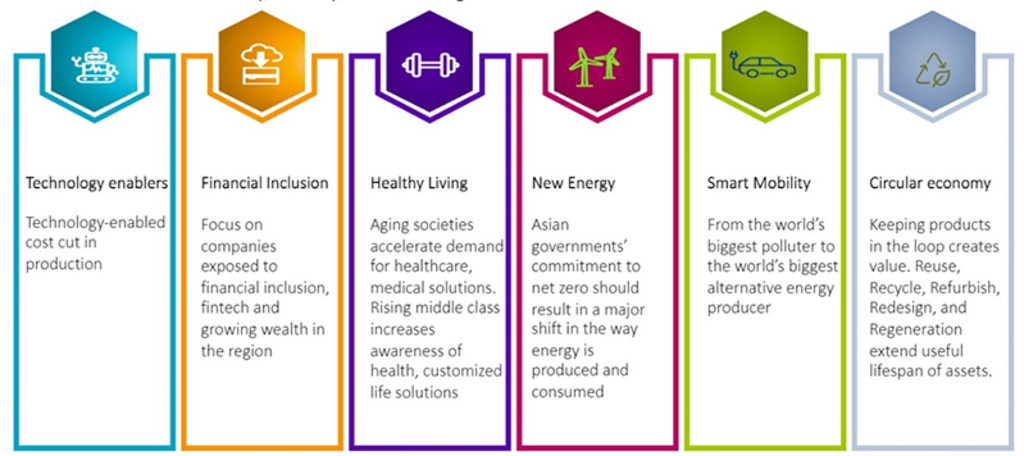
The backdrop of geopolitical fears and global macroeconomic worries has left sentiment on Asian equities unjustifiably weak with valuations still close to historical trough levels. This creates a universe of opportunity for stock pickers in Asia. Combined with the ongoing political and societal momentum behind sustainability in Asia, we believe this is an opportune time to build or extend exposure to the region, through a sustainable lens. Our Sustainable Asian Stars strategy is a high-conviction, active investment approach that is appropriate for the current volatile environment. We are excited about the diverse themes including technology enablers, financial inclusion, healthy living, new energy, smart mobility, and circular economy that we have summarized below.
Key investment themes in the Robeco Sustainable Asian Stars strategy
獲取最新市場觀點
訂閱我們的電子報,時刻把握投資資訊和專家分析。
重要資料
本網站僅供《證券及期貨條例》(香港法例第571章)及其附屬法例所界定之專業投資者瀏覽及使用。 投資涉及風險。過往表現並不代表未來表現。本網站所載資料僅供參考之用,並不構成任何投資建議,亦非作出買賣任何證券或採納任何投資策略之要約或招攬。投資者不應僅憑本網站提供之資料作出投資決定,在作出任何投資決定前,應徵詢獨立意見(包括有關稅務影響之意見)。投資者應確保完全理解投資產品的相關風險,亦應考量自身投資目標及風險承受水平。投資乃閣下之個人決定。除非銷售投資產品的中介人已向閣下告知該投資產品適合閣下,並已解釋其符合閣下投資目標之原因,否則閣下不應投資。請參閱相關發售文件或其他法律文件,以獲取包括風險因素在內的進一步詳情。 本網站由荷寶投資管理香港有限公司發布,該公司受香港證券及期貨事務監察委員會(「證監會」)規管(中央編號:APU851)。本網站未經證監會審閱。 無法保證任何投資產品可實現其投資目標。概不就任何投資產品之表現或投資回報作任何聲明或承諾。投資的價值或會波動。本網站所載過往表現、推算或預測,均不應視作未來表現之保證或指標,且概不提供任何明示或暗示之保證。本網站內容建基於相信為可靠之來源,惟因應資料傳遞技術特性及須採用多項數據來源(包括第三方內容),故概不保證其準確性。所述觀點僅乃截至上述日期,或會隨市況變化而改變,可予更改而毋須另行通知。該等意見可能有別於其他荷寶投資專業人士之意見。因使用本材料或當中所載任何評論、意見或估算而引致之直接、間接或相應損失,荷寶概不承擔法律責任。荷寶並無責任更新本網站或任何網站內容。未經荷寶事先書面許可,不得複製、分發或刊發本網站任何材料。 除非另有說明,資料來源:荷寶。