

Chief Researcher


• 市場觀點
Mind the gap: Effectively replacing sustainability exclusions
Sustainable investors commonly exclude the least sustainable companies, but in doing so create a gap in the portfolio. Our latest research compares various methods to replace these excluded stocks.
作者




Researcher

Researcher
概要
- Excluding unsustainable stocks leaves a gap that needs to be filled
- Naïve rescaling of the remaining stocks is inefficient, research shows
- We aim for better performance by using more sophisticated approaches
When it comes to sustainable investing, common examples of exclusions include the tobacco industry, companies involved with controversial weapons and thermal coal producers. However, exclusions can also be implicit, such as constraints on the carbon footprint or ESG score of the portfolio which necessitate divesting from certain stocks that score poorly on these metrics.
These exclusions result in underweight positions compared to the market portfolio, leaving a gap to be filled. In order to remain fully invested, sustainable investors must replace such underweights with overweight positions in other stocks. There are several ways to go about this, each with its own pros and cons. Since active decision making is required, sustainable investing is, by its nature, active investing; see also Blitz and de Groot (2019). The purpose of our recent research is to compare the financial performance of various methods used to replace excluded stocks.
Three approaches
The base-case, ‘naïve’ approach is to rescale the weights of remaining stocks in proportion to their market capitalizations. One concern is that this method can inadvertently bet against proven factors. Another issue is that rescaling often replaces stocks like utilities companies with heavyweight tech stocks like Apple, Microsoft, and Alphabet, introducing significant tracking error.
Our first alternative approach aims to minimize the tracking error resulting from exclusions, striving to realign closely with the return of the market index. The second alternative uses the forced underweights from exclusions to buy stocks with attractive factor characteristics, with the goal of maximizing risk-adjusted returns. In the appendix to our research we also explore a third alternative, which involves replacing exclusions with highly sustainable stocks, using alternative energy stocks as a concrete example.
Methodology and findings
For our empirical analyses, we consider two types of exclusions: carbon footprint constraints and exclusions based on Sustainable Development Goal (SDG) scores. For the carbon footprint constraint, we explore reductions of 50%, 60%, 70%, or 80% compared to the benchmark index. The SDG data is drawn from Robeco’s proprietary SDG framework, with scores ranging from -3 (worst) to +3 (best). Our sample encompasses the MSCI World (developed markets) universe from January 2006 to December 2022.
For instance, portfolios with exclusions underperformed by 2 to 4% in 2022 alone
Our initial analysis shows that the naïve approach doesn't significantly affect long-term performance, but it does introduce a large amount of tracking error. For instance, portfolios with exclusions underperformed by 2 to 4% in 2022 alone, and over periods of two to five years, such exclusions can even lead to return differences of more than 10%.
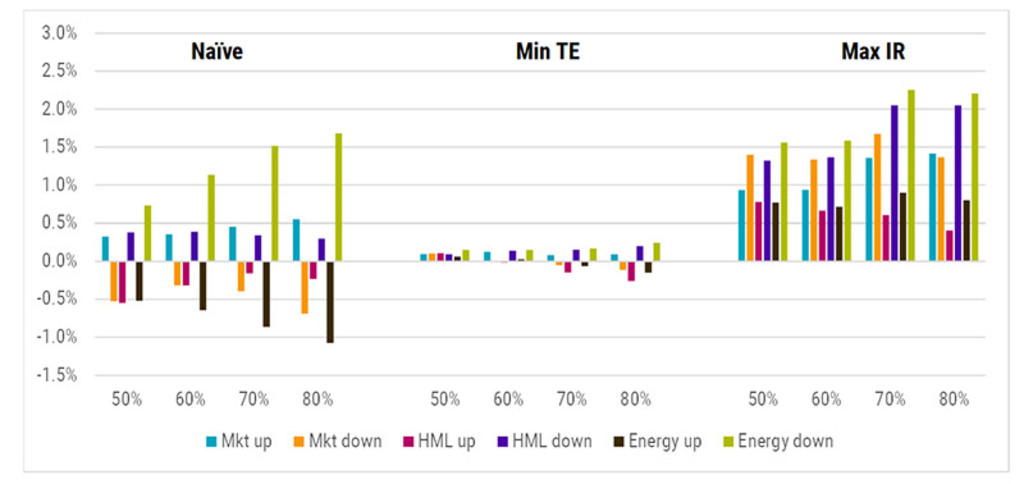
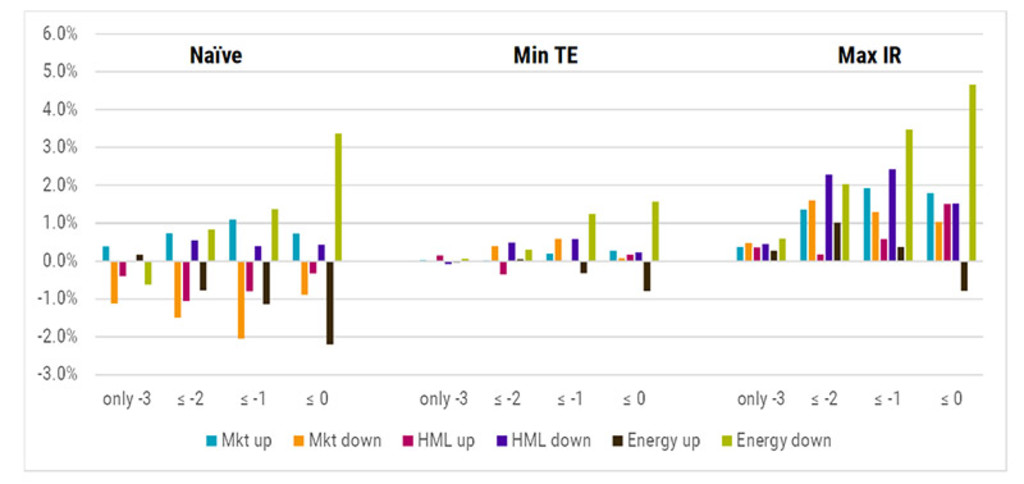
We then deploy our two advanced approaches: one minimizing tracking error and the other maximizing return. The former reduces tracking error by 50-70% for carbon constraints and 30-50% for SDG exclusions. The latter focuses on maximizing factor exposure, leading to net information ratios of about 1, signifying decent outperformances. Figure 1 compares these approaches in terms of carbon constraint and Figure 2 in terms of SDG exclusions.
Figure 1: Conditional performance of portfolios with carbon constraints
Source: Robeco
Figure 2: Conditional performance of portfolios with SDG exclusions
Source: Robeco
We find that compared to the naïve approach, both alternatives are less sensitive to various market environments. The return-optimized portfolios, in particular, manage to achieve positive expected returns in almost every scenario.
Conclusion
Sustainable investing involves exclusions that require careful portfolio rebalancing. Our research suggests that a simple rescaling approach can be inefficient and introduces unnecessary risk. However, more sophisticated approaches, either minimizing tracking error or maximizing returns, can significantly improve performance.
重要資料
本網站僅供《證券及期貨條例》(香港法例第571章)及其附屬法例所界定之專業投資者瀏覽及使用。 投資涉及風險。過往表現並不代表未來表現。本網站所載資料僅供參考之用,並不構成任何投資建議,亦非作出買賣任何證券或採納任何投資策略之要約或招攬。投資者不應僅憑本網站提供之資料作出投資決定,在作出任何投資決定前,應徵詢獨立意見(包括有關稅務影響之意見)。投資者應確保完全理解投資產品的相關風險,亦應考量自身投資目標及風險承受水平。投資乃閣下之個人決定。除非銷售投資產品的中介人已向閣下告知該投資產品適合閣下,並已解釋其符合閣下投資目標之原因,否則閣下不應投資。請參閱相關發售文件或其他法律文件,以獲取包括風險因素在內的進一步詳情。 本網站由荷寶投資管理香港有限公司發布,該公司受香港證券及期貨事務監察委員會(「證監會」)規管(中央編號:APU851)。本網站未經證監會審閱。 無法保證任何投資產品可實現其投資目標。概不就任何投資產品之表現或投資回報作任何聲明或承諾。投資的價值或會波動。本網站所載過往表現、推算或預測,均不應視作未來表現之保證或指標,且概不提供任何明示或暗示之保證。本網站內容建基於相信為可靠之來源,惟因應資料傳遞技術特性及須採用多項數據來源(包括第三方內容),故概不保證其準確性。所述觀點僅乃截至上述日期,或會隨市況變化而改變,可予更改而毋須另行通知。該等意見可能有別於其他荷寶投資專業人士之意見。因使用本材料或當中所載任何評論、意見或估算而引致之直接、間接或相應損失,荷寶概不承擔法律責任。荷寶並無責任更新本網站或任何網站內容。未經荷寶事先書面許可,不得複製、分發或刊發本網站任何材料。 除非另有說明,資料來源:荷寶。