
Head of SI Thought Leadership and Climate & Biodiversity Strategist


• Climate Survey
Survey shows biodiversity rises in importance for investors
More than half of investors plan to make biodiversity a significant part of their investment policy, Robeco’s Global Climate Survey has revealed.
作者

概要
- 56% of investors will make biodiversity a core strategy in the next two years
- 79% complain of low awareness of the financial implications of biodiversity loss
- Large interest in investments that can help as their impact can be assessed
However, almost four in five respondents said there was a general lack of awareness of the financial implications of biodiversity loss, which is making it difficult to implement clear nature-friendly investment policies.
And almost three in four said investors do not have a way to assess the impact of investment decisions on biodiversity, led by a lack of data that also bedevils other attempts to pursue sustainable investing strategies such as net zero emissions.
These were key findings of the 2022 survey, the second of its kind to ask 300 investors with a combined USD 23.7 trillion in assets under management for their views on everything from climate change and engagement, to attitudes to the SDGs. This year a special section was included to garner opinions about biodiversity.
In January, Robeco published a white paper outlining its approach to biodiversity from all angles, and began a partnership with the World Wide Fund for Nature Netherlands to assist with its further integration into the investment process.
Perhaps the greatest revelation was the number of investors who now treat biodiversity seriously. Although crucial to maintaining the ecosystems on which all economic activity depends, biodiversity in the past has been seen as either a minor issue, or something that investors thought difficult to approach from a financial perspective.
Some 56% of investors said biodiversity will be at the center of, or a significant factor in, their investment policy in the next two years, while 41% have it playing a major role today. Regarding their motivation, 65% of wholesale investors and 52% of all those polled said they wanted to reduce long-term systemic risks associated with biodiversity loss, such as wide-scale deforestation and overly exploited ocean life.
The main findings of the biodiversity questions in the survey
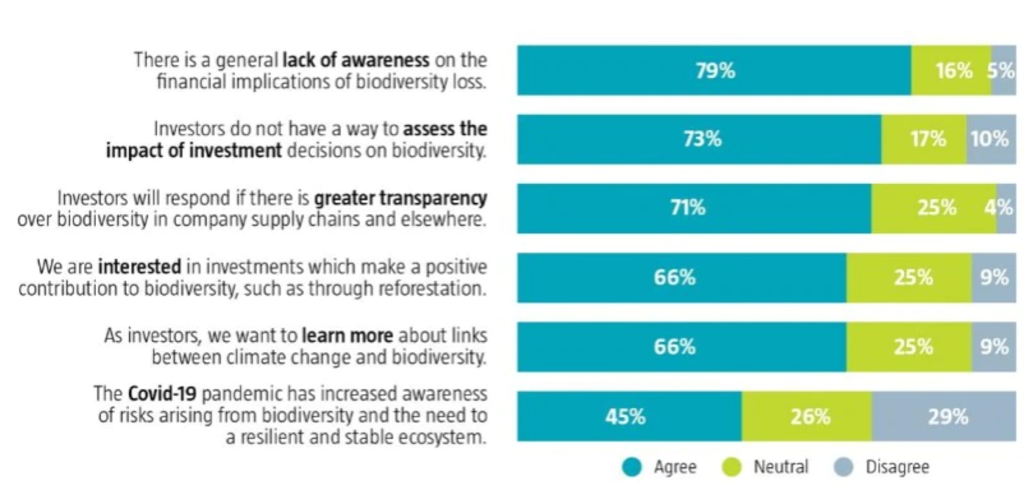
Source: Robeco, CoreData
What to invest in
So, what to invest in? Some 63% said food security and nutrition were good options, while 62% went for sustainable agribusiness. And 40% wanted to see more thematic investing offerings related to biodiversity – Robeco is working to launch such as strategy later this year.
Aside from direct investment, engaging with companies was seen as being important by 46% of those surveyed, while 37% said investors should work more with environmental organizations (such as the WWF-NL) to make an impact. Some 34% said exclusions or divestments should be used more often for the worst offenders on biodiversity.
Problems remain
However, keenness to get involved is not matched by the ability to do so. Some 79% said there is a general lack of awareness on the financial implications of biodiversity loss, partly due to difficulties in quantifying it on the bottom line. Some 73% said they do not have a way to assess the impact of investment decisions on biodiversity, and 50% cited a lack of data, reporting and ratings on biodiversity as an obstacle to taking account of it in investment portfolios.
Support for biodiversity investments is also not as high as it is for climate change. Only 36% said they had seen demand for it from their own stakeholders, while the same figure said they believed biodiversity was the next major trend. For climate change, a clear majority said both were relevant.
Global Climate Investing Survey 2022: Engagement and biodiversity
‘The next big thing’
“Biodiversity is often referred to as ‘the next big thing’, and this is reflected in the findings of our survey,” says Lucian Peppelenbos, Climate Strategist at Robeco. “A majority of investors are prioritizing biodiversity: they understand well how the global economy and financial markets are embedded in and dependent on the biosphere.”
“But they are struggling to make it concrete and operational in their portfolios. Because how does one link these impacts to individual issuers, and how do you aggregate this in portfolios? That’s the ‘million dollar question’.”
Building knowledge
“At Robeco, we recognized this challenge and initiated our biodiversity roadmap two years ago. In the first instance, our focus was on building knowledge and understanding the data, through partnerships such as with the University of Cambridge and more recently with the World Wide Fund for Nature Netherlands. Currently we are trialling data sources, building biodiversity investment strategies and developing an overall framework to address biodiversity across our portfolios.”
“Building on the momentum in the industry, we hope to come to tangible results in 2022 so that we can make a real difference for biodiversity through our investments.”
了解最新的可持續性市場觀點
訂閱我們的電子報,探索塑造可持續投資的趨勢。
重要資料
本網站僅供《證券及期貨條例》(香港法例第571章)及其附屬法例所界定之專業投資者瀏覽及使用。 投資涉及風險。過往表現並不代表未來表現。本網站所載資料僅供參考之用,並不構成任何投資建議,亦非作出買賣任何證券或採納任何投資策略之要約或招攬。投資者不應僅憑本網站提供之資料作出投資決定,在作出任何投資決定前,應徵詢獨立意見(包括有關稅務影響之意見)。投資者應確保完全理解投資產品的相關風險,亦應考量自身投資目標及風險承受水平。投資乃閣下之個人決定。除非銷售投資產品的中介人已向閣下告知該投資產品適合閣下,並已解釋其符合閣下投資目標之原因,否則閣下不應投資。請參閱相關發售文件或其他法律文件,以獲取包括風險因素在內的進一步詳情。 本網站由荷寶投資管理香港有限公司發布,該公司受香港證券及期貨事務監察委員會(「證監會」)規管(中央編號:APU851)。本網站未經證監會審閱。 無法保證任何投資產品可實現其投資目標。概不就任何投資產品之表現或投資回報作任何聲明或承諾。投資的價值或會波動。本網站所載過往表現、推算或預測,均不應視作未來表現之保證或指標,且概不提供任何明示或暗示之保證。本網站內容建基於相信為可靠之來源,惟因應資料傳遞技術特性及須採用多項數據來源(包括第三方內容),故概不保證其準確性。所述觀點僅乃截至上述日期,或會隨市況變化而改變,可予更改而毋須另行通知。該等意見可能有別於其他荷寶投資專業人士之意見。因使用本材料或當中所載任何評論、意見或估算而引致之直接、間接或相應損失,荷寶概不承擔法律責任。荷寶並無責任更新本網站或任何網站內容。未經荷寶事先書面許可,不得複製、分發或刊發本網站任何材料。 除非另有說明,資料來源:荷寶。