

Chief Researcher


• 研究
The implications of divesting from fossil fuel stocks
Excluding fossil fuel companies from a portfolio comes down to an active bet against the oil price. This exposes the portfolio to significant risk of under performance in the short and medium term.
作者



概要
- Several major asset owners are divesting from fossil fuel stocks
- This amounts to an active bet against oil, given the lack of a suitable hedge
- It carries the risk of prolonged underperformance during energy and oil rallies
In recent years, the growing sense of urgency about climate change has intensified the drive to tackle the issue and mitigate its effects. To this end, the financial industry is seen as having a critical role to play in enabling decarbonization. Against this backdrop, several large institutional investors have either divested from fossil fuel stocks or announced their intention to do so.1 That said, it is worth being cognizant of the portfolio implications of precluding investments in such companies.
In recent years, the growing sense of urgency about climate change has intensified the drive to tackle the issue and mitigate its effects. To this end, the financial industry is seen as having a critical role to play in enabling decarbonization. Against this backdrop, several large institutional investors have either divested from fossil fuel stocks or announced their intention to do so.1 That said, it is worth being cognizant of the portfolio implications of precluding investments in such companies.
In our research,2 we examined the effect that the exclusion of fossil fuel stocks has on the systematic risk exposure of equity portfolios. We focused on macroeconomic risk factors that explain large differences in short and medium-term returns. Our sample period spanned from January 1995 to December 2021. Given that fossil fuel divestments tend to focus on oil and gas companies, we used the energy industry as a proxy for our study. Figure 1 shows that the sector exhibits an exceptionally high beta towards changes in oil prices, i.e. fossil fuel prices.
Figure 1 | Estimated oil betas of global sector indices, January 1995 to December 2021
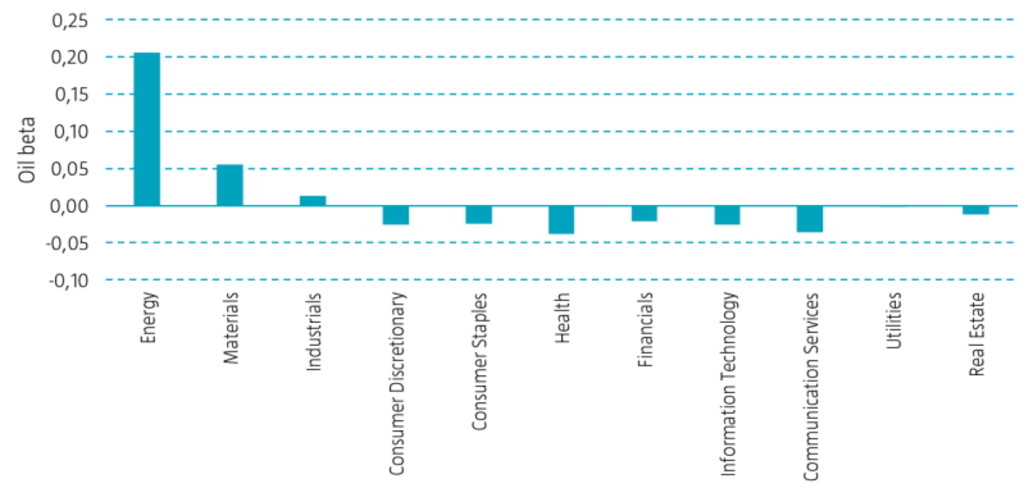
Robeco Quantitative Research, Refinitiv Datastream. The chart uses monthly USD returns for the MSCI World Index and the 11 GICS level 1 sectors, as well as monthly oil price data for the period January 1995 to December 2021.
To get a better feel for the economic relevance of the oil exposure of the energy sector, we examined how it performed during oil bull and bear markets. We saw that the bull and bear scenarios accounted for 61% and 39% of the sample period, respectively. As depicted in Figure 2, the energy industry strongly outperformed during oil bull markets and severely underperformed during oil bear markets, in line with its high oil beta.
Figure 2 | Sector performance relative to market during oil bull regimes versus bear regimes, January 1995 to December 2021
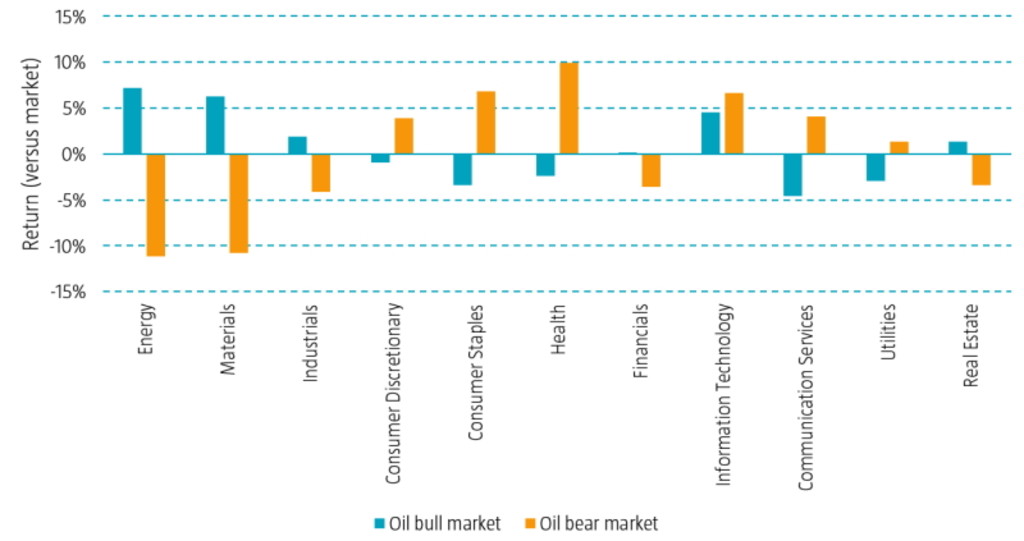
Robeco Quantitative Research, Refinitiv Datastream. The chart uses monthly USD returns for the MSCI World Index and the 11 GICS level 1 sectors, as well as monthly oil price data for the period January 1995 to December 2021.
Surprisingly, the materials sector delivered a similar pattern of returns, despite having a much smaller oil beta. This result suggests that it could serve as a good substitute for the energy sector. However, it is doubtful whether it qualifies as an acceptable alternative for investors who wish to divest from fossil fuel stocks, because, like energy, the materials sector has high carbon emissions and a range of environmental issues.
The next best hedge appeared to be the industrials segment, but the sector generated significantly less pronounced returns during oil bull and bear regimes. Moreover, it also contains many firms with high carbon footprints, such as airplane manufacturers and airline companies. The remaining industries exhibited the opposite sensitivity to oil price changes, i.e. they underperformed during oil bull markets and outperformed during oil bear markets.
Aside from the equity market, oil futures present another hedging option. By systematically going long oil futures, positive returns are achieved during oil bull phases and negative returns during oil bear regimes, similar to the market-relative performance of the energy sector. However, if the purpose of excluding energy stocks is to divest from fossil fuels, then oil futures are unlikely to be considered as an acceptable solution.
Therefore, divesting from fossil fuel stocks entails actively betting against oil, as it seems as if this risk cannot be hedged without taking on other (implicit or explicit) forms of fossil fuel exposure.
了解最新的可持續性市場觀點
訂閱我們的電子報,探索塑造可持續投資的趨勢。
As with oil-market cycles, so also for energy bull and bear markets
We also investigated how various industries performed in energy bull and bear markets. Although the results were generally similar to the oil bull and bear market phases (there is a 74% overlap), the two regime classifications are not entirely synchronous. Roughly speaking, the energy sector generated strong outperformance until mid-2008, after which it became a steady underperformer. The bull and bear scenarios each comprised 50% of the sample period.
Interestingly, the energy industry had almost identical returns compared to the market over the full sample period. This suggests that energy stocks offer neither a premium nor a discount in the very long run, consistent with findings from other research.3
Figures 3 illustrates how the energy sector predictably exhibited more pronounced outperformance and underperformance during energy bull and bear markets respectively, than it did for the oil bull and bear regimes. Once again, materials emerged as the best hedge, albeit to a lesser extent than in the oil scenarios. In line with the previous results, none of the other sectors provided a very effective substitute for energy. In fact, most even exhibited an opposite performance pattern.
Figure 3 | Sector performance relative to market during bull versus bear regimes, January 1995 to December 2021
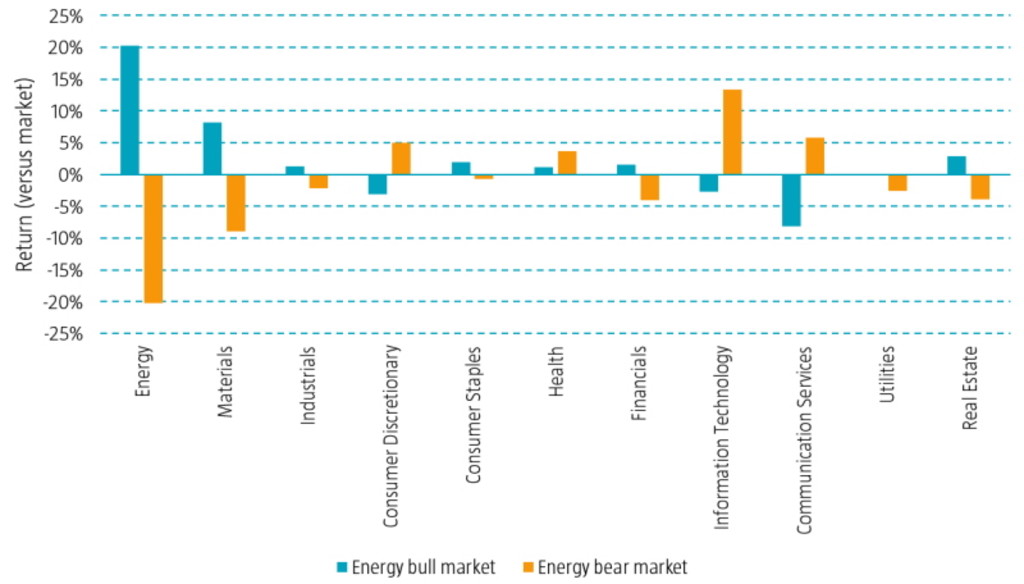
Source: Robeco Quantitative Research, Refinitiv Datastream. The chart uses monthly USD returns for the MSCI World Index and the 11 GICS level 1 sectors for the period January 1995 to December 202
The performance impact of excluding energy stocks
Furthermore, we explored what impact the exclusion of the energy sector from a global equity portfolio would have on its returns over a decade. We saw that over the most recent period, from 2011 to 2020, which was mostly an oil and energy bear market, the preclusion of investments in energy stocks would have boosted the annualized return of the portfolio by almost 1%. However, over the preceding decade from 2001 to 2010, which was mostly an oil and energy bull market, it would have lowered the performance by more than 1% per annum.
Thus, divesting from fossil fuel stocks can have a substantial impact on equity portfolio returns over typical evaluation horizons.
Conclusion
We conclude that divesting from fossil fuel stocks comes down to an active systematic bet against the oil price that is probably hard to avoid. And while excluding these stocks appears to have a neutral effect on long-term expected returns, it does make a portfolio vulnerable over the short and medium term to significant underperformance during oil or energy rallies.
Footnote
1 Bradford, H., September 2021, “Dutch fund PME completes fossil-fuel divestment”, Pensions & Investments; Pielichata, P., October 2021, “ABP to divest from fossil-fuel stocks immediately”, Pensions & Investments; and Steyer, R., December 2021, “3 NYC pension funds divest $3 billion from fossil fuels”, Pensions & Investments.
2 Blitz, D., January 2022, “Betting against oil: the implications of divesting from fossil fuel stocks”, SSRN working paper.
3 Sireklove, J., 2016, “Fossil-free investing”, Journal of Index Investing; Trinks, A., Scholtens, B., Mulder, M., and Dam, L., April 2018, “Fossil fuel divestment and portfolio performance”, Ecological Economics; and Plantinga, A., and Scholtens, B., 2021, “The financial impact of fossil fuel divestment” Climate Policy.
下載刊物
重要資料
本網站僅供《證券及期貨條例》(香港法例第571章)及其附屬法例所界定之專業投資者瀏覽及使用。 投資涉及風險。過往表現並不代表未來表現。本網站所載資料僅供參考之用,並不構成任何投資建議,亦非作出買賣任何證券或採納任何投資策略之要約或招攬。投資者不應僅憑本網站提供之資料作出投資決定,在作出任何投資決定前,應徵詢獨立意見(包括有關稅務影響之意見)。投資者應確保完全理解投資產品的相關風險,亦應考量自身投資目標及風險承受水平。投資乃閣下之個人決定。除非銷售投資產品的中介人已向閣下告知該投資產品適合閣下,並已解釋其符合閣下投資目標之原因,否則閣下不應投資。請參閱相關發售文件或其他法律文件,以獲取包括風險因素在內的進一步詳情。 本網站由荷寶投資管理香港有限公司發布,該公司受香港證券及期貨事務監察委員會(「證監會」)規管(中央編號:APU851)。本網站未經證監會審閱。 無法保證任何投資產品可實現其投資目標。概不就任何投資產品之表現或投資回報作任何聲明或承諾。投資的價值或會波動。本網站所載過往表現、推算或預測,均不應視作未來表現之保證或指標,且概不提供任何明示或暗示之保證。本網站內容建基於相信為可靠之來源,惟因應資料傳遞技術特性及須採用多項數據來源(包括第三方內容),故概不保證其準確性。所述觀點僅乃截至上述日期,或會隨市況變化而改變,可予更改而毋須另行通知。該等意見可能有別於其他荷寶投資專業人士之意見。因使用本材料或當中所載任何評論、意見或估算而引致之直接、間接或相應損失,荷寶概不承擔法律責任。荷寶並無責任更新本網站或任何網站內容。未經荷寶事先書面許可,不得複製、分發或刊發本網站任何材料。 除非另有說明,資料來源:荷寶。