
Head of Sustainability Integration

• 可持續投資《開闊視野》
SI Opener: Loss of biodiversity is a bigger threat than climate change
Biodiversity represents the knowledge learned by evolving species over millions of years. It reflects the ability of animals and plants to survive the vastly varying environmental conditions that Earth has experienced. It encompasses life in all forms, from genes to entire ecosystems. The interactions played by these different elements have ensured that the Earth has been habitable for millions of years. Yet biodiversity is declining faster than it has at any other time in human history: the current rate of extinction is tens to hundreds of times higher than the average over the past 10 million years.
作者

Head of Active Ownership
概要
- Biodiversity loss has passed a planetary boundary posing high risk
- Financial firms need to check if they are part of the problem
- Call on investors to sign the UN Finance for Biodiversity Pledge
For this reason, scientists warn that we are in the middle of the ‘sixth mass extinction’. Research undertaken by the Stockholm Resilience Centre analyses threats to what they have termed ‘planetary boundaries’. They define these boundaries as nine processes through which humans can ‘regulate the stability and resilience of the Earth system’. Within these boundaries, the planet can continue to thrive and cater to the needs of humanity.
Figure 1 shows the state of our Earth according to this research. You can see that biosphere integrity measured by the extinction rate (extinctions per million species/years (E/MSY)) is at high risk and has already passed the boundary of uncertainty. As biogeochemical flows (nitrogen and phosphorus) have also passed the boundaries, we do not know how ecosystems will react.
Figure 1 | Boundary threats to biosphere integrity
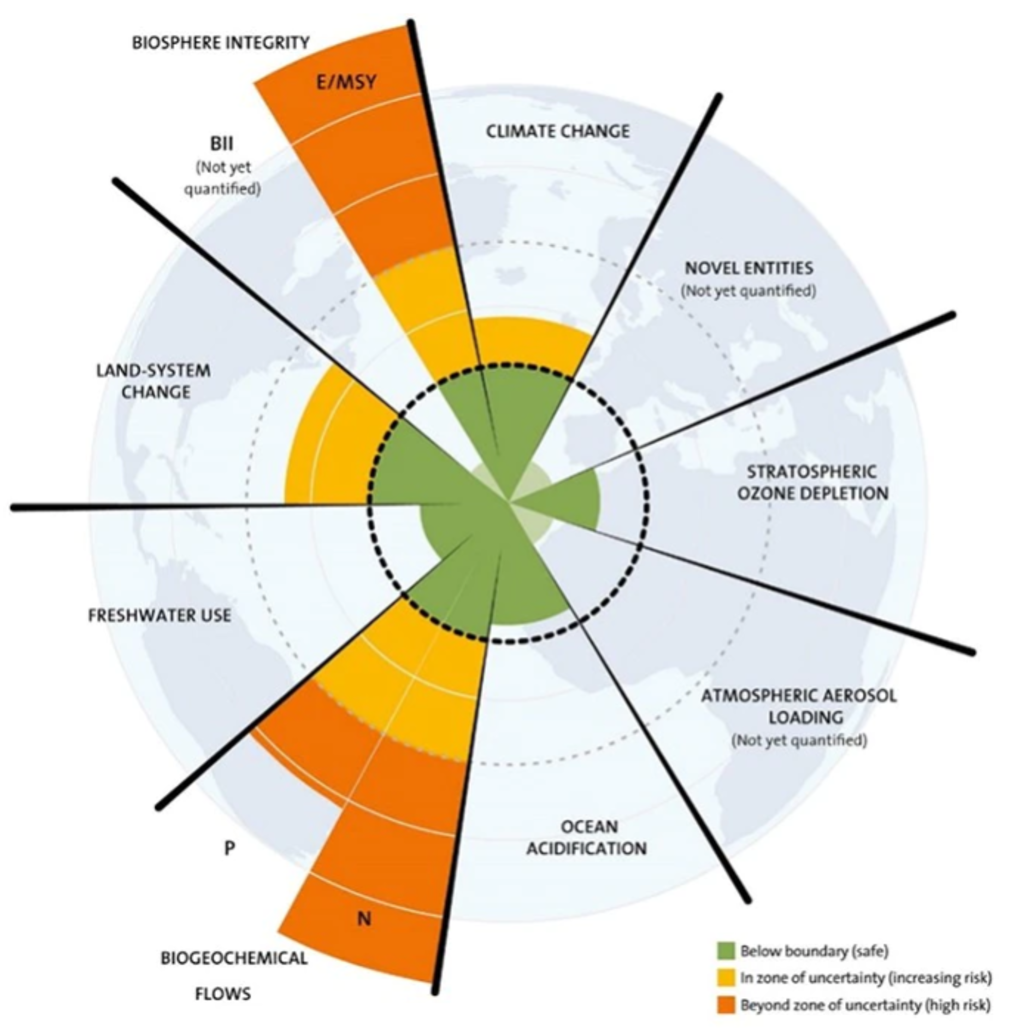
Source: Stockholm University1
According to this research, these two issues provide even bigger uncertainties than climate change. However, combatting global warming remains very important, as it ranks high on the list of direct drivers of biodiversity loss, and it increasingly aggravates the negative impact of other drivers, such as land use change, on nature.
Research conducted by De Nederlandsche Bank (DNB) and the PBL Netherlands Environmental Assessment Agency identify “EUR 81 billion in loans provided by Dutch financial institutions to high nitrogen-emitting sectors, and a EUR 28 billion exposure to companies that operate in protected or high conservation value (HCV) regions and face potential stranded assets risks”.2
This is an example of the interconnectedness of Dutch and other financial institutions to high-emitting and biodiversity-threatening industries. On the one hand, this confirms their negative role in reaching planetary boundaries of uncertainty. On the other hand, it highlights the risks they face if legislation or consumer behavior changes on this topic.
Next to this, biodiversity loss is posing a systemic risk, of which investors should become aware. As we find ourselves at the doorstep of the sixth mass extinction, both businesses and regulators have a huge role to play in shifting paradigms about who pays for the externalities created by ‘business-as-usual’.
Frontrunners in ESG are working together on this topic
Many investors are currently focusing on climate change and developing metrics to measure, manage and monitor climate risks and opportunities in their portfolios. However, given the growing body of evidence on the large impact that biodiversity loss will have globally, we believe more effort should be put into measuring the biodiversity impact of portfolios.
In the Netherlands, several investors under leadership of the ASN bank are collaborating in the Partnership for Biodiversity Accounting Financials (PBAF) to develop such metrics. They aim to create a framework for financial institutions to consider and address the biodiversity impact of their portfolios across asset classes.
Furthermore, Robeco started an engagement theme on biodiversity earlier this year. Land use change is one of the major contributors to biodiversity loss, and much of this is driven by crop commodity production. Therefore, our engagement will focus on the impact on biodiversity of deforestation that is linked to five high-risk crop commodities – cocoa, natural rubber, soy, beef, and tropical timber and pulp.
Our engagement centers around five issues. The first three engagement objectives will focus on environmental management, with a clear value placed on ‘zero deforestation’ commitments, biodiversity impact assessments, fauna and flora restoration and conservation, and circular economy principles within companies’ production lines. We deem these highly relevant, especially for the five commodities that fall under this engagement.
The fourth objective will address disclosures, certifications and traceability. The fifth will focus on the social aspect of the production of these commodities, and will tackle both community and land rights, along with labor rights. We want to steer towards reaching 100% traceability for producers and users of these chains. Only then will it be possible to trace the impact on biodiversity in the supply chain.
Call to action: join the Biodiversity pledge
On 25 September the Finance for Biodiversity Pledge will be launched during the Nature for Life Hub at the 75th UN General Assembly. The organizations that have signed the pledge have committed to protecting and restoring biodiversity through their financial activities and investments.
As one of the signatories, Robeco is extending a firm ‘call to arms’ to other investors to sign up. Then they can make sure they are not part of a problem which is already testing the Earth’s ability to digest it.
By signing the pledge, institutions commit to collaborating and sharing knowledge, engaging with companies, assessing impact, setting targets and report publicly on progress. This entails a roadmap that will take up several years, requiring commitment and resources from as many investors as possible. More information on the pledge can be found here.
Make it happen!
SI Opener: Seeing is believing.
重要資料
本網站僅供《證券及期貨條例》(香港法例第571章)及其附屬法例所界定之專業投資者瀏覽及使用。 投資涉及風險。過往表現並不代表未來表現。本網站所載資料僅供參考之用,並不構成任何投資建議,亦非作出買賣任何證券或採納任何投資策略之要約或招攬。投資者不應僅憑本網站提供之資料作出投資決定,在作出任何投資決定前,應徵詢獨立意見(包括有關稅務影響之意見)。投資者應確保完全理解投資產品的相關風險,亦應考量自身投資目標及風險承受水平。投資乃閣下之個人決定。除非銷售投資產品的中介人已向閣下告知該投資產品適合閣下,並已解釋其符合閣下投資目標之原因,否則閣下不應投資。請參閱相關發售文件或其他法律文件,以獲取包括風險因素在內的進一步詳情。 本網站由荷寶投資管理香港有限公司發布,該公司受香港證券及期貨事務監察委員會(「證監會」)規管(中央編號:APU851)。本網站未經證監會審閱。 無法保證任何投資產品可實現其投資目標。概不就任何投資產品之表現或投資回報作任何聲明或承諾。投資的價值或會波動。本網站所載過往表現、推算或預測,均不應視作未來表現之保證或指標,且概不提供任何明示或暗示之保證。本網站內容建基於相信為可靠之來源,惟因應資料傳遞技術特性及須採用多項數據來源(包括第三方內容),故概不保證其準確性。所述觀點僅乃截至上述日期,或會隨市況變化而改變,可予更改而毋須另行通知。該等意見可能有別於其他荷寶投資專業人士之意見。因使用本材料或當中所載任何評論、意見或估算而引致之直接、間接或相應損失,荷寶概不承擔法律責任。荷寶並無責任更新本網站或任何網站內容。未經荷寶事先書面許可,不得複製、分發或刊發本網站任何材料。 除非另有說明,資料來源:荷寶。