• Visión

Beyond the AI giants: Finding opportunity in the overlooked long tail

AI is making it cheaper to research thousands of overlooked companies for investment opportunities. As these tools become widely available, the advantage will lie in identifying which opportunities are worth pursuing and how to turn them into returns.

Autores/Autoras

    Director de Next Gen Research

Resumen

  • AI makes overlooked small-cap companies cheaper to research
  • Wider access to AI makes information processing less distinctive
  • Rigorous testing and implementation matter for returns after costs

Anyone invested in a broad global equity index already has significant exposure to the AI giants. At the end of September 2026, the ten largest constituents accounted for almost a quarter of the MSCI World IMI by weight.1 Much of the debate about AI and markets centers on those companies. For investors, AI’s less obvious impact lies in how it changes the economics of researching the rest of the market.

Reviewing every filing and earnings-call transcript for a company with little analyst coverage used to be expensive. AI has made that task far cheaper. The catch is that it has done the same for everyone else

The long tail becomes searchable

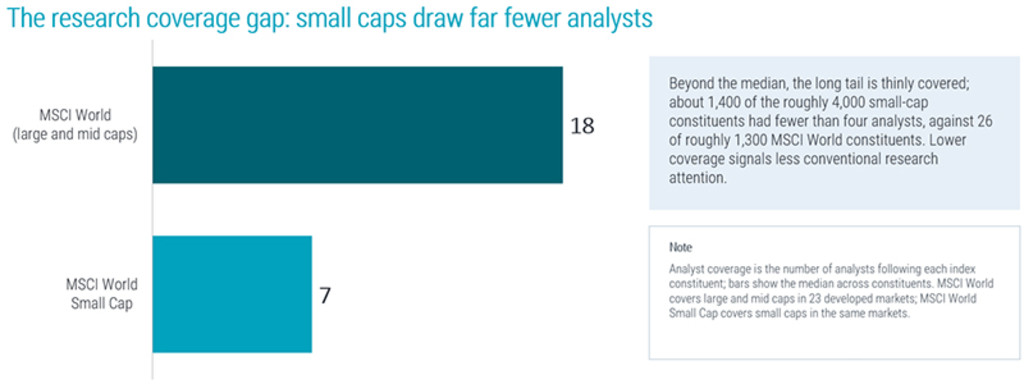
With 3,873 constituents, the MSCI World Small Cap Index accounts for nearly three-quarters of the MSCI World IMI by number but only about a tenth by market value.2 Its stocks attract far less analyst coverage. Investigating a small company need not require much less effort than investigating a large one, while the potential payoff also depends on how much capital an investor can deploy.

Figure 1 | Analyst coverage by company size

Source: Robeco, MSCI. Analyst-coverage data: February 2026.

Thin coverage on its own says little about mispricing. Smaller stocks may simply be riskier or less liquid, and any return premium may reflect compensation for those risks rather than investment skill. Yet limited coverage can also slow the incorporation of information into prices. Hong, Lim and Stein found stronger momentum among stocks with low analyst coverage relative to their size, particularly following bad news.3

Systematic research changes the arithmetic. Once a process is built, the three-thousandth company costs little more to screen than the thirtieth, and machine learning can model how a security’s various characteristics interact. 4 Rising earnings may signal a stronger opportunity at a reasonably valued company with a sound balance sheet than at one facing refinancing at higher rates. A model can look for combinations like that across an entire index at once.

Consider Hammond Power Solutions, a Canadian transformer maker that reported CAD 197 million in sales in Q2 2024. Its Q2 2024 report highlighted record shipments, a new factory in Mexico and sales 14% higher than a year earlier. New orders had normalized by June as US sales of standard products cooled, while demand for custom transformers, particularly for data centers, grew faster than expected.5 None of this was hidden, but it was buried among thousands of reports that no analyst team can scrutinize in full. Language models can extract such statements from filings and compare them with margins, balance sheets and valuations. This makes companies like Hammond cheaper to investigate. But whether the information was already priced in, whether similar statements predict returns across companies, and whether trading on them generates returns after costs can only be established through disciplined testing.

Turning research into returns

Finding and summarizing public information faster than others once offered an edge, but quantitative and AI models are eroding that advantage. Cheap search also makes it easier to fool yourself. Test enough candidate signals, and some will appear profitable by chance. What remains scarce is judgment about which findings are credible and how to act on them.

A study of 1,056 machine-learning specifications for US equities found that choices such as the prediction target and training window materially affected simulated performance. More complex models did not consistently outperform simpler ones.6 An impressive backtest means little until you know how many alternatives were tried.

Acting on a forecast is a separate problem. In a Robeco simulation of MSCI World Small Cap stocks from December 2000 to April 2025, a machine-learning model separated next-month winners from losers slightly more accurately than a common value, quality and momentum model, though both were right barely more than half the time.78 That is ranking skill on paper, but investors are paid only for what survives trading. Earlier Robeco simulations of US stocks found that strategies based on one-month forecasts generated little to no alpha9 after transaction costs, while models using longer forecast horizons traded less and performed considerably better.10

In Next Gen Research, findings like these lead us to start with an economic rationale for a signal rather than a more sophisticated model. The refinancing example is the kind of interaction worth looking for, because it makes economic sense before any backtest is run. It also gives us a better basis for questioning the signal when market conditions change. Any added complexity must justify itself against a strong conventional factor model, using out-of-sample tests and portfolios that account for realistic trading costs and capacity limits.

In 2027, AI tools for researching and screening companies will be more capable and more widely available. Searching the long tail will become easier, and the ability to do so will count for less.

None of this argues for an indiscriminate overweight in small caps, which carry their own liquidity, credit and factor risks. How much to hold there is an allocation question. Where to take stock-selection risk is a different one. I think investors should take systematic stock selection beyond the mega-caps more seriously. They should judge the managers offering it, ourselves included, on whether scalable research delivers returns after costs. As AI makes information cheaper for everyone, the managers worth backing will be those who know what to do with it.

Footnotes


1MSCI (2026). MSCI World IMI Index (USD), index factsheet, data as of 30 September 2026. https://www.msci.com/indexes/index/664185/msci-world-imi-index
2MSCI (2026). MSCI World Small Cap Index (USD), index factsheet, data as of 30 September 2026. https://www.msci.com/indexes/index/106230/msci-world-small-cap-index
3Hong, H., T. Lim and J. C. Stein (2000). “Bad News Travels Slowly: Size, Analyst Coverage, and the Profitability of Momentum Strategies.” Journal of Finance 55(1): 265-295. https://doi.org/10.1111/0022-1082.00206
4Gu, S., B. Kelly and D. Xiu (2020). “Empirical Asset Pricing via Machine Learning.” Review of Financial Studies 33(5): 2223-2273. https://doi.org/10.1093/rfs/hhaa009
5Hammond Power Solutions (2024). “Q2 Report: For the six months ended June 29, 2024.” Shareholders’ message and management’s discussion and analysis (MD&A as at July 25, 2024). The companies shown in this article are for illustrative purposes only. No inference can be made on the future development of the company. This is not a buy, sell, or hold recommendation. Q2 2024 Report
6Chen, M., M. X. Hanauer and T. Kalsbach (2024). “Design Choices, Machine Learning, and the Cross-Section of Stock Returns.” SSRN Working Paper 5031755. https://doi.org/10.2139/ssrn.5031755
7Simulated past performance is no guarantee for future results. Source: Robeco. For illustration purposes only. This information is presented solely to illustrate machine learning factor models across small cap stocks. This does not represent returns of an actual portfolio. Back-tested performance differs from actual performance because it is achieved through the retroactive application of a model designed with the benefit of hindsight. Returns are shown gross of fees and are based on historical data. In reality, costs (such as management fees and other costs) are charged. These have a negative effect on the returns shown.
8Robeco (2025). “Using artificial intelligence for selecting small-cap stocks.” Robeco Insights, September 2025. https://www.robeco.com/en-int/insights/2025/09/using-artificial-intelligence-for-selecting-small-cap-stocks
9Alpha refers to the excess return of an investment relative to a benchmark index and is a measure of performance.
10Robeco (2023). “The term structure of machine learning alpha.” Robeco Insights, July 2023. Summary of research by D. Blitz, M. X. Hanauer, T. Hoogteijling and C. Howard. https://www.robeco.com/en-int/insights/2023/07/the-term-structure-of-machine-learning-alpha

2027 Investment outlook

The forces beneath the surface

Discover more

MSCI disclaimer:
Source: MSCI. The MSCI information may only be used for your internal use, may not be reproduced or redisseminated in any form and may not be used as a basis for or a component of any financial instruments or products or indices. None of the MSCI information is intended to constitute investment advice or a recommendation to make (or refrain from making) any kind of investment decision and may not be relied on as such. Historical data and analysis should not be taken as an indication or guarantee of any future performance analysis, forecast or prediction. The MSCI information is provided on an “as is” basis and the user of this information assumes the entire risk of any use made of this information. MSCI, each of its affiliates and each other person involved in or related to compiling, computing or creating any MSCI information (collectively, the “MSCI Parties”) expressly disclaims all warranties (including, without limitation, any warranties of originality, accuracy, completeness, timeliness, non-infringement, merchantability and fitness for a particular purpose) with respect to this information. Without limiting any of the foregoing, in no event shall any MSCI Party have any liability for any direct, indirect, special, incidental, punitive, consequential (including, without limitation, lost profits) or any other damages. (www.msci.com)”

Mantengamos la conversación

Manténgase al día de los constantes cambios en inversión sostenible y factorial, tendencias y crédito.

No se lo pierda

El objetivo de Robeco es proporcionar a sus clientes unos rendimientos y soluciones de inversión superiores para que consigan sus objetivos financieros y de sostenibilidad.

Información importante
Los Fondos Robeco Capital Growth no han sido inscritos conforme a la Ley de sociedades de inversión de Estados Unidos (United States Investment Company Act) de 1940, en su versión en vigor, ni conforme a la Ley de valores de Estados Unidos (United States Securities Act) de 1933, en su versión en vigor. Ninguna de las acciones puede ser ofrecida o vendida, directa o indirectamente, en los Estados Unidos ni a ninguna Persona estadounidense en el sentido de la Regulation S promulgada en virtud de la Ley de Valores de 1933, en su versión en vigor (en lo sucesivo, la “Ley de Valores”)). Asimismo, Robeco Institutional Asset Management B.V. (Robeco) no presta servicios de asesoramiento de inversión, ni da a entender que puede ofrecer este tipo de servicios, en los Estados Unidos ni a ninguna Persona estadounidense (en el sentido de la Regulation S promulgada en virtud de la Ley de Valores). Este sitio Web está únicamente destinado a su uso por Personas no estadounidenses fuera de Estados Unidos (en el sentido de la Regulation S promulgada en virtud de la Ley de Valores) que sean inversores profesionales o fiduciarios profesionales que representen a dichos inversores que no sean Personas estadounidenses. Al hacer clic en el botón “Acepto” que se encuentra en el aviso sobre descargo de responsabilidad de nuestro sitio Web y acceder a la información que se encuentra en dicho sitio, incluidos sus subdominios, usted confirma y acepta lo siguiente: (i) que ha leído, comprendido y aceptado el presente aviso legal, (ii) que se ha informado de las restricciones legales aplicables y que, al acceder a la información contenida en este sitio Web, manifiesta que no infringe, ni provocará que Robeco o alguna de sus entidades o emisores vinculados infrinjan, ninguna ley aplicable, por lo que usted está legalmente autorizado a acceder a dicha información, en su propio nombre y en representación de sus clientes de asesoramiento de inversión, en su caso, (iii) que usted comprende y acepta que determinada información contenida en el presente documento se refiere a valores que no han sido inscritos en virtud de la Ley de Valores, y que solo pueden venderse u ofrecerse fuera de Estados Unidos y únicamente por cuenta o en beneficio de Personas no estadounidenses (en el sentido de la Regulation S promulgada en virtud de la Ley de Valores), (iv) que usted es, o actúa como asesor de inversión discrecional en representación de, una Persona no estadounidense (en el sentido de la Regulation S promulgada en virtud de la Ley de Valores) situada fuera de los Estados Unidos y (v) que usted es, o actúa como asesor de inversión discrecional en representación de, un inversión profesional no minorista.


El acceso a este sitio Web ha sido limitado, de manera que no constituya intento de venta dirigida (según se define este concepto en la Regulation S promulgada en virtud de la Ley de Valores) en Estados Unidos, y que no pueda entenderse que a través del mismo Robeco dé a entender al público estadounidense en general que ofrece servicios de asesoramiento de inversión. Nada de lo aquí señalado constituye una oferta de venta de valores o la promoción de una oferta de compra de valores en ninguna jurisdicción. Nos reservamos el derecho a denegar acceso a cualquier visitante, incluidos, a título únicamente ilustrativo, aquellos visitantes con direcciones IP ubicadas en Estados Unidos. Este sitio Web ha sido cuidadosamente elaborado por Robeco. La información de esta publicación proviene de fuentes que son consideradas fiables. Robeco no es responsable de la exactitud o de la exhaustividad de los hechos, opiniones, expectativas y resultados referidos en la misma. Aunque en la elaboración de este sitio Web se ha extremado la precaución, no aceptamos responsabilidad alguna por los daños de ningún tipo que se deriven de una información incorrecta o incompleta. El presente sitio Web podrá sufrir cambios sin previo aviso. El valor de las inversiones puede fluctuar. Rendimientos anteriores no son garantía de resultados futuros. Si la divisa en que se expresa el rendimiento pasado difiere de la divisa del país en que usted reside, tenga en cuenta que el rendimiento mostrado podría aumentar o disminuir al convertirlo a su divisa local debido a las fluctuaciones de los tipos de cambio. Para inversores profesionales únicamente. Prohibida su comunicación al público en general.