

Portfolio Manager


• Insight
Asia: A once-in-a-decade opportunity
The long-term opportunity to gain exposure to Asia-Pacific equities is currently being obscured by a resilient US dollar and geopolitical worries which ignore the region’s solid macroeconomic advantages.
Authors


Client Portfolio Manager
Summary
- Valuation gap with US still enormous and contrary to macro fundamentals with reopening occurring
- Asia ex-China economies can benefit from China offshoring, and remain key US trade partners
- Asia-Pacific investment universe offers unrivalled combination of diversity, value and growth potential
The first half of 2023 has been a false start for Asia Pacific equities with optimism over China re-opening fading and the Fed’s hawkish stance surviving the ongoing sequence of mid-size US bank failures, supporting the US dollar. This has left Asia Pacific markets treading water and especially as concerns over the outlook for high value exports like semiconductors to the slowing US economy have increased.
This absence of short term catalysts is keeping investors on the sidelines but we think the long-term structural foundations of Asia-Pacific should be more important, and will assert themselves over time, making this an opportune moment to invest in Asia-Pacific ahead of the next era of growth.
Figure 1: Price-to-book valuation gap is enormous
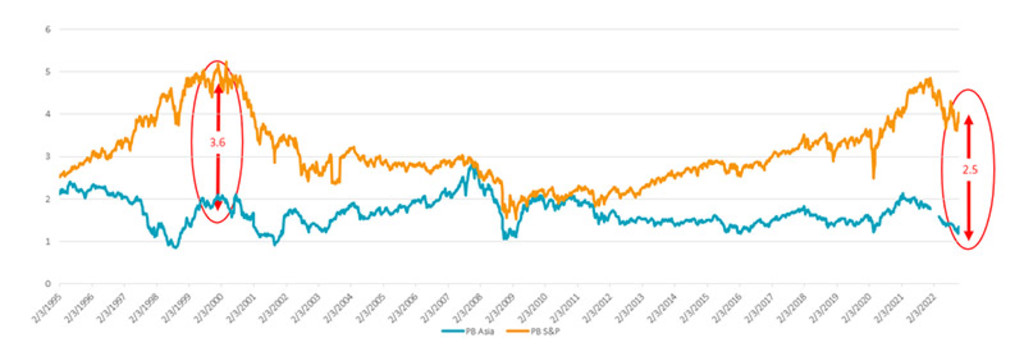
Source: MSCI, Bloomberg.Price-to-book MSCI Asia ex Japan and S&P 500 indices. Data range: Dec 2000 to April 2023
The valuation gap is not justified
The valuation gap remains enormous, despite the slow-burning banking crisis in the US, and the S&P 500 has outperformed relative to Asia-Pacific markets. In previous cycles, post the dotcom bubble and after the global financial crisis, this kind of gap has heralded a strong and long period of outperformance for Asia-Pacific. In addition, Asia Pacific economies are not suffering from high inflation in the same way as Europe, the US or some emerging economies. This gives governments in the region policy flexibility, and supports our view that macro fundamentals will start to be reflected in relative equity valuations.
Get the latest insights
Subscribe to our newsletter for investment updates and expert analysis.
ASEAN will thrive as US-China face-off
The structural set up for Association of Southeast Asian Nations (ASEAN) economies is already positive. The combined GDP of ASEAN countries in 2019 was valued at USD 3.2 trillion – making ASEAN the fifth-largest economy in the world, and it’s tracking to become the fourth largest by 2030 as the region sucks in foreign direct investment at an accelerated pace. With a total population of about 700 million people, 61% under the age of 351 – combined with improving educational attainment and mass digital adoption, the contrast with North East Asia and Europe is stark.
ASEAN economies will, alongside India, be key beneficiaries of the China offshoring trend, where foreign companies are trying to build more redundancy and resilience into their supply chain by setting up manufacturing elsewhere, with some Chinese companies following suit2. This will see ASEAN companies further embedding themselves as key links in the global supply chain for technology and manufactured goods. Given ongoing tension between the two global powers, ASEAN economies are in our view likely to play both sides and from a trade perspective at least will seek to take a neutral stance. In addition, the consumer space in ASEAN offers exciting long-term winners that will grow with an increasing shift towards consumption in the region. We are riding both trends as part of our Asia-Pacific equity strategy.
ASEAN equities have very strong medium-term prospects at good valuations
India valuations have reset
At the start of 2023 we believed that valuations in India were stretched and we were very underweight relative to the index. Since the Adani group of companies corrected after being targeted by short sellers, the wider market was dragged down as a consequence, making some long-term value ideas more attractive. We are not only focused on the China offshoring trend but are also keen to find consumption plays. We believe digital adoption by Generation Z and younger is a structural shift that will allow even those in rural areas, previously excluded from the consumer economy, to become more economically active going forward. Deepening internet penetration means that close to 77% of the country’s population will be internet and technology savvy by 2030. This has the potential to turbocharge the existing demographic advantages India possesses.
Nevertheless, we remain underweight India, and will only accumulate what we consider the very best ideas rather than just pure India growth proxies, or the traditional large cap technology names that mainly serve developed markets.
North East Asia
The mature economies of North East Asia don’t share the same demographic advantages as the younger nations to the south but still host exciting investment opportunities.
Even under US-China ‘decoupling’, other countries can benefit from supply chain diversification. South Korea’s position as a key player in semiconductors and display technology has been augmented by other industries set to serve the energy transition, including a strong position in electronic vehicle batteries which are benefiting directly from the US choosing to exclude China-based suppliers from tax breaks under the Inflation Reduction Act. After a weak 2022 due to the semiconductor and tech cycle rolling over, South Korean equities have performed strongly in 2023, reflecting the resilient domestic economy and in anticipation of South Korea being potentially reclassified as a developed market by MSCI which would yield inflows from a rebalancing effect3. For us, South Korea is a country where we find plenty of companies with value and earnings turnaround stories.
Like South Korea, the Taiwan market suffered as technology sold off in 2022. We now think the semiconductor cycle may have bottomed, offering good entry points to long-term investors. Obviously there is a geopolitical overhang in Taiwan but we consider the prospect of a surprise China invasion very unlikely.
Unlike their counterparts in the US, many South Korean and Taiwanese companies are trading at floor asset valuations, pricing in very little improvement in the economic outlook.
Conclusion: Time to act
The key focus for our portfolio construction in Asia remains avoiding proxies for US or Europe consumption, or stocks that trade at valuations comparable to peers in the US. Within the Asia-Pacific equities universe, we continue to identify companies whose share prices do not reflect the company’s true potential and we believe will re-rate to a higher level.
Macroeconomic weakness in the US and Europe, and recurrent crises in the US, the latest being the ‘debt ceiling’, continue to impact sentiment. On the other hand, financials risks are lower in Asia given more conservative monetary and fiscal policies. In these periods of risk-off the US dollar tends to firm and this is a headwind for our Asia-Pacific strategy. Nevertheless, from our perspective gradually increasing allocation to Asia-Pacific makes sense as the region is strategic to the world’s two dominant economies, and exposure now will capture upside as the valuation gap narrows.
Footnotes
1ASEAN development trajectories reach new milestone – ASEAN.org – 23 August, 2021
2Chinese company moves some production abroad to escape geopolitics – 17 April, 2023
3Why Korea Is Beating Other Asian Stock Markets – WSJ – 26 April, 2023
Important information
This information is for informational purposes only and should not be construed as an offer to sell or an invitation to buy any securities or products, nor as investment advice or recommendation. The contents of this document have not been reviewed by the Monetary Authority of Singapore (“MAS”). Robeco Singapore Private Limited holds a capital markets services license for fund management issued by the MAS and is subject to certain clientele restrictions under such license. An investment will involve a high degree of risk, and you should consider carefully whether an investment is suitable for you.