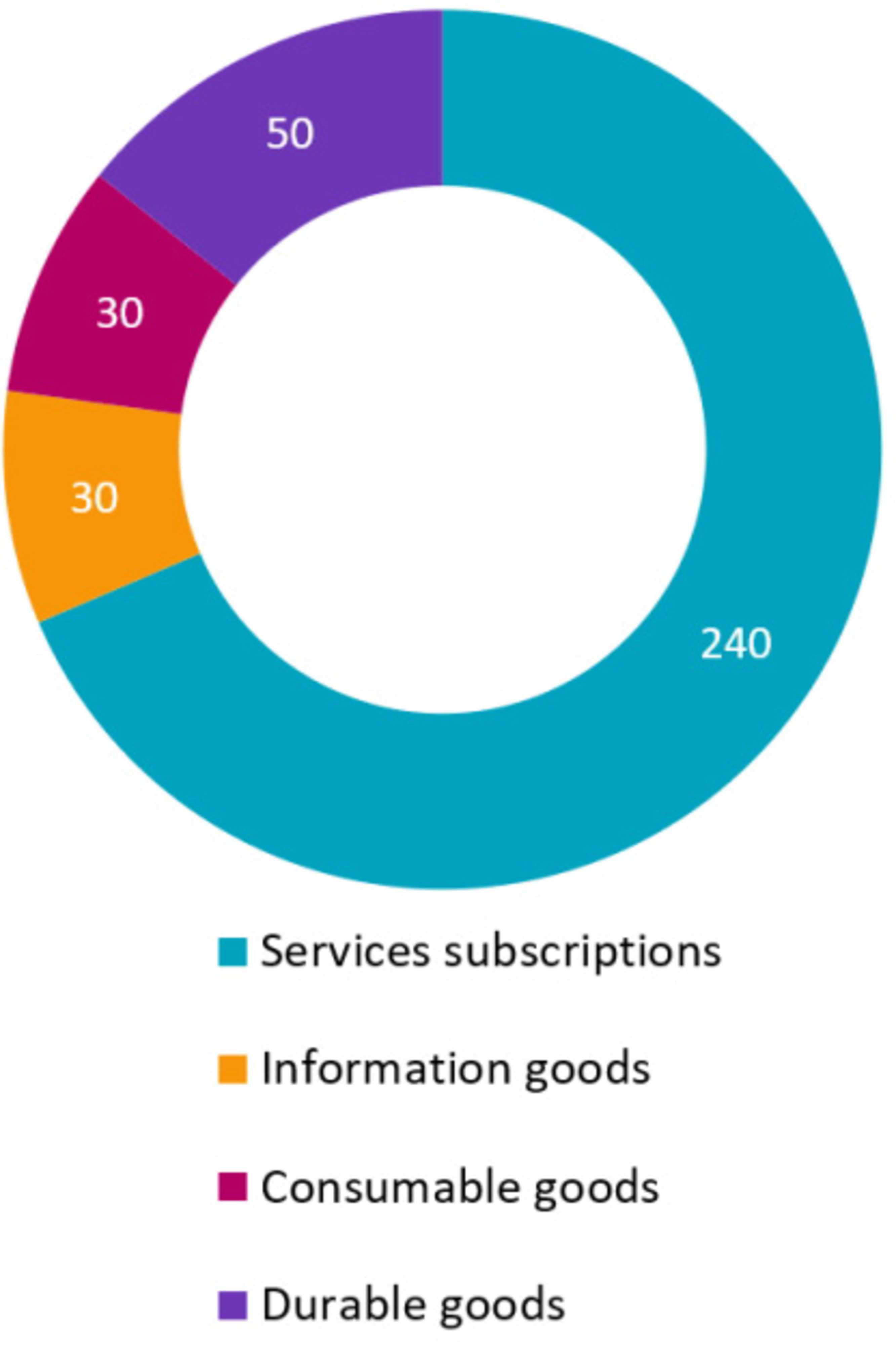
For investors, subscription businesses typically offer reduced uncertainty regarding revenue and profit generation in the long term, relative to more traditional business models. Moreover, these companies tend to generate a constant stream of data that can be used to improve service, raise customer satisfaction, and identify complementary business opportunities. This generally leads to relatively stable growth over time.
Admittedly, subscription businesses may not be appealing to all investors, as they incur customer acquisition costs – such as sales and marketing, or software development – upfront, while revenues are recognized over time. This combination leads to a misalignment of revenues and expenses, understating the true financial health of the company. However, as long-term investors able to look beyond short-term cashflow generation, we see this as an opportunity rather than a challenge.
Subscription businesses grew nearly six times faster than firms of the S&P 500 Index over the 2012-2020 period, driven by rising consumer demand for subscription services, according to Zuora, a subscription management platform.1 The Covid-19 pandemic further increased the gap. Many subscription businesses experienced a strong growth acceleration, as consumers moved from fixed towards variable costs, and companies focused on their core operations while outsourcing the rest.
In 2020, revenues of subscription businesses tracked by Zuora grew by 11.6%, while those of the companies in the S&P 500 Index declined by 1.6%. Admittedly, lockdowns and other safety measures taken in the first quarter initially seemed to slow subscription revenue growth. But when lockdowns returned in the last quarter, subscription revenue growth accelerated, suggesting that subscription companies had been able to adapt their offerings quickly.
We expect this trend to continue in the coming decades, essentially driven by the ongoing digitalization of the economy. According to recent estimates by UBS Wealth Management and Bernstein, the digital subscription economy is currently a USD 650 billion market and is set to more than double by 2025 reaching a market size of USD 1.5 trillion.2 This represents an impressive 18% compound average growth rate.
New technology now enables businesses from virtually all economic sectors to offer membership services to their customers. On the corporate side, rapidly falling costs of data storage and rising computing power have enabled businesses to offer consumers access to their services at a very low cost. Meanwhile, the ubiquity of online services has enabled consumers to be in touch with content, services and even other members at all times.
Another important tailwind for the coming years is the unavoidable generational transition, as millennials and generation-Zs3 tend to be keener on subscription and usership schemes than older cohorts.4 Consumer surveys suggest that, for younger generations, the promise of always getting the latest product, the lack of associated maintenance, as well environmental concerns often tend to player a larger role in the purchase decision making than traditional ownership considerations.