

Head of Next Gen Research


• Insight
Small caps, enhanced signals: Our new NextGen ETF
Small-cap equities have long been associated with growth potential and diversification, but have been out of favor for much of the past decade. That may be changing, and our new active ETF aims to make the most of the opportunities.
Authors


Head of Exchange Traded Funds
With mega-cap stocks dominating index performance, investors are increasingly looking beyond the obvious – toward the broader ‘long tail’ of opportunity.
While small caps have outperformed large caps over the last 20+ years (see Figure 1), they have been lagging since 2018. However, Figure 1 also reveals that changes in relative valuations between these segments were the main reason for this underperformance.
Figure 1 – Relative performance and valuation of small vs. large caps (Developed Markets)
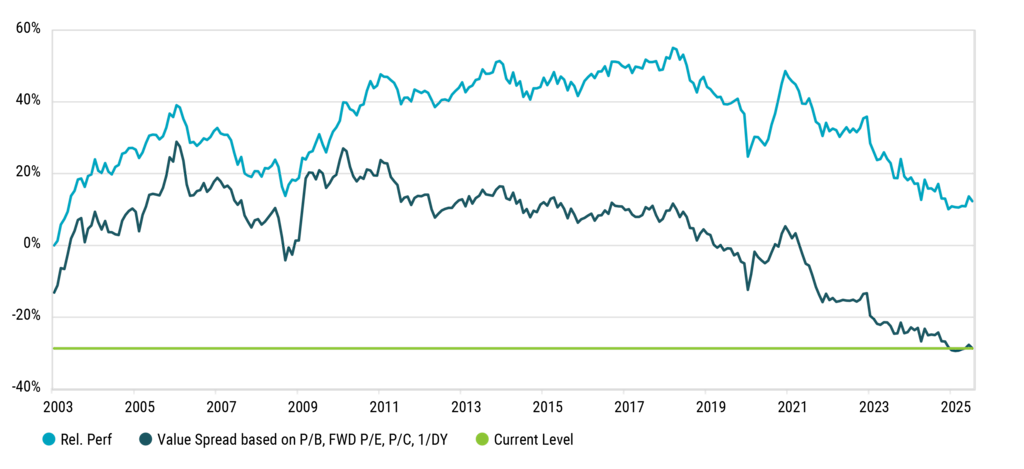
Past performance is no guarantee of future results. The value of your investments may fluctuate. Source: Robeco, MSCI, LSEG. The figure shows the relative performance and valuation of the MSCI World Small Cap Index vs. the MSCI World Index. Performance is measured via the total return index (in USD), and the relative valuation is based on four bottom-up-calculated multiples (price-to-book, forward price-to-earnings, price-to-cash EPS, and price-to-dividend). For each multiple, the valuation ratio of the MSCI Small Cap Index is divided by the same valuation ratio for the MSCI World Index. The sample period is March 2003 to December 2025.



Engineered to filter market noise
Our Active Quant strategy is designed to be highly effective by analyzing vast amounts of potential opportunities and exploiting market inefficiencies resulting from predictable patterns.
Historically, small caps have traded at valuation premiums of up to 30% versus large caps. Today, they trade at a 30% discount – a gap not seen over the last 20 years. From an allocation perspective, this creates both cyclical and structural appeal.
“Small caps bring very different return drivers to large caps,” Nick King, Head of ETFs, explains. “That makes them a powerful diversifier, particularly when used as part of a broader equity allocation.” They also tend to be earlier in their growth cycle and less dominated by global macro drivers, making them a complementary allocation alongside large caps.

Explore Active ETFs
Turn research into results with Robeco’s active ETFs — disciplined, innovative strategies built for today’s markets.
Why small caps are quant’s natural fit
Structurally, small caps remain one of the least efficiently researched parts of global equity markets. With more than 4,000 stocks worldwide and significantly lower analyst coverage than large caps, the universe combines breadth with informational inefficiency – a powerful combination for quant investors.
“A data-driven approach makes sense given the sheer breadth of the market,” says King. Quant strategies process large datasets, apply consistent definitions, and update signals with discipline, turning the small-cap ‘needle-in-a-haystack’ problem into a repeatable selection process.
The NextGen evolution: what machine learning brings
As Mike Chen, Head of NextGen Quant, puts it, “As small caps are a very rich and idiosyncratic hunting ground for quant, they are also the perfect environment for machine learning to shine.”
The NextGen Global Small Cap Equities ETF builds on decades of quant research using our range of established and next-generation quant signals as input. And then it takes a step further by selectively applying machine learning and alternative data to capture more complex market dynamics.
Machine learning helps in two key ways:
Identifying non-linear relationships, where signals behave differently depending on context
Capturing interaction effects, where combinations of signals matter more than each individually
“We let machine learning determine how features should be combined for each stock,” Chen explains. “Some companies are driven more by value, others by quality. The model adapts dynamically.”
This flexibility matters particularly in small caps, where company drivers are more diverse and less correlated. “Machine learning allows us to extract nonlinear, higher-order dynamics that traditional linear models simply cannot capture,” he adds.
Keeping the guardrails: explainable, benchmark-aware implementation
While AI enhances stock selection, implementation discipline remains central. The strategy is constructed within clear constraints across sectors, countries, and regions, with controlled turnover and governance oversight. It is designed to remain benchmark-aware while seeking excess returns.
Crucially, the model is fully interpretable. “We don’t see this as a black box. It’s a glass box,” says Chen. “We have tools to attribute performance and understand exactly which signals are driving portfolio decisions.” This transparency extends across both stock-level positioning and portfolio-level outcomes, ensuring the strategy remains explainable for investors and risk teams alike.
Human oversight in an AI-driven process
Even the most advanced models operate within the limits of their assumptions, which is why human oversight remains integral. “Models are simplifications of reality,” Chen notes. “Portfolio managers monitor assumptions constantly – especially during extreme events like Covid, where market regimes shift suddenly.”
Oversight does not mean interfering with day-to-day model outputs. Instead, it focuses on validating whether the structural assumptions underpinning the model remain intact. This balance preserves the strengths of systematic investing, such as discipline, scalability, and bias reduction, while ensuring resilience during periods of structural change.
ETF implementation: innovation that’s usable
The strategy is delivered through an active ETF wrapper, combining a research-driven stock-selection engine with intraday liquidity, transparency, and operational efficiency. From a portfolio construction perspective, the ETF is designed as a diversifying small-cap allocation with controlled active risk.
With tracking error of roughly 3–4%, it sits between enhanced indexing and more thematic exposures on the active risk spectrum, offering structured alpha potential without concentrated bets.
“Investors want innovation that’s usable,” says King. “A strategy that can be explained, fits cleanly into portfolios, and trades efficiently. That’s where the ETF wrapper adds real value.”
He adds: “Small caps are often used as a diversifying sleeve within global equities. Delivering this exposure through an ETF makes it easy to integrate into broader allocations.”
The next evolution, not just the next label
In recent years, many strategies have adopted an AI label. The more important question for investors is whether the investment process meaningfully evolves, in other words, does it improve outcomes without sacrificing discipline, transparency, or risk control.
For Robeco, the NextGen Quant platform is designed to do precisely that. “NextGen is about pushing the frontier,” Chen says. “We’re continuing to build the suite; launching new strategies while constantly iterating and improving existing ones.”
Robeco’s NextGen Global Small Cap Equities ETF reflects that philosophy: combining an established quant heritage with modern AI techniques, applied where market structure makes them most relevant.