
Impact Specialist


• 市場觀點
Finland and Norway claim top honors in latest Country Sustainability Rankings
A trio of Nordic nations made another clean sweep of the final country sustainability rankings of 2022. Scores for Finland, last year’s top finisher, slipped only slightly, but enough to share top honors with Norway. Just a razor’s edge behind sits Sweden. The equally familiar trio of Denmark, Switzerland and Iceland rounded out the elite six with the world’s best sustainability performance. The dazzling display of decades-long consistency at the top attests to the long-duration value of sustainable policies and practices.
作者


Strategist
概要
- Long-term consistency at the top demonstrates sustainability’s enduring value
- Political instability looms large across regions
- Environmental and social indicators strengthened in CSR revamp
The top twenty showed similar consistency, once more dominated by EU member countries alongside New Zealand, Australia, Canada, and Japan from the rest of world. Among high- and middle-income countries (based on nominal GDP), China, the Philippines, India, Nigeria and Pakistan rounded out the bottom five. However, they are replaced by Libya, Sudan, Iran, Iraq, and Yemen – all economically, socially, and politically fragile states in the Middle East and Africa when considering the full 150-member strong country universe.
Governance factors have long dominated ESG country analysis, and rightly so. Healthy institutions, systematic process, government accountability, as well as empowered citizens provide a protective platform for nurturing and sustaining social and environmental goals. Though governance is still the most heavily weighted overall, the CSR methodology was modified this year to reflect the increasing risks of climate change, biodiversity loss and human rights abuses for country sustainability performance.
了解最新的可持續性市場觀點
訂閱我們的電子報,探索塑造可持續投資的趨勢。
Controversial names capture short-term gains
This year, Saudi Arabia moved the most thanks to improvements in human and labor rights in addition to governance factors such as globalization and innovation. The Kingdom is slowly gaining ground across all three ESG dimensions as a result of its “Vision 2030” strategy which, in addition to social reforms that give more rights to women and migrant workers, also aims to curb greenhouse gas emissions, boost renewable energy and become net-zero by 2060. Still, gains are easy when working from such a low base; and while human rights in general advanced, gender equality has barely nudged.
Controversy-courting Türkiye1 and Brazil have also seen modest gains this year in part from solid or improving environmental measures; however, overall, they still underperform relative to emerging market peers. The defiant authoritarian and nationalist policies of Türkiye’s long-serving president, Recep Tayyip Erdogan, have damaged economic and political stability and undermined institutional frameworks, personal freedoms and human rights. Brazil has suffered similar governance setbacks under Jair Bolsonaro’s populist-driven regime.
Controversy-courting Türkiye and Brazil have also seen modest gains this year in part from solid or improving environmental measures
The recent win of a more conciliatory and inclusive Luiz Inácio Lula da Silva (popularly known as “Lula”) in Brazil and a strengthening opposition in Türkiye signal changing political tides that could favorably benefit sustainability performance.
Figure 1 | Largest gains and losses in ESG scores over six months and three years
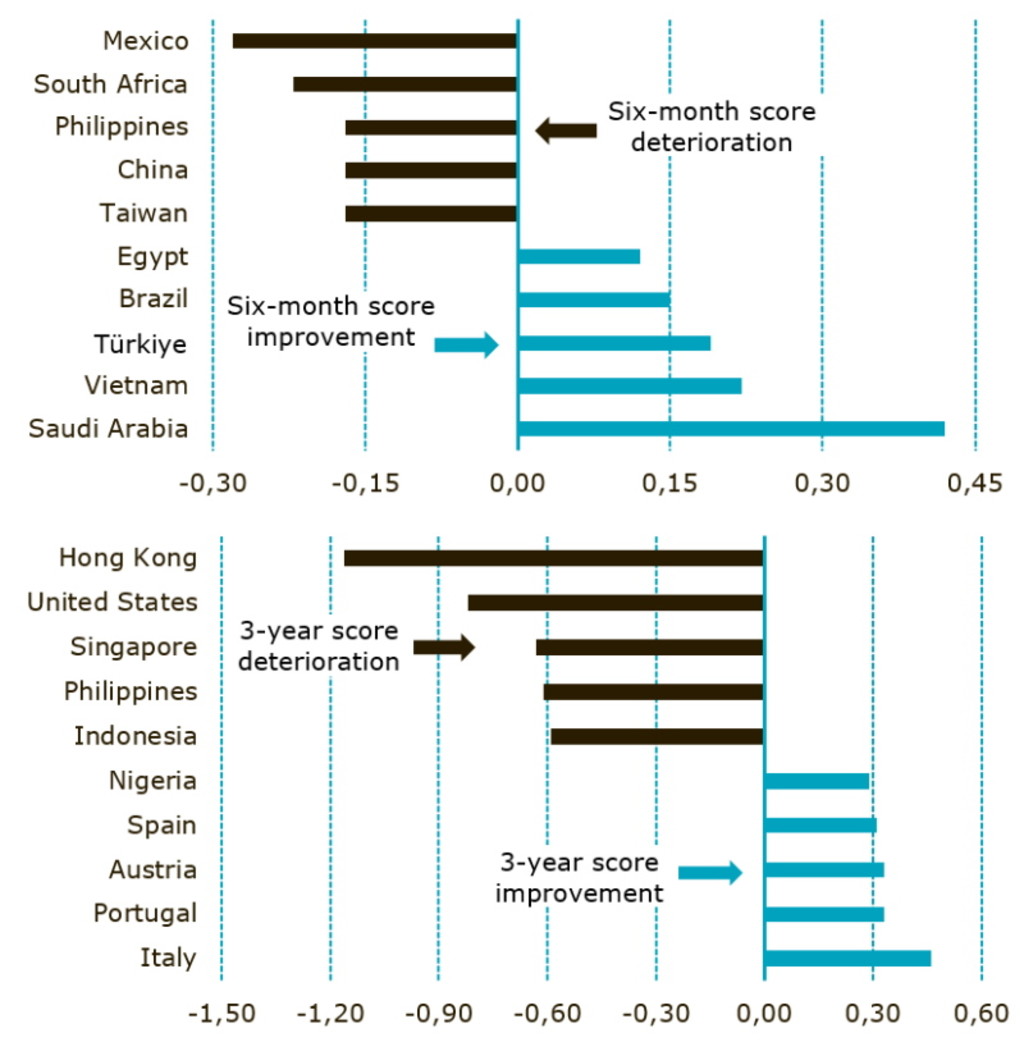
Data source: Robeco; data assessed as of October 2022
Data note: The chart displays countries with the largest score losses (left) and gains (right) over the past six months and three years ending October 2022. Only countries within the universe comprising the top-50 developed and emerging economies in terms of nominal GDP are shown.
Mexico, South Africa, the Philippines, China and Taiwan were the countries with the largest losses over the six months. Mexico’s scores were beat down by anti-democratic and anti-climate tendencies of its sitting president, Andres Manuel Lopez Obrador, or simply AMLO. Meanwhile, South Africa’s scores were mired down by poor health systems, lacking energy infrastructure, chronic corruption and persistent poverty and inequality. China, already a bottom-five performer among higher income nations, slid further still due to deteriorating social indicators. Growth in elderly populations is outpacing that of younger workers, threatening to hamper future growth and productivity and to deepen future public debt.
Southern Europe advances most over three years
Italy, Nigeria, Austria, Portugal and Spain saw the most improvements over a three-year horizon, driven by a mix of social and environmental factors including stronger labor force participation as well as better climate and energy performance.
Though Italy showed the largest score gains, the jury is still out on whether Giorgia Meloni, the new Italian PM, can continue the advance. Renewable energy investments, low carbon emissions and high recycling / waste control measures relative to the EU average, have lifted Italy’s environmental performance in recent years. The same applies to Italy's record on human rights. Yet, recurrent political turmoil has beleaguered other reforms and led to a slippage in key governance criteria over the past two decades. Strong governance is desperately needed to combat Italy’s structural challenges from low productivity and feeble economic growth to unfavorable demographics and high unemployment.
Political instability cast three-year shadow
Political risk and instability loomed large in three-year losses. Hong Kong led declines due to China’s long-standing interference with institutional and individual freedoms. The US too lost ground, owing to residual damage inflicted in the Trump era. Ground-breaking legislation from the Biden administration along with promising mid-term election results provide positive precursors for a recovery in US sustainability scores.
Rising political opposition, harsh economic conditions, and the Covid crisis, all stirred turbulence across Singapore in recent years, reflected in heightened political risks scores. Meanwhile, separatist movements and Islamic extremism have stoked political instability and strangled ESG performance in Indonesia. And while recent elections were favorable for Brazil’s sustainable future, they seemed less so for the Philippines where the offspring of two controversial former presidents have won the right to rule. Skeptics doubt a return to political normalcy and fear a further concentration of power and influence among a political elite.
Financial markets increasingly accept the critical link between country ESG data, economic prosperity and fiscal solvency
A sovereign tool
Financial markets increasingly accept the critical link between country ESG data, economic prosperity and fiscal solvency. Robust sustainability performance demonstrates political, economic, environmental and social stability – factors that promote economic growth, a solid fiscal position and positive long-term sovereign credit profiles. The opposite is also true; poor performance on ESG factors can signal foreboding risks that should give investors caution. Consistently strong correlations between Robeco’s Country Sustainability Ranking and key measures of sovereign bond risk bear this out and underscore its usefulness as a tool for making holistically informed investment decisions.
Footnote
1 As of June 2022, Türkiye (pronounced (tur-key-YAY) is now the official name of the country formerly known worldwide under the anglicized name of Turkey.
重要資料
本網站僅供《證券及期貨條例》(香港法例第571章)及其附屬法例所界定之專業投資者瀏覽及使用。 投資涉及風險。過往表現並不代表未來表現。本網站所載資料僅供參考之用,並不構成任何投資建議,亦非作出買賣任何證券或採納任何投資策略之要約或招攬。投資者不應僅憑本網站提供之資料作出投資決定,在作出任何投資決定前,應徵詢獨立意見(包括有關稅務影響之意見)。投資者應確保完全理解投資產品的相關風險,亦應考量自身投資目標及風險承受水平。投資乃閣下之個人決定。除非銷售投資產品的中介人已向閣下告知該投資產品適合閣下,並已解釋其符合閣下投資目標之原因,否則閣下不應投資。請參閱相關發售文件或其他法律文件,以獲取包括風險因素在內的進一步詳情。 本網站由荷寶投資管理香港有限公司發布,該公司受香港證券及期貨事務監察委員會(「證監會」)規管(中央編號:APU851)。本網站未經證監會審閱。 無法保證任何投資產品可實現其投資目標。概不就任何投資產品之表現或投資回報作任何聲明或承諾。投資的價值或會波動。本網站所載過往表現、推算或預測,均不應視作未來表現之保證或指標,且概不提供任何明示或暗示之保證。本網站內容建基於相信為可靠之來源,惟因應資料傳遞技術特性及須採用多項數據來源(包括第三方內容),故概不保證其準確性。所述觀點僅乃截至上述日期,或會隨市況變化而改變,可予更改而毋須另行通知。該等意見可能有別於其他荷寶投資專業人士之意見。因使用本材料或當中所載任何評論、意見或估算而引致之直接、間接或相應損失,荷寶概不承擔法律責任。荷寶並無責任更新本網站或任何網站內容。未經荷寶事先書面許可,不得複製、分發或刊發本網站任何材料。 除非另有說明,資料來源:荷寶。