
Impact Specialist


• 市場觀點
Finland tops country sustainability ranking for the first time
After decades in the shadows of its Nordic neighbors, Finland finally emerges as the new northern light for sustainability performance.
作者


Strategist
概要
- Strong energy and environmental policies help lift Finland to new heights
- Environment and governance were key differentiators in rankings
- Robeco country rankings correlate strongly with independent indices and sovereign ratings
In the autumn edition of the Robeco Country Sustainability ranking, Finland has emerged as the leader in country sustainability performance. This marks the first time Finland has received top honors after overcoming perennial ESG powerhouses, Sweden and Norway. Finland edged out Sweden, which fell to second, followed by the Scandinavian trio of Denmark, Norway and Iceland. Other high performers include European names as well as New Zealand, Australia and Canada.
In terms of low performers, South Africa, Egypt, India, Nigeria and Pakistan round out the bottom of the ranking when only considering the 50 countries in the investable universe (see Figure 1).
Finland outperformed the EU average across all 15 ESG criteria
Environment and governance were key performance differentiators, in the most recent ranking. Sweden lost ground in governance and was unable to compensate despite strong results for social and environmental dimensions. Finland outperformed the EU average across all 15 ESG criteria, however, its high environmental scores compared to both Scandinavian and European counterparts played the decisive role in elevating it to best performer in the final country sustainability assessment of 2021.
Finland’s strong environmental protection policies have been effective at reducing pollution, promoting natural conservation and safeguarding biodiversity. And with nearly a 40% share of renewables in the energy mix, it also leads the world in transitioning its energy sector to a low-carbon future. Moreover, robust institutions have helped it contain Covid-19 caseloads and largely avoid the pandemic’s economic knock-on effects.
Other nations have not fared so well. With the pandemic still raging, it is impossible at present to assess the full extent of the damage to sustainability performance. However, it is already clear that the pandemic has reversed progress across all ESG dimensions. Disparities in education, healthcare, poverty, and social inequalities are widening, with less developed nations suffering the biggest brunt. Democratic governance has also taken a hit, as authoritarian regimes over the world have manipulated economic uncertainties and social unrest to their own advantage. For the fifth straight year, governance data show the world moving towards anti-democratic structures.
Figure 1 | Top five and bottom five sustainability performers
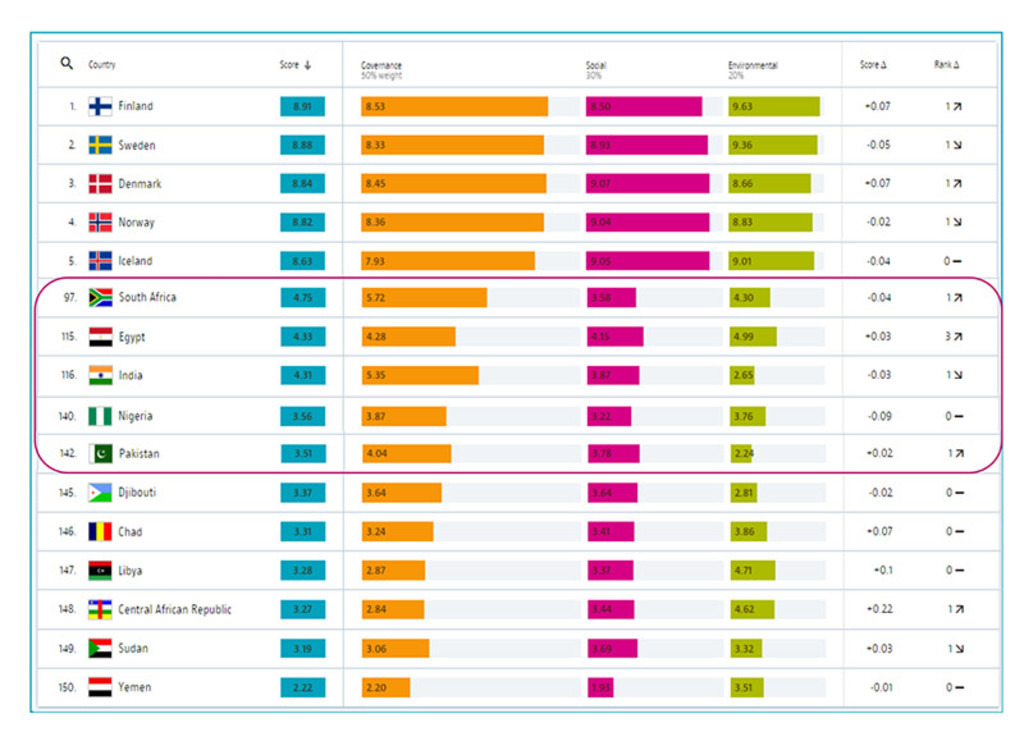
Data source: Robeco, Country sustainability scores as of October 2021
Data note: The five countries framed in the middle of the chart designate the bottom-five ranked emerging market countries within the investable universe, the top-50 developed and emerging economies in terms of nominal GDP. When considering all 150 countries of the ESG universe, Chad, Libya, Central African Republic, Sudan and Yemen occupy the bottom ranks.
Leaders in losses
Hong Kong leads the list of countries with the unsavory distinction of having the largest losses over the past three years. Its sustainability performance continues to weaken as mainland China maintains its attack on individual freedom and democratic privileges. In contrast, Turkey, Argentina and Nigeria’s governments have no one to blame but themselves for declines in their ESG scores and rank. At present, distrust and dysfunction characterize both their politics and their institutions with no hope for reform in sight.
France, India and Brazil join them on the list of countries with significant losses over the course of 2021. Though France has set a strong precedent for environmental leadership, its early gains are threatened by an over-reliance on nuclear and an under-investment in energy efficiency and renewables according to an IEA report. Moreover, Macron’s reform agenda has been hampered by Covid-19 and residual social inequalities still felt across many segments of French society.
Further east, India’s once shining star has been repeatedly tarnished by mismanagement, missteps and outright abuse. Abroad, Prime Minister Modi and his Hindu Nationalist party have taken a hard line in their approach to relations with neighbor Pakistan and nemesis China. At home, the government has taken an equally harsh stance on Muslims, fueling sectarian violence. What’s more, poverty and inequalities that have plagued Indian society are intensifying as a result of more Covid-19 outbreaks. A bright note against a backdrop of gloom is that Germany announced new commitments to support India’s energy transition and its fight against climate change.
Risers in the ranks
Even as Hong Kong suffers, Taiwan, has managed to evade negative impacts from an intimidating, power-hungry China and saw the largest advance in scores of any country over a three-year period. Major factors in its ascent include strong governance and innovation. South Korea, Saudi Arabia, and the United Arab Emirates also experienced gains thanks largely to governance (South Korea) and social reforms (Saudi Arabia and UAE).
In the Middle East, Israel and Qatar showed significant short-term gains. Qatar on the back of migrant labor reforms as it prepares to host the 2022 FIFA World Cup and Israel as a result of better human rights, reduced poverty and lower political risks. In Europe, the Czech Republic and Denmark were among European countries that improved their standings. Both showed better scores for corruption, political risk and overall economic equality.
Countries with strong ESG scores also enjoy higher sovereign ratings; conversely, low ESG scores correlate with lower ratings
了解最新的可持續性市場觀點
訂閱我們的電子報,探索塑造可持續投資的趨勢。
Confirmation, consensus and confidence
The strength and reliability of the Robeco Country Sustainability Ranking is confirmed when results are compared with highly respected indices from external institutions. More relevant for investors is the high correlation between Robeco’s country ranking and the sovereign ratings of Fitch, Moody’s and S&P. Countries with strong ESG scores also enjoy higher sovereign ratings; conversely, low ESG scores correlate with lower ratings. The strong correlation even extends to sovereign credit default swaps (CDS). High performing ESG countries have lower CDS spreads, whereas low performers tend to face higher spreads.
What are the most sustainable countries in the world?
The Country Sustainability Ranking is a comprehensive framework for analyzing countries’ performance on a wide range of ESG metrics.
重要資料
本網站僅供《證券及期貨條例》(香港法例第571章)及其附屬法例所界定之專業投資者瀏覽及使用。 投資涉及風險。過往表現並不代表未來表現。本網站所載資料僅供參考之用,並不構成任何投資建議,亦非作出買賣任何證券或採納任何投資策略之要約或招攬。投資者不應僅憑本網站提供之資料作出投資決定,在作出任何投資決定前,應徵詢獨立意見(包括有關稅務影響之意見)。投資者應確保完全理解投資產品的相關風險,亦應考量自身投資目標及風險承受水平。投資乃閣下之個人決定。除非銷售投資產品的中介人已向閣下告知該投資產品適合閣下,並已解釋其符合閣下投資目標之原因,否則閣下不應投資。請參閱相關發售文件或其他法律文件,以獲取包括風險因素在內的進一步詳情。 本網站由荷寶投資管理香港有限公司發布,該公司受香港證券及期貨事務監察委員會(「證監會」)規管(中央編號:APU851)。本網站未經證監會審閱。 無法保證任何投資產品可實現其投資目標。概不就任何投資產品之表現或投資回報作任何聲明或承諾。投資的價值或會波動。本網站所載過往表現、推算或預測,均不應視作未來表現之保證或指標,且概不提供任何明示或暗示之保證。本網站內容建基於相信為可靠之來源,惟因應資料傳遞技術特性及須採用多項數據來源(包括第三方內容),故概不保證其準確性。所述觀點僅乃截至上述日期,或會隨市況變化而改變,可予更改而毋須另行通知。該等意見可能有別於其他荷寶投資專業人士之意見。因使用本材料或當中所載任何評論、意見或估算而引致之直接、間接或相應損失,荷寶概不承擔法律責任。荷寶並無責任更新本網站或任何網站內容。未經荷寶事先書面許可,不得複製、分發或刊發本網站任何材料。 除非另有說明,資料來源:荷寶。