• Visión

Sustainable investing: The resilience premium

Is the sustainable investing winter over? After several years of weak flows, sustainable funds showed signs of recovery in 2026. In the US, flows turned positive in Q2, led by passive and fixed income funds; Asia saw more fund launches, particularly in China’s energy storage segment. Globally, sustainable funds attracted USD 4.6 billion in H1 2026, compared with USD 84 billion in outflows in 2025. Flows nevertheless remained far below the roughly USD 650 billion recorded at the 2021 peak.1

Autores/Autoras

    Sector Lead
    Head of Sustainability Integration

Resumen

  • Sustainable funds see large inflows in 2026 compared with outflows in 2025
  • Cybersecurity, critical minerals and tech sovereignty lead resilience themes
  • Energy security and climate change adaptation also opportunities for investors

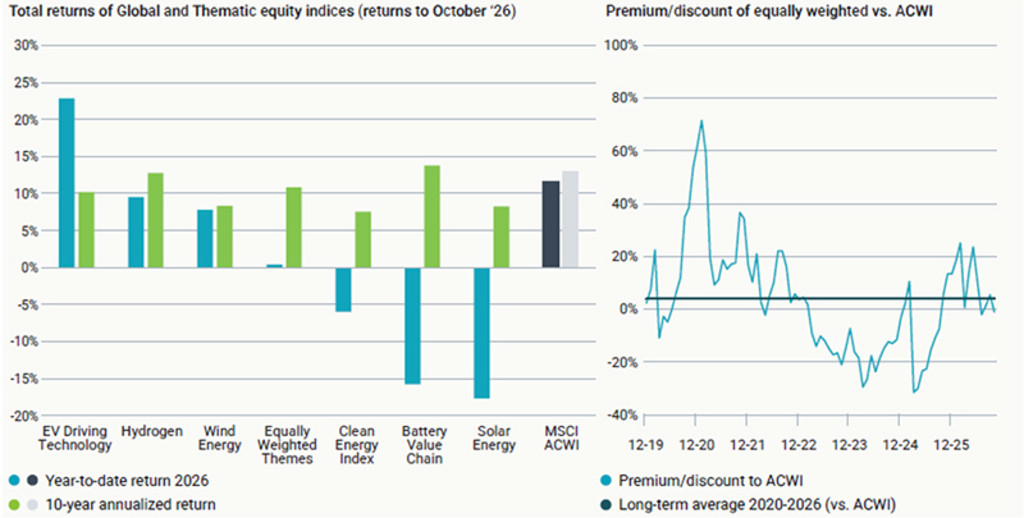
Through September 2026, sustainable equities outperformed globally by around 2%, lifting valuation premiums, although these remained below the long-term historical average.2 In fixed income, performance differences were limited, with sustainable benchmarks slightly underperforming. E-mobility, wind and hydrogen were among the best-performing themes. Performance divergence supports active theme selection.

Figure 1: Performance and relative valuation of sustainable themes

Source: Bloomberg, MSCI, Robeco, data as of October 2026. Indices are unmanaged, and one cannot invest directly in an index. They do not reflect any fees, expenses or sales charges.

Despite signs of recovery, it is too early to declare the end of the sustainable investing winter. Regardless of near-term fund flows, protecting economic, environmental and social assets remains essential for long-term returns, while growing investor interest in systemic resilience is creating new opportunities.

The resilience premium: Widening the lens of sustainable investing

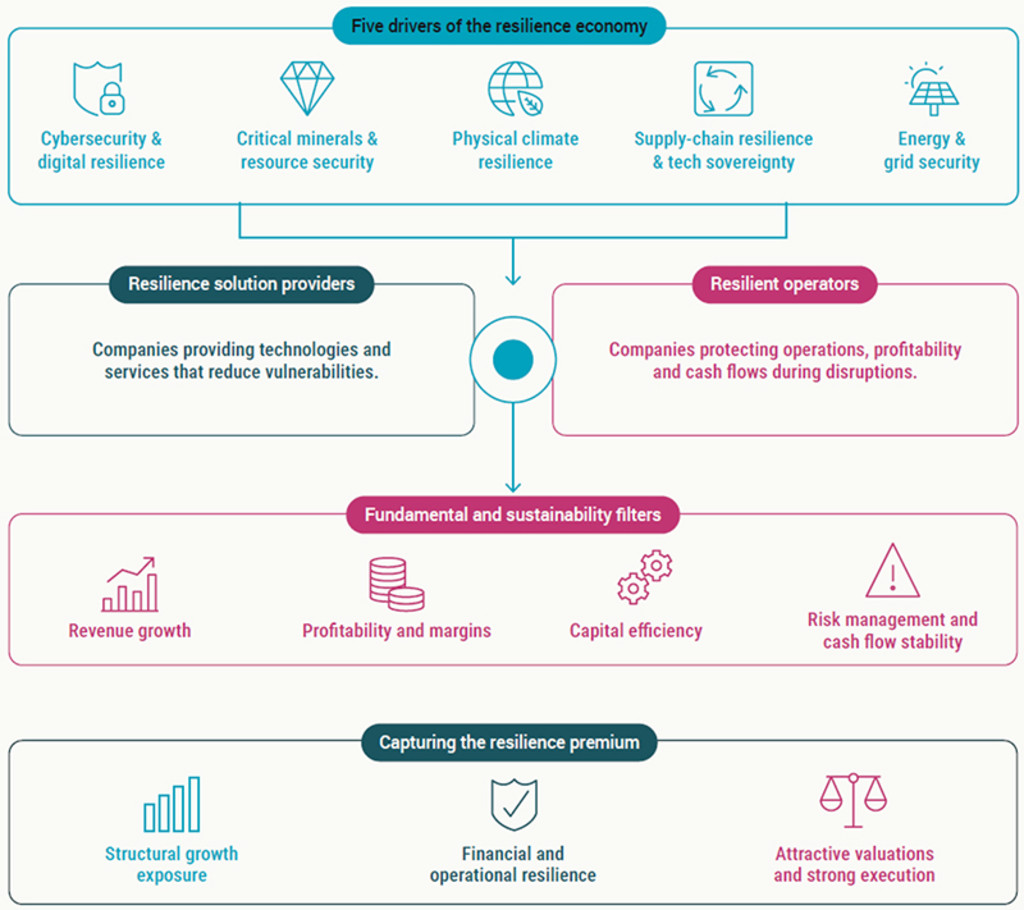
Geopolitical tensions, cyber threats, resource bottlenecks and extreme weather are making operational and systemic resilience central to corporate competitiveness. The shift from a ‘just-in-time’ to a ‘just-in-case’ economy is driving a multi-year investment cycle. In 2027, we see two opportunities within this emerging resilience economy:

  • Resilience solution providers: Companies supplying technologies, materials and services that reduce systemic vulnerabilities.

  • Resilient operators: Companies across sectors that maintain operations, margins and cash flows during disruptions.

Investment potential is strongest where these two strengths overlap. For solution providers, we assess resilience-related revenue exposure and growth, order backlogs and management targets. For resilient operators, we examine supplier diversification, production flexibility, inventory buffers and reshoring initiatives. Sector-specific indicators of operational continuity, margin stability and cash-flow protection help establish whether resilience creates financial value. Five pillars underpin the resilience economy:

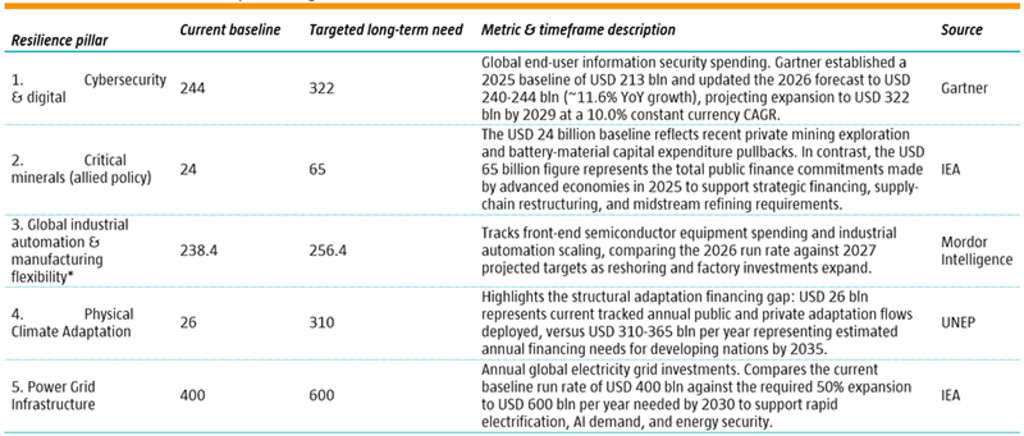
  1. Cybersecurity and digital resilience: As AI connects more industrial, financial and critical infrastructure systems, cyber protection becomes essential. Global end-user spending on information security is projected to reach USD 244 billion in 2026, representing 11.6% growth in constant currency terms.3 We favor providers with differentiated technology, recurring revenue and strong customer retention, while assessing their own cyber-risk governance.

  2. Critical minerals and resource security: Mineral processing remains a geopolitical chokepoint. In 2025, the largest refining country accounted for an average of 72% of refined output across key energy minerals, excluding rare earths, with China dominating most markets. Rare earth export controls threaten downstream industries outside China, while price volatility and geopolitical uncertainty contributed to a 9% decline in critical mineral investment in 2025, including a 20% drop in investment by companies focused on battery materials.4 Ownership of raw materials alone does not guarantee returns. We favor recycling, substitution and diversified refining, supported by cost discipline and long-term supply contracts.

  3. Supply-chain resilience and technology sovereignty: Dependence on single-source suppliers is encouraging reshoring and factory investment in semiconductors, manufacturing and healthcare. Yet spending alone does not guarantee shareholder returns. The global industrial automation market is projected to reach USD 373.6 billion by 2032.5 Equipment and automation leaders with defensible technology, pricing power and strong customer relationships are best positioned to turn this investment into sustained earnings growth.

  4. Physical climate resilience: Extreme heat, flooding and water scarcity are increasingly disrupting business operations, damaging assets and driving up insurance costs. The ongoing El Niño, which is expected to remain strong to very strong into early 2027, could disrupt agricultural production and consumer staples supply chains, increasing input costs and squeezing margins.67 Global insured catastrophe losses reached USD 135 billion in 2024,8 while developing countries face annual adaptation financing needs of USD 310-365 billion by 2035.9 For investors, opportunities lie in scalable solutions such as water treatment, industrial cooling, flood protection and climate-resilient agriculture, particularly companies with recurring revenue and strong pricing power.10

  5. Energy and infrastructure security: Rapid electrification, geopolitical uncertainty and AI-driven demand are straining aging power grids. Global electricity demand is forecast to grow by an average of 3.6% annually through 2030,11 requiring annual grid investment to rise by 50%, from USD 400 billion to USD 600 billion12 a year. We favor grid equipment, storage and power management companies with strong execution, pricing power and limited exposure to inflation-sensitive fixed-price contracts.

Figure 2: The resilience premium framework

Source: Robeco Sustainable Investing Research, October 2026. For illustrative purposes only. This does not constitute a binding element for investment selection.

Table 1: The resilience spending wave

Source: Gartner, IEA, SEMI, UNEP, Robeco. Data as of Q4 2026, Mordor Intelligence, 2026.

* This pillar tracks broader factory automation and smart-manufacturing systems (scaling toward USD 373.6 billion by 2032) rather than specialized wafer fabrication equipment. However, semiconductor companies are key end-users driving demand for these automation and manufacturing flexibility systems as they expand and re-shore production facilities.

The hidden cost of resilience: Who pays and who profits?

Higher resilience spending does not necessarily translate into better returns. High valuations, weak pricing power and execution risks can erode profitability, while reshoring and mineral processing can introduce environmental and social trade-offs. Sustainable investing research helps identify who benefits, who bears the costs and which risks traditional financial analysis may overlook.

Actionable outlook for 2027

We assess three criteria to identify companies positioned to capture the resilience premium:

  1. Structural growth: Exposure to long-term resilience demand and expanding revenue opportunities.

  2. Operational and financial strength: Flexible supply chains and pricing power that protect margins during disruptions.

  3. Valuation discipline: Strong execution, disciplined capital allocation and reasonable valuations.

Ultimately, the resilience premium accrues to companies that turn resilience investment and operational adaptability into lasting shareholder value.13

This article was originally published as a special feature in our 2027 Investment Outlook.

Footnotes

1 Morningstar Global Sustainable Fund flows; Q2 2026.
2Past performance is no guarantee of future results. The value of your investments may fluctuate.
3Gartner, Forecast Analysis: Information Security, Worldwide, 2026, 5 February 2026.
4International Energy Agency (IEA), Global Critical Minerals Outlook, 2026.
5Mordor Intelligence, Industrial Automation Market Size & Share Analysis, (2026), Mordor Intelligence Market Research
6Allianz Research (15 July 2026) – Super El Niño Risk: More Inflation in Asia, Oversupply in Latin America Yet Little Disruption in Financial Markets.
7Citi Research (25 June 2026) – Global Economic Outlook & Strategy: The Resilient Global Economy – Cascading Supply Shocks.
8 Swiss Re Annual Report 2024
9UNEP Adaptation Gap Report 2025
10Barclays Research (21 September 2026) – Sustainable Investing: Adaptation in Action – A Global Universe of Solution Providers.
11International Energy Agency (IEA), Electricity 2026 (February 2026).12Deutsche Bank Research, DeBLASEing the Trail, October 2026.
13Investing in financial instruments carries risks, including potential loss of your invested capital. Investors may not get back the amount originally invested. Assess your financial situation and risk tolerance carefully and seek independent advice if needed.

2027 Investment outlook

The forces beneath the surface

Discover more

Morningstar disclaimer:
All Rights Reserved. The information, data, analyses and opinions (“Information”) contained herein: (1) include the proprietary information of Morningstar and its contentproviders; (2) may not be copied or redistributed except as specifically authorised; (3) do not constitute investment advice; (4) are provided solely for informational purposes; (5) are not warranted to be complete, accurate or timely; and (6) may be drawn from data published on various dates. Morningstar is not responsible for any trading decisions, damages or other losses related to the Information or its use. Please verify all of the Information before using it and don’t make any investment decision except upon the advice of a professional financial adviser. Past performance is no guarantee of future results. The value and income derived from investments may go down as well as up.

MSCI disclaimer:
Source: MSCI. The MSCI information may only be used for your internal use, may not be reproduced or redisseminated in any form and may not be used as a basis for or a component of any financial instruments or products or indices. None of the MSCI information is intended to constitute investment advice or a recommendation to make (or refrain from making) any kind of investment decision and may not be relied on as such. Historical data and analysis should not be taken as an indication or guarantee of any future performance analysis, forecast or prediction. The MSCI information is provided on an "as is" basis and the user of this information assumes the entire risk of any use made of this information. MSCI, each of its affiliates and each other person involved in or related to compiling, computing or creating any MSCI information (collectively, the "MSCI Parties") expressly disclaims all warranties (including, without limitation, any warranties of originality, accuracy, completeness, timeliness, non-infringement, merchantability and fitness for a particular purpose) with respect to this information. Without limiting any of the foregoing, in no event shall any MSCI Party have any liability for any direct, indirect, special, incidental, punitive, consequential (including, without limitation, lost profits) or any other damages. (www.msci.com)

Bloomberg disclaimer:
The following are trademarks and service marks of Bloomberg Finance L.P., a Delaware limited partnership, or its subsidiaries: BLOOMBERG, BLOOMBERG ANYWHERE, BLOOMBERG MARKETS, BLOOMBERG NEWS, BLOOMBERG PROFESSIONAL, BLOOMBERG TERMINAL and BLOOMBERG.COM: Absence of any trademark or service mark from this list does not waive Bloomberg's intellectual property rights in that name, mark or logo. All rights reserved.

Mantengamos la conversación

Manténgase al día de los constantes cambios en inversión sostenible y factorial, tendencias y crédito.

No se lo pierda

El objetivo de Robeco es proporcionar a sus clientes unos rendimientos y soluciones de inversión superiores para que consigan sus objetivos financieros y de sostenibilidad.

Información importante
Los Fondos Robeco Capital Growth no han sido inscritos conforme a la Ley de sociedades de inversión de Estados Unidos (United States Investment Company Act) de 1940, en su versión en vigor, ni conforme a la Ley de valores de Estados Unidos (United States Securities Act) de 1933, en su versión en vigor. Ninguna de las acciones puede ser ofrecida o vendida, directa o indirectamente, en los Estados Unidos ni a ninguna Persona estadounidense en el sentido de la Regulation S promulgada en virtud de la Ley de Valores de 1933, en su versión en vigor (en lo sucesivo, la “Ley de Valores”)). Asimismo, Robeco Institutional Asset Management B.V. (Robeco) no presta servicios de asesoramiento de inversión, ni da a entender que puede ofrecer este tipo de servicios, en los Estados Unidos ni a ninguna Persona estadounidense (en el sentido de la Regulation S promulgada en virtud de la Ley de Valores). Este sitio Web está únicamente destinado a su uso por Personas no estadounidenses fuera de Estados Unidos (en el sentido de la Regulation S promulgada en virtud de la Ley de Valores) que sean inversores profesionales o fiduciarios profesionales que representen a dichos inversores que no sean Personas estadounidenses. Al hacer clic en el botón “Acepto” que se encuentra en el aviso sobre descargo de responsabilidad de nuestro sitio Web y acceder a la información que se encuentra en dicho sitio, incluidos sus subdominios, usted confirma y acepta lo siguiente: (i) que ha leído, comprendido y aceptado el presente aviso legal, (ii) que se ha informado de las restricciones legales aplicables y que, al acceder a la información contenida en este sitio Web, manifiesta que no infringe, ni provocará que Robeco o alguna de sus entidades o emisores vinculados infrinjan, ninguna ley aplicable, por lo que usted está legalmente autorizado a acceder a dicha información, en su propio nombre y en representación de sus clientes de asesoramiento de inversión, en su caso, (iii) que usted comprende y acepta que determinada información contenida en el presente documento se refiere a valores que no han sido inscritos en virtud de la Ley de Valores, y que solo pueden venderse u ofrecerse fuera de Estados Unidos y únicamente por cuenta o en beneficio de Personas no estadounidenses (en el sentido de la Regulation S promulgada en virtud de la Ley de Valores), (iv) que usted es, o actúa como asesor de inversión discrecional en representación de, una Persona no estadounidense (en el sentido de la Regulation S promulgada en virtud de la Ley de Valores) situada fuera de los Estados Unidos y (v) que usted es, o actúa como asesor de inversión discrecional en representación de, un inversión profesional no minorista.


El acceso a este sitio Web ha sido limitado, de manera que no constituya intento de venta dirigida (según se define este concepto en la Regulation S promulgada en virtud de la Ley de Valores) en Estados Unidos, y que no pueda entenderse que a través del mismo Robeco dé a entender al público estadounidense en general que ofrece servicios de asesoramiento de inversión. Nada de lo aquí señalado constituye una oferta de venta de valores o la promoción de una oferta de compra de valores en ninguna jurisdicción. Nos reservamos el derecho a denegar acceso a cualquier visitante, incluidos, a título únicamente ilustrativo, aquellos visitantes con direcciones IP ubicadas en Estados Unidos. Este sitio Web ha sido cuidadosamente elaborado por Robeco. La información de esta publicación proviene de fuentes que son consideradas fiables. Robeco no es responsable de la exactitud o de la exhaustividad de los hechos, opiniones, expectativas y resultados referidos en la misma. Aunque en la elaboración de este sitio Web se ha extremado la precaución, no aceptamos responsabilidad alguna por los daños de ningún tipo que se deriven de una información incorrecta o incompleta. El presente sitio Web podrá sufrir cambios sin previo aviso. El valor de las inversiones puede fluctuar. Rendimientos anteriores no son garantía de resultados futuros. Si la divisa en que se expresa el rendimiento pasado difiere de la divisa del país en que usted reside, tenga en cuenta que el rendimiento mostrado podría aumentar o disminuir al convertirlo a su divisa local debido a las fluctuaciones de los tipos de cambio. Para inversores profesionales únicamente. Prohibida su comunicación al público en general.