• Insight

Could French bond stress change the ECB's course?

France’s fiscal and political risks are putting pressure on its government bonds We examine how wider French bond spreads could affect the ECB’s interest rate outlook and what this means for sovereign bond investors.

Authors

    Strategist
    Strategist
    Strategist

Summary

  • Spillovers from French bond stress could delay ECB hikes
  • Fed, ECB and BoJ look set to hike in December
  • Fed and ECB could hike again in Q1 before peaking

Why are French bonds under pressure?

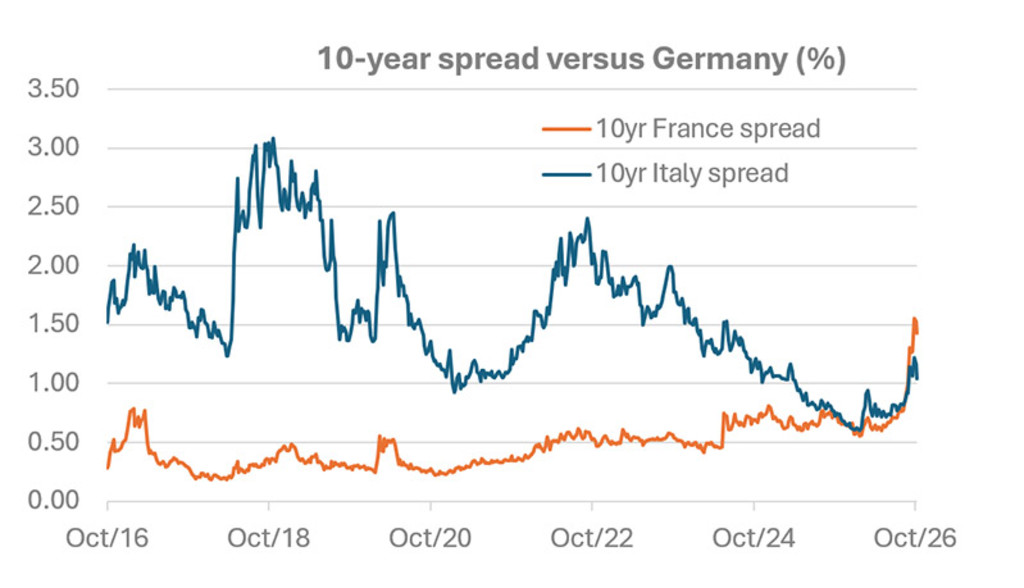
Spreads have risen again recently, as the market has been giving greater attention to difficult budget negotiations and opinion polls for next spring’s presidential election. Social unrest has added to the pressure. These developments suggest that fiscal consolidation will be difficult over both shorter and longer horizons.

Debt dynamics have become even more important with rising interest expenses. If current fiscal policies persist, French debt could easily rise to 137% of GDP by 2030, a level similar to Italy’s. Interest payments alone could then reach 5% of GDP, making deficit reduction even more difficult. Rising debt levels and a lack of policies to curb fiscal deficits would put continued pressure on the credit rating and potential demand for French OATs.

When does a French problem become a European one?

The market scare in French bonds has also affected spreads for lower-rated euro-area government bonds, such as Italian BTPs and Greek government bonds. Euro government-related and corporate bonds have also experienced pressure on their spreads.

A rapid further widening in countries such as Italy and Greece would signal broader stress. Spreads on shorter-maturity bonds will be monitored closely, as will pressure on European banks’ share prices and credit spreads.

Source: Bloomberg,1 November 2026.

Could bond-market pressure change the ECB’s next moves?

Elevated energy prices underpin our expectation of ECB hikes in December and March. However, further material widening in French spreads, accompanied by spillovers, could cause hikes to be skipped.

There is probably no magic level. The speed of spread widening and its breadth outside France will play important roles. Material widening in shorter-maturity bonds can be an early sign that stress may be intensifying. Postponing further hikes could then help calm market concerns to some extent.

What’s new in credits?

Stay ahead with our newsletter on the latest in credit investing.

Discover credits

What other measures could the ECB take?

If tensions in the OAT market continue to spread to other sovereign debt markets, pressure on the ECB may increase to the point where intervention becomes unavoidable. The ECB could initially intervene verbally by reminding markets of its Transmission Protection Instrument (TPI). The instrument allows the ECB to buy bonds from eligible euro-area countries if unwarranted, disorderly market moves threaten the transmission of monetary policy across the euro area.

In our view, there should ultimately be enough flexibility in the TPI rules to allow bond purchases, including OATs. However, there is a high hurdle to activating the tool, as it could give policymakers the wrong incentives – the problem of moral hazard.

Are investors being paid enough to take French risk?

Uncertainty around the French fiscal outlook is likely to remain elevated in the coming months. While there may be room for temporary relief rallies after significant widening, the outlook going into the election will probably remain difficult for French OATs. Pressure on France’s credit rating is also likely to continue.

We will continue to trade French OATs actively.2 For now, the outlook remains challenging, but we remain open to buying French debt, depending on spread levels and political developments.

What is the team monitoring across euro-area sovereign bonds?

Some issuers have seen significant spread widening even though their credit profiles remain strong (the EU) or have improved significantly (Greece and Portugal). For France, quick approval of the 2027 budget or stronger support in opinion polls for centrist candidates with fiscal consolidation plans would be positive signals.

Footnotes

1 The following are trademarks and service marks of Bloomberg Finance L.P., a Delaware limited partnership, or its subsidiaries: BLOOMBERG, BLOOMBERG ANYWHERE, BLOOMBERG MARKETS, BLOOMBERG NEWS, BLOOMBERG PROFESSIONAL, BLOOMBERG TERMINAL and BLOOMBERG.COM: Absence of any trademark or service mark from this list does not waive Bloomberg's intellectual property rights in that name, mark or logo.
2 Specific issuers or securities are for illustrative and factual market review purposes only and do not constitute an investment recommendation or financial advice.

Warning – Fraudulent use of Robeco on websites and social media Read more