

Chief Researcher


• Insight
What increased index concentration means for active investors
Mega-cap dominance has reshaped the landscape of active investing, creating both opportunities and risks. While their meteoric growth has driven innovation as well as outsized returns, tech giants have also made markets more vulnerable. In recent research we zoom in on the implications of increased index concentration for active investors.
Authors



Summary
- Mega-tech dominance has increased risks and opportunities
- Smart beta strategies especially face challenges from index concentration
- Tracking error-controlled multi-factor strategies help mitigate risks
Over the past decade, the stock market has undergone a dramatic transformation, with market value increasingly concentrated in a small number of giants related to the technology sector. The group’s composition and nickname has evolved over the years, from FAANG to the Magnificent Seven to the latest, BATMMAAN.
This growing dominance has had a profound impact on index composition and market behavior. The weight of the five biggest stocks in the MSCI World index has grown from around 6% in 2015 to nearly 20% nowadays. Similarly, the weight of the top ten has risen from less than 10% to over 25% today.
Discover the value of quant
Subscribe for cutting-edge quant strategies and insights.
Smart beta challenges
The concentration of market returns in a handful of mega caps has created a dilemma for single-factor ‘smart beta’ strategies. These indices often take large overweight or underweight positions in individual stocks – either doubling up on a stock that is already significant in the market index or taking no position at all.
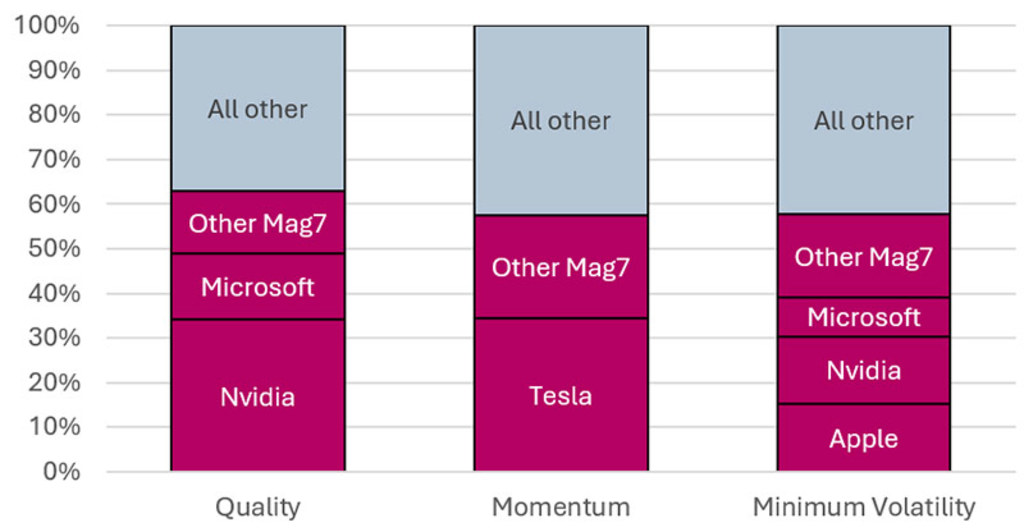
To illustrate the implications of smart beta portfolio design choices, we consider the MSCI World Quality, Momentum, and Minimum Volatility indices over the seven-year period from 2018 to 2024. The Quality index was the best performer over this period, with a cumulative outperformance of around 50%, followed by the Momentum index with almost 30% outperformance. Notably, Figure 1 shows that over 60% of the outperformance of the Quality index can be attributed to the Magnificent Seven stocks, and over 50% for the Momentum index.
In contrast, the Minimum Volatility index underperformed by 55%, as its methodology largely ignored these mega-cap stocks. This illustrates how factor strategies that do not carefully handle index concentration risk may end up primarily exposed to idiosyncratic risk rather than true factor premiums, raising questions about whether their returns are truly factor-driven.
Figure 1 | Outperformance decomposition MSCI Quality, Momentum and Minimum Volatility indices, 2018-2024
Source: Robeco, MSCI. This chart is for illustrative purposes only.
The case for tracking error-controlled multi-factor strategies
Given the challenges posed by increased index concentration, a more resilient approach is needed. We find that multi-factor strategies with tracking error management, such as enhanced indexing, provided risk-adjusted performance that should be largely immune to increased index concentration.
Enhanced indexing portfolios typically achieve this by taking a large number of small overweight positions in stocks with attractive factor characteristics, together with a large number of small underweight positions in unattractive stocks. By tightly limiting the active position in each individual stock, the idiosyncratic risk of the portfolio is contained.
Although a slight reduction of the transfer coefficient cannot be avoided as index concentration increases, the impact on bottom-line performance is comparatively minor. We conclude that tracking error control is crucial to prevent active management from degenerating into a binary bet on the fortunes of a few dominant tech stocks.
Conclusion
The rise of mega tech stocks has created new dynamics in active portfolio management. Smart beta indices have not adapted their methodologies to the increased concentration of the market index and take big over- and underweights in mega caps that can make or break their performance.
By contrast, the performance of diversified factor strategies with tracking error management is largely unaffected by increased index concentration. While it has become slightly more difficult to implement ideal underweights, the impact on overall performance is minor.
We conclude that no active strategy is completely immune to the effects of increased index concentration, but proper tracking error control is essential. This ensures that active management does not become a binary bet on the fortunes of a few tech giants.
Important information
THIS WEBSITE IS SOLELY INTENDED FOR PROFESSIONAL INVESTORS, WHICH HAS THE MEANING ASCRIBED TO IT IN THE SECURITIES AND FUTURES ORDINANCE (CAP. 571 OF THE LAWS OF HONG KONG) AND ITS SUBSIDIARY LEGISLATION. Investment involves risks. Past performance is not indicative of future performance. The information contained in this website is provided for reference only and does not constitute investment advice or an offer or solicitation to buy or sell in any securities or to adopt any investment strategy. Investors should not base their investment decisions solely on the information provided on this website and are advised to seek independent advice (including advice on tax implications) before making any investment decisions. Investors should ensure they fully understand the risks associated with the investment products and should also consider their own investment objectives and risk tolerance level. The investment decision is yours. You should not invest unless the intermediary who sells you the investment products has advised you that it is suitable for you and has explained how it is consistent with your investment objectives. Please refer to the relevant offering documents or other legal documents for further details including the risk factors. This website is published by Robeco Hong Kong Limited which is regulated by the Hong Kong Securities and Futures Commission (“SFC”) (CE No. APU851). This website has not been reviewed by the SFC. No assurance can be given that the investment objective of any investment products will be achieved. No representation or promise as to the performance of any investment products or the return on an investment is made. The value of investments may fluctuate. Past performance, projections, or forecasts included in this website should not be regarded as guarantees or indications of future performance, and no express or implied warranty is provided. The contents of this website are based on sources believed to be reliable, but due to the nature of information delivery technology and the necessity of using multiple data sources, including third party content, their accuracy is not guaranteed. The opinions expressed are as of the date shown above and may change as market conditions evolve, and are subject to change without notice. These opinions may differ from those of other Robeco investment professionals. Robeco accepts no liability for any direct, indirect, or consequential loss arising from the use of this material or any comments, opinions, or estimates contained herein. Robeco has no duty to update this website or any website content. Materials on this website may not be reproduced, distributed, or published without prior written permission from Robeco. Unless otherwise specified, Source: Robeco.