

Head of Fixed Income Asia


• Insight
Emerging markets credit: Untapped growth
After surviving an aggressive US rate-hiking cycle and China's economic downturn, emerging markets credit has had a strong 2024. And the future looks promising.
Authors


Meena Santhosh
Client Portfolio Manager
Summary
- Competitive risk-adjusted returns and diversification
- Exposure to high-growth regions driving global economic and sustainable solutions
- Robeco has positioned strategies to capitalize on long-term growth
Emerging markets credit has proven its resilience throughout 2024, navigating both macroeconomic headwinds and regional challenges. A key factor behind this performance has been the proactive policy responses from EM central banks, which, by acting ahead of their developed market counterparts have been able to stabilize growth and control inflation. The early rate cuts create a more favorable environment for corporate debt issuers, strengthening corporate financial positions and lowering default risks.
Over the past decade, emerging market central banks have enhanced their market credibility, allowing greater independence from the Fed in setting policy. This flexibility has enabled EM central banks to respond more effectively to their domestic economic conditions, helping them manage inflation and growth more successfully. As the Fed continues its rate cuts, a softer dollar could further benefit EM markets by appreciating local currencies and reducing debt costs for EM issuers.
EM credit has evolved into a distinct, stand-alone asset class. The JPM Corporate EMBI Broad Diversified index, one of the most widely used benchmarks, has grown to nearly USD 500 billion. However, the broader investment universe for external EM corporates exceeds USD 1.5 trillion, suggesting that strict index rules leave significant portions of the market untapped. This growth has sparked increasing institutional interest, boosting trading volumes, and deepening market liquidity. As a result, investors can find hidden value in segments of the EM credit market that lie beyond standard benchmarks.
Sustainability and transition investing: a growth driver
A key factor in the growth of emerging markets has been the rise of transition investing, as businesses across emerging markets shift toward more sustainable and resilient models. According to PWC, EM economies could grow around twice as fast as DM economies, and by 2050 six of the seven largest economies will be what we currently consider EM countries1. The rapid growth of these regions, which account for 65% of GHG emissions and over 80% of the world’s population, brings significant challenges, particularly as they face the most severe impacts of climate change.
From a fixed income perspective there are a couple of instruments available to finance the transition. Green bonds, where the proceeds are exclusively applied to finance eligible climate projects, is a great example. This market is expanding rapidly, especially in emerging markets. Green bond sales in this region has risen nearly 50% year-to-date, highlighting the region’s growing role in sustainable finance.
Emerging market companies are often underrated relative to their strong fundamentals
An alternative is to select companies that are at the beginning of their journey to combat climate change. Investments in hard-to-abate sectors, like energy, materials, and utilities, are needed if we want to decarbonize and limit global temperature rise. Any company that is currently preparing for a low-carbon future will have a significant advantage over those that are not. Using our proprietary forward-looking IP allows us to pinpoint companies that have credible plans to eventually reach net zero in 2050. A good example is a Mexican cement producer, which at this point is perhaps too dirty, but has the right investments in place to be one of the market leaders in driving the transition. Selecting these types of investments not only drives our ability to transition, but also to generate the best risk-adjusted returns possible. We have strategically positioned our EM strategies as transition-focused to align with these emerging trends.
However, the impact aspect of EM credits is not the only story. Here we unpack the many opportunities for investors within this asset class.
Superior risk-adjusted returns
Emerging market companies are often underrated relative to their strong fundamentals. This is partly due to the country ceiling approach used by rating agencies, which caps a company's credit rating based on the sovereign rating of its home country, regardless of the company’s financial robustness. As a result, many high-quality emerging market companies are assigned lower ratings than their balance sheets suggest, creating an opportunity for investors to capture higher yields.
This is why emerging markets corporate bonds (CEMBI Broad Div) offer better risk-adjusted returns than developed market bonds, as demonstrated by higher Sharpe ratios, stronger cumulative returns, and relatively favorable annual returns, despite higher volatility. Figure 1 illustrates that over the long term, emerging markets credit proves more attractive than other credit asset classes, delivering consistently strong performance.
Diversification and resilience
Despite facing two major downturns in the past decade — Latin America's commodity crisis in 2015 and Asia's property bust in 2020 — emerging markets have demonstrated resilience through stronger, proactive policies and corporate deleveraging. These events have also highlighted the disconnection between emerging market economies and developed markets, as well as within EM regions. While Asia thrived during the commodity crisis, Latin American credits outperformed during Asia’s slowdown. This shows the significant diversification benefits of emerging markets credits, making them a compelling asset class for investors seeking both stability and growth potential.
Sharpe ratio of various asset classes: CEMBI IG has a compelling Sharpe ratio
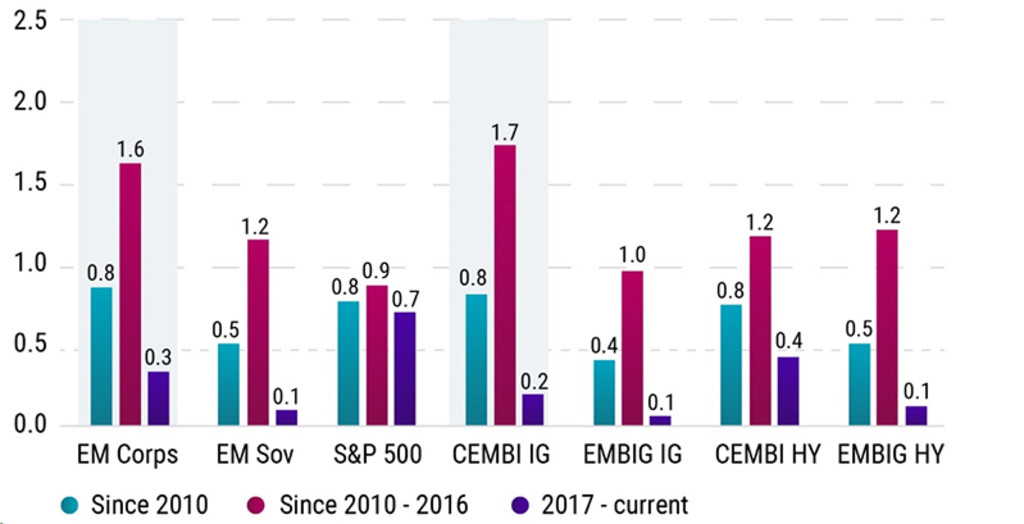
Source: JPM, August 2024. EM Corps (corporate bonds), EM Sov (sovereign bonds), S&P 500 (equities), CEMBI IG (corporate investment grade), EMBIG IG (sovereign investment grade), CEMBI HY (corporate high yield), EMBIG HY (sovereign high yield).
Our solutions: Positioned to capture flows
Emerging markets credit has proven its resilience in 2024, overcoming global challenges while offering attractive yields and diversification. As capital increasingly seeks companies capable of transitioning, Robeco is positioned ahead of the curve. Our Transition Emerging Credits strategy focuses on hard currency bonds, which are more widely traded and typically less volatile. Combined with our robust credit framework and strong sustainability focus, this approach has allowed us to consistently outperform the market over time.
Footnote
Important information
THIS WEBSITE IS SOLELY INTENDED FOR PROFESSIONAL INVESTORS, WHICH HAS THE MEANING ASCRIBED TO IT IN THE SECURITIES AND FUTURES ORDINANCE (CAP. 571 OF THE LAWS OF HONG KONG) AND ITS SUBSIDIARY LEGISLATION. Investment involves risks. Past performance is not indicative of future performance. The information contained in this website is provided for reference only and does not constitute investment advice or an offer or solicitation to buy or sell in any securities or to adopt any investment strategy. Investors should not base their investment decisions solely on the information provided on this website and are advised to seek independent advice (including advice on tax implications) before making any investment decisions. Investors should ensure they fully understand the risks associated with the investment products and should also consider their own investment objectives and risk tolerance level. The investment decision is yours. You should not invest unless the intermediary who sells you the investment products has advised you that it is suitable for you and has explained how it is consistent with your investment objectives. Please refer to the relevant offering documents or other legal documents for further details including the risk factors. This website is published by Robeco Hong Kong Limited which is regulated by the Hong Kong Securities and Futures Commission (“SFC”) (CE No. APU851). This website has not been reviewed by the SFC. No assurance can be given that the investment objective of any investment products will be achieved. No representation or promise as to the performance of any investment products or the return on an investment is made. The value of investments may fluctuate. Past performance, projections, or forecasts included in this website should not be regarded as guarantees or indications of future performance, and no express or implied warranty is provided. The contents of this website are based on sources believed to be reliable, but due to the nature of information delivery technology and the necessity of using multiple data sources, including third party content, their accuracy is not guaranteed. The opinions expressed are as of the date shown above and may change as market conditions evolve, and are subject to change without notice. These opinions may differ from those of other Robeco investment professionals. Robeco accepts no liability for any direct, indirect, or consequential loss arising from the use of this material or any comments, opinions, or estimates contained herein. Robeco has no duty to update this website or any website content. Materials on this website may not be reproduced, distributed, or published without prior written permission from Robeco. Unless otherwise specified, Source: Robeco.