

Head of SI Thought Leadership and Climate & Biodiversity Strategist
• Insight
Physical climate risks are reshaping asset prices and investment strategies
The impact of climate change is becoming more important to investors, with physical risks expected to affect asset prices even over the near term, the Robeco Global Climate Investing Survey 2026 shows.
Authors


Summary
- Two-thirds of investors think physical climate risks will impact asset prices
- Respondents believe this is already happening within the next five years
- Nearly half eye potential returns from adaptation and resilience solutions
Global warming’s increasingly destructive effects, seen in the wildfires that led to a quarter of a million people in Europe being evacuated this summer and the extreme heatwaves affecting industry and labor productivity, are now top of mind for investors. It provided one of the most striking responses in the sixth annual Robeco survey of 300 financial firms in the investment industry.
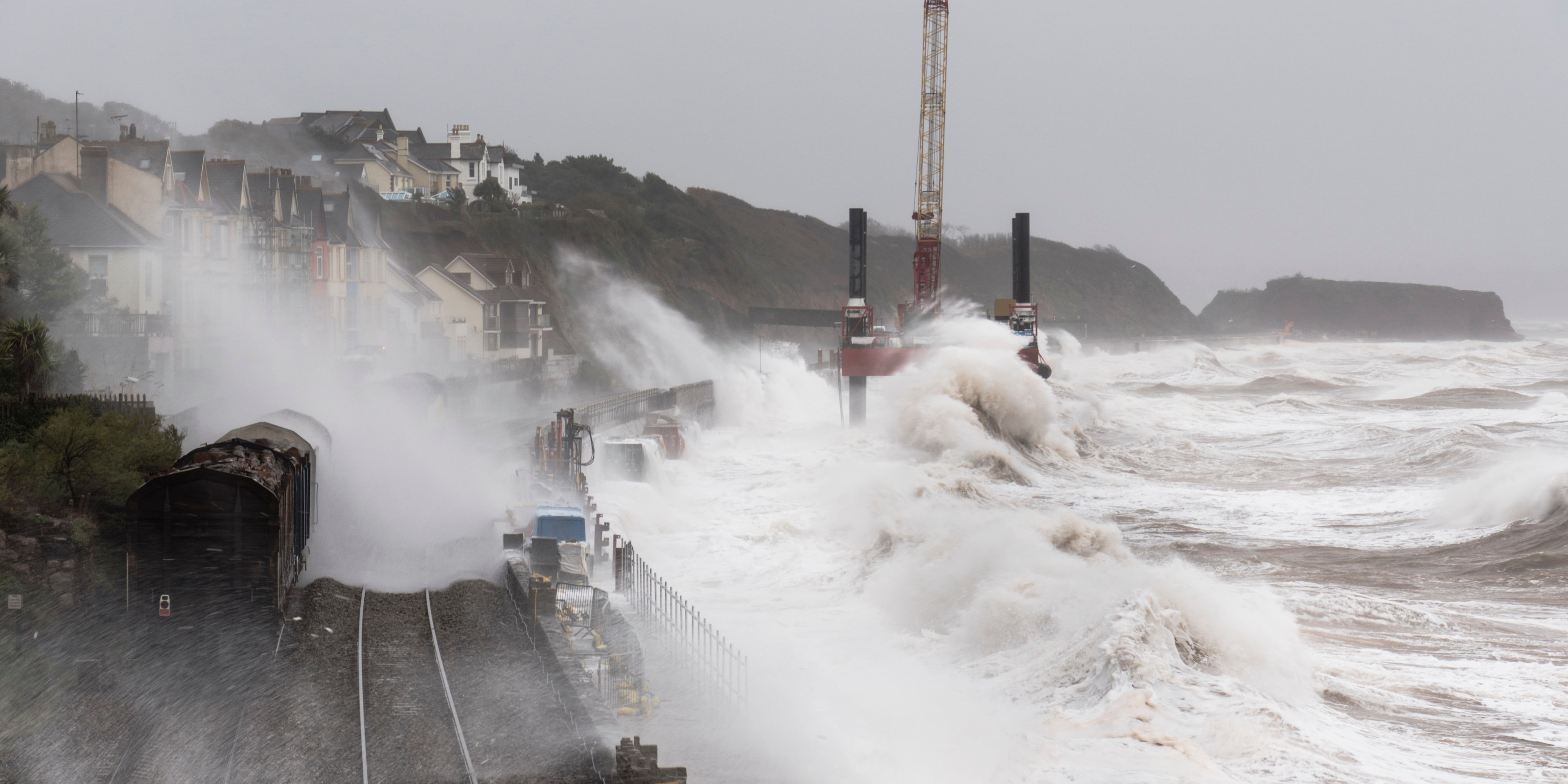
Physical risks are classified as either acute , such as the storms, droughts, forest fires and floods that now occur regularly all over the world, or chronic, such as rising sea levels, thawing permafrost, ocean acidification and falling crop yields that may have significant long-term economic and societal consequences.
Financial impacts are already evident, including billions in insurance claims for weather damage, with insurance cover being pulled in certain markets such as housing in Florida, California and Louisiana, along with costly disruptions to infrastructure such as railway lines from extreme heat or cold.
“Physical climate risk is no longer only a long-term sustainability consideration,” says Lucian Peppelenbos, Climate and Biodiversity Strategist at Robeco. “Investors increasingly expect it to affect valuations, capital allocation and security selection within conventional investment horizons.”
In the 2026 survey, 66% of investors said they expect physical climate risks to have a moderate to significant impact on asset prices over the next five years, rising to 82% over 10 years and 87% over 20 years.
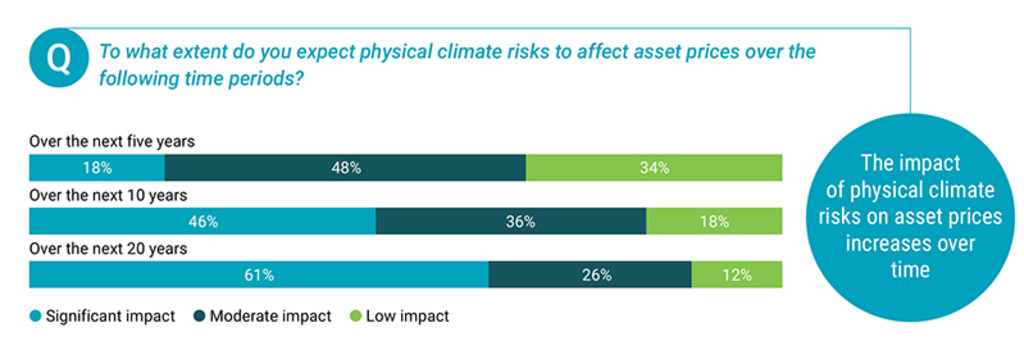
Source: Robeco Global Climate Investing Survey 2026.
Regionally, European and APAC investors are more likely to expect physical risks to have an impact on asset prices and investment activities than their peers in North America.
A similar picture emerges when investors were asked to what extent they expected physical climate risks to have an impact on investment activities within their firm. Some 64% said it would have a significant or moderate impact on risk budgeting and 63% said it would affect strategic asset allocation. It also has implications for a majority of respondents (above 50%) for tactical asset allocation, capital market assumptions, asset manager selection and stock picking.
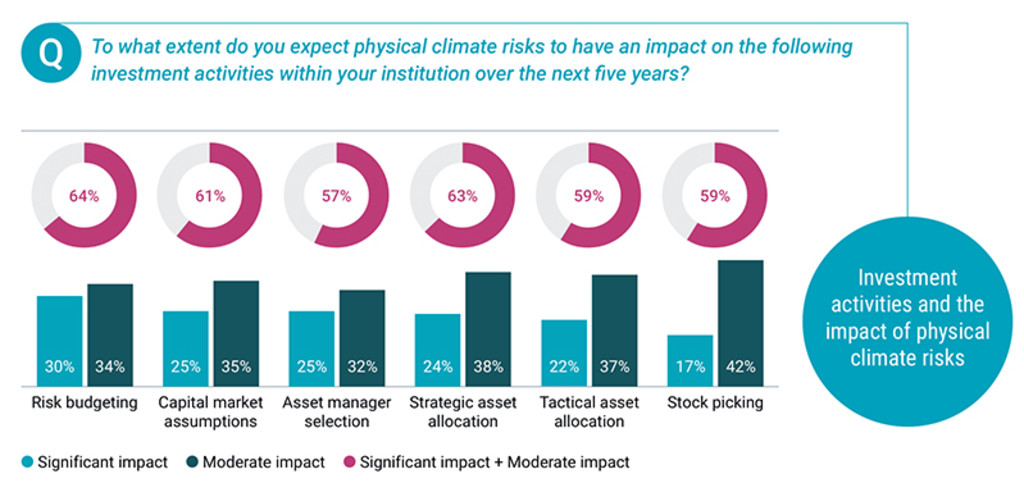
Source: Robeco Global Climate Investing Survey 2026.
The very presence of physical risks was also a major factor in 47% of investors thinking that not enough is being done to meet the climate goals of the Paris Agreement in limiting global warming to below 20 C. Only 19% think an orderly reduction in emissions to try to achieve net zero by 2050 is now possible.
But there is still continued investor interest for the potential solutions to climate change, through two principal avenues – climate adaptation and resilience, and climate mitigation. Climate adaptation and resilience methods range from rebuilding sea defences to acquiring more firefighting or flood alleviation equipment, and even rehousing coastal populations into inland settlements. Climate mitigation is mainly focused on existing solutions, led by renewable energy.
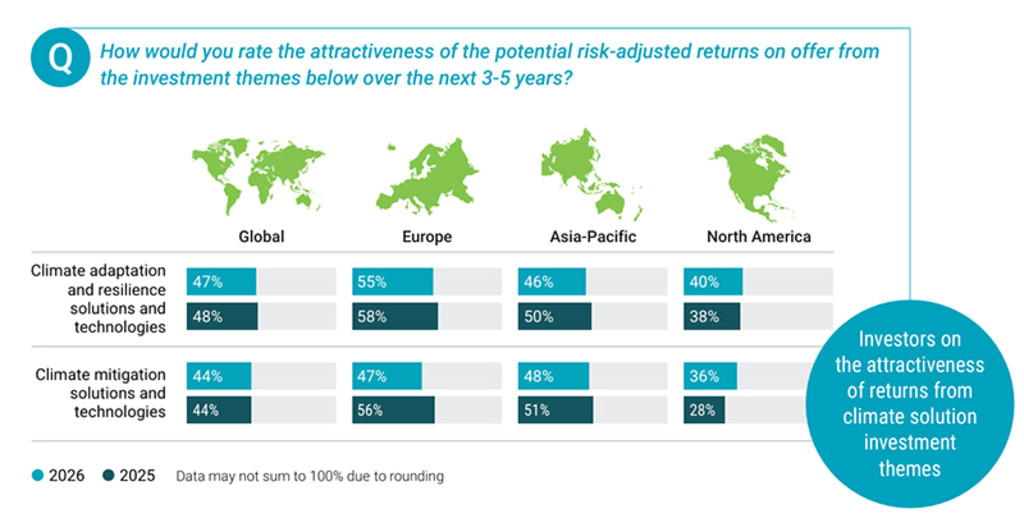
Source: Robeco Global Climate Investing Survey 2026.
There is a fairly even split on the attractiveness of either method. Nearly half (47%) of global investors say the potential risk-adjusted returns from climate adaptation and resilience solutions and technologies over the next 3-5 years are ‘very or somewhat attractive’, while 44% would say the same for climate mitigation solutions and technologies.
There is perhaps understandably more interest in adaptation and resilience solutions in Europe – which saw severe wildfires across Spain, France and Greece in 2026 – where 55% rate them as attractive, although this was down on the 58% citing this last year. Only 46% of APAC and 40% of North American investors were interested in this avenue.
“The opportunity extends beyond companies selling adaptation solutions,” Peppelenbos says. “Investors also need to assess which businesses can protect their assets, supply chains and cash flows as physical hazards intensify. This shifts the investment question form identifying solution providers alone to assessing which companies are emerging as resilience leaders.”
Stay informed on Climate investing
An attractive growth theme
Over half of global investors (55%) agree that climate adaptation and resilience will become an increasingly attractive growth theme for equity investments over the next 3-5 years. The most widely held investments are currently in water management systems (41%), vaccines or drugs for new diseases (40%), climate-resilient energy technologies and systems (39%), and climate-resilient infrastructure and transportation (38%).
However, only 21% think there is a sufficient investment universe of listed companies producing adaptation and resilience solutions to enable them to scale up their public market exposure to this theme. There is also uncertainty over the ability of adaptation companies to achieve competitive risk-adjusted returns, although the numbers citing this as a barrier fell to 39% of investors from 58% in 2025.
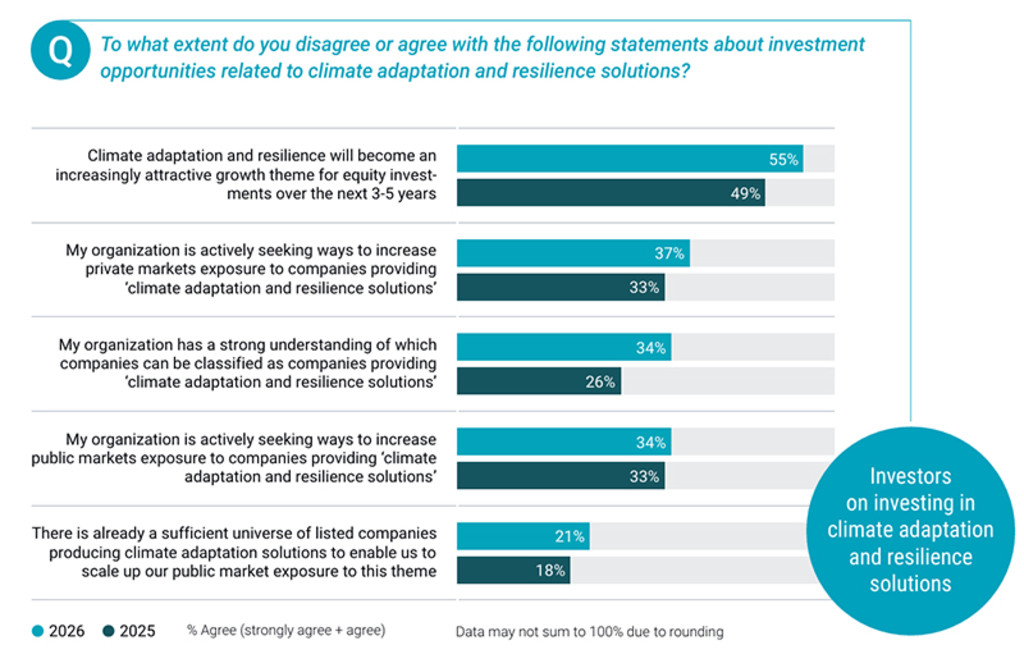
Source: Robeco Global Climate Investing Survey 2026.
Mitigation is still strong
Meanwhile, support for climate mitigation strategies is largely unchanged. Over half of investors (59%) believe that demand for renewable energy or low-carbon technologies will remain strong, regardless of any political backlash and backtracking on net-zero goals.
Just over a third said they plan to increase investments in renewable energy, electricity grid modernization and battery technologies in the next two years, though policy uncertainty is cited as a significant barrier by 45% of investors globally and 48% in Europe. Electric vehicles are affected by government policies on phasing out petrol-driven cars, while grid modernization requires government support to build the infrastructure.
A more selective opportunity set
In other mitigation solutions, 37% of European investors plan to increase investments in sustainable real estate in the next two years, while 38% in APAC will raise their exposure to carbon capture and storage.
“Mitigation remains investable, but the opportunity set is becoming more selective,” Peppelenbos says. “Demand for renewable energy, grids and storage is supported by strong drivers and structural demand. For other mitigation solutions, policy uncertainty makes selectivity and rigorous assessment increasingly important to investment outcomes.”
“For investors, the survey points to a broader climate agenda in which physical-risk assessment, corporate resilience and selective exposure to mitigation and adaptation solutions increasingly need to be considered together.”

Global Climate Investing Survey 2026
Investors commit to net zero goals amid energy security and climate risks
Important information
THIS WEBSITE IS SOLELY INTENDED FOR PROFESSIONAL INVESTORS, WHICH HAS THE MEANING ASCRIBED TO IT IN THE SECURITIES AND FUTURES ORDINANCE (CAP. 571 OF THE LAWS OF HONG KONG) AND ITS SUBSIDIARY LEGISLATION. Investment involves risks. Past performance is not indicative of future performance. The information contained in this website is provided for reference only and does not constitute investment advice or an offer or solicitation to buy or sell in any securities or to adopt any investment strategy. Investors should not base their investment decisions solely on the information provided on this website and are advised to seek independent advice (including advice on tax implications) before making any investment decisions. Investors should ensure they fully understand the risks associated with the investment products and should also consider their own investment objectives and risk tolerance level. The investment decision is yours. You should not invest unless the intermediary who sells you the investment products has advised you that it is suitable for you and has explained how it is consistent with your investment objectives. Please refer to the relevant offering documents or other legal documents for further details including the risk factors. This website is published by Robeco Hong Kong Limited which is regulated by the Hong Kong Securities and Futures Commission (“SFC”) (CE No. APU851). This website has not been reviewed by the SFC. No assurance can be given that the investment objective of any investment products will be achieved. No representation or promise as to the performance of any investment products or the return on an investment is made. The value of investments may fluctuate. Past performance, projections, or forecasts included in this website should not be regarded as guarantees or indications of future performance, and no express or implied warranty is provided. The contents of this website are based on sources believed to be reliable, but due to the nature of information delivery technology and the necessity of using multiple data sources, including third party content, their accuracy is not guaranteed. The opinions expressed are as of the date shown above and may change as market conditions evolve, and are subject to change without notice. These opinions may differ from those of other Robeco investment professionals. Robeco accepts no liability for any direct, indirect, or consequential loss arising from the use of this material or any comments, opinions, or estimates contained herein. Robeco has no duty to update this website or any website content. Materials on this website may not be reproduced, distributed, or published without prior written permission from Robeco. Unless otherwise specified, Source: Robeco.