

Head of Multi Asset & Equity Solutions, Co-Head Investment Solutions


• Monthly outlook
The US consumer carries the world on its shoulders
The US economy, driven by a resilient consumer, has been the most important source of growth in the global economy post-Covid, and there are reasons to be confident that this will continue through 2024, says multi-asset investor Colin Graham.
Authors

Summary
- Real wage growth has driven buoyant consumption
- Interest rate rise still only impacts a minority of consumers
- Fiscal largesse likely to be maintained through the election cycle
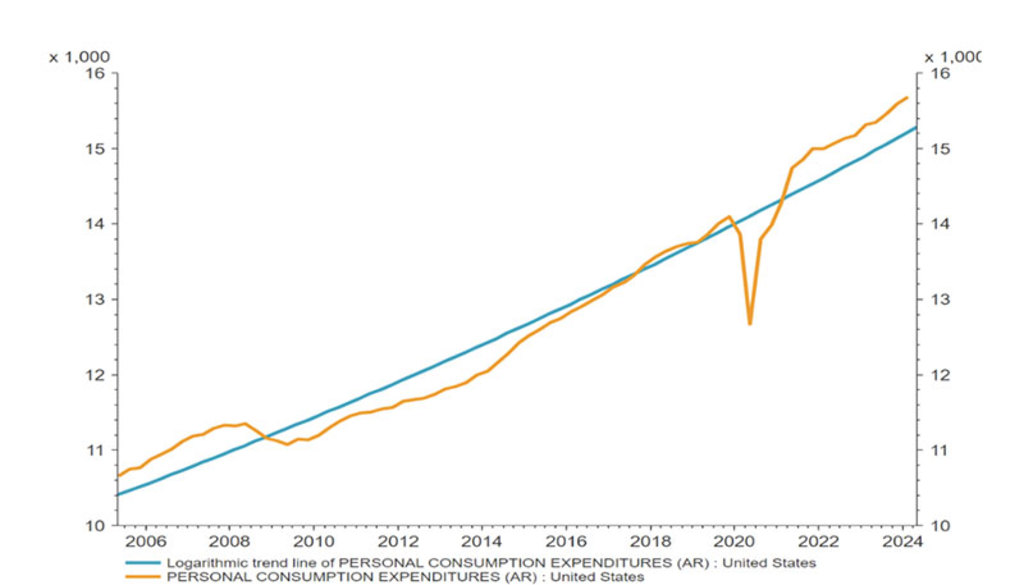
The divergence between the US economy and the rest of the world has characterized the post-Covid period with Europe narrowly escaping recession and China battling a property bubble burst, while the US has grown GDP at an above-trend rate.
“The mainstay of this growth has been the resilient US consumer supported by profligate government spending and a lack of sensitivity to rising interest rates,” says Graham, Head of Multi-Asset Strategies at Robeco.
Figure 1: Real consumer spending has stayed above the pre-Covid trend
Source: LSEG Datastream, Robeco
“At first glance, part of the explanation lies in lockdown policies, where the US put money in the consumers' pockets while other governments gave to companies or in some cases didn’t hand out cash.”
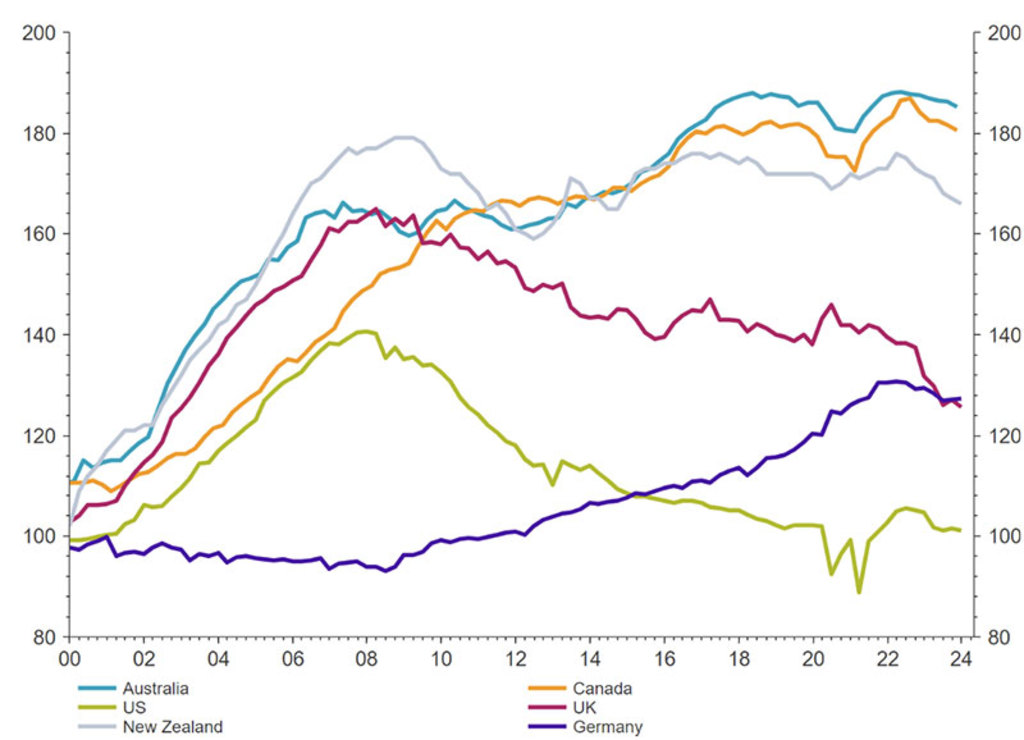
The second reason why the consumer has held up is that the US is predominantly a fixed mortgage rate market for households, so ultra-low rates allowed consumers to ‘term out’ their debt, locking in 3% rates for 30 years as recently as 3 years ago. This means the recent 7.55% 30-year mortgage rate1 is irrelevant unless you are a first-time buyer or need to relocate.
“As a result, US consumers are still harvesting the post-GFC deleveraging (Figure 2) whilst easily servicing debt costs,” says Graham.
Figure 2: Household debt as a % of disposable income
Source: LSEG Datastream, Robeco
Real income is growing
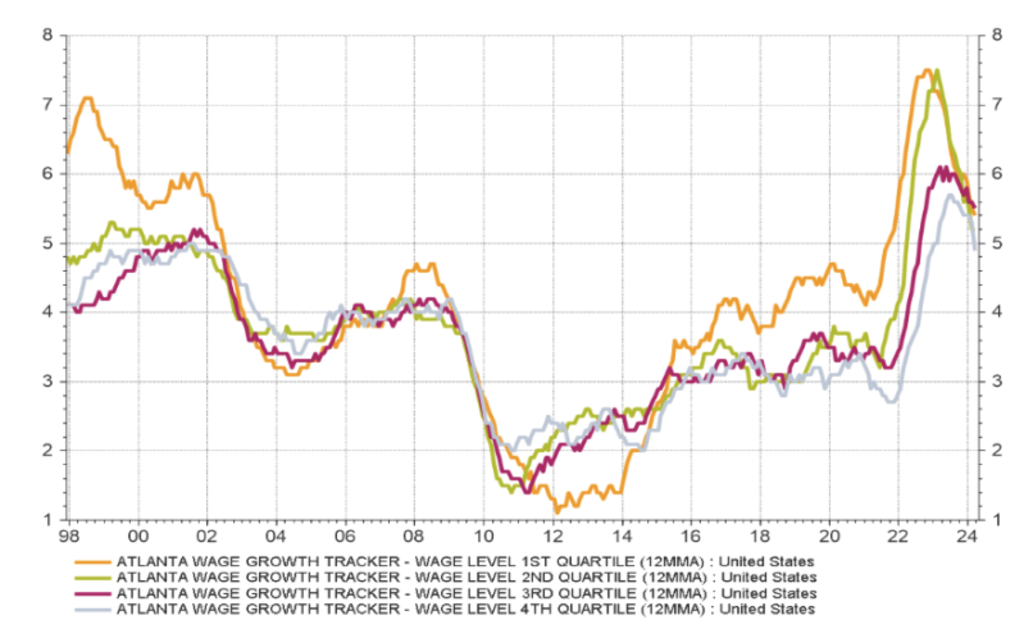
The underlying data suggests consumption is well-supported. First, because of strong disposable income growth that exceeds inflation, the median US consumer is still experiencing real wage growth. Purchasing power is increasing, allowing them to sustain consumption levels even in the face of rising prices.
Figure 3: Wage growth remains elevated
Source: LSEG Datastream, Robeco
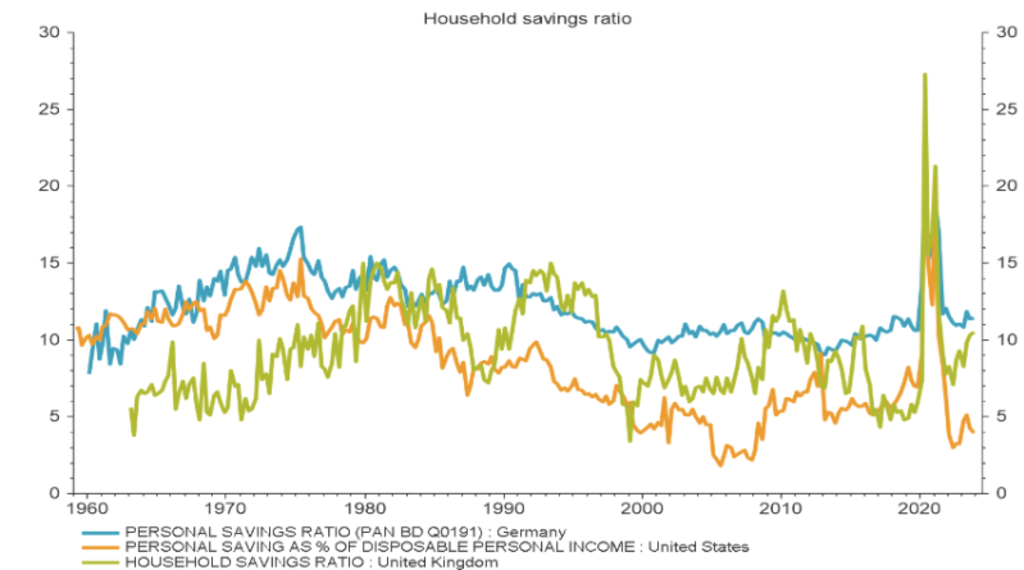
Second, consumer confidence in the US remains relatively high and broad based, which encourages spending.“In an inflationary environment, it pays to spend today because tomorrow the goods & services will be more expensive.”
Figure 4: The US savings rate is back near record lows
Source: LSEG Datastream, Robeco
Third, during the Covid-19 pandemic consumption shifted toward goods rather than services due to lockdowns and restrictions. This forced consumers online to purchase goods to improve ‘home life’, and this trend has not reversed because online penetration remains about 30% higher than pre-Covid levels, although some sports equipment manufacturers may disagree. The lasting effect has been that consumers have increased loyalty to ultra-lux brands, reduced brand loyalty more broadly, and are more likely to surf across a wider range of retail stores, price and quality points.
“In addition, post-lockdown, the US experienced an explosion of revenge spending on travel and services, which has continued due to higher wages and US consumers’ lower propensity to save handouts and wages than in Europe or China.”
Services is the biggest constituent of US GDP, hence its importance to the overall economy, and its contribution to US economic exceptionalism.
Lastly, various government support measures, such as stimulus checks and unemployment benefits, have provided a buffer for US consumers, allowing them to maintain spending levels even during periods of economic uncertainty. As mentioned above this was absent elsewhere in the world.
Where could the cracks in consumer spending appear?
It would be remiss not to mention where the US consumer could be derailed. First, government spending could fall, although that is unlikely as Biden tries to sweeten the voters to back him in the November presidential election. Second, the long and variable lags of monetary policies start to bite and increase the debt servicing burden of more consumers, draining disposable income. Additionally the servicing of government debt by the US Treasury department constrains fiscal expansion (mainstay of consumer spending support), hence why refinancing in a higher-for-longer Fed policy environment remains a concern for all.
Lastly, there are concerns such as weakening labor market indicators.
“The recent fall in quit rates suggests that the wage premium for switching to an alternative employer has declined or been eliminated, implying current job security is of increasing importance to US households,” says Graham.
He also sees a potential ‘destocking’ of labor from the post-Covid hoarding as small and mid-size companies reassess their costs and let workers go. This would send the US consumer exceptionalism into reverse as wage growth would cool more rapidly on the back of an increase in US unemployment above 5%.
“All in all, the US consumer looks well supported during 2024 and ahead of the presidential election, explaining the Fed’s reticence to relax monetary policy just yet.”
Footnote
1From bankrate.com, 30 April 2024
Get the latest insights
Subscribe to our newsletter for investment updates and expert analysis.
Important information
THIS WEBSITE IS SOLELY INTENDED FOR PROFESSIONAL INVESTORS, WHICH HAS THE MEANING ASCRIBED TO IT IN THE SECURITIES AND FUTURES ORDINANCE (CAP. 571 OF THE LAWS OF HONG KONG) AND ITS SUBSIDIARY LEGISLATION. Investment involves risks. Past performance is not indicative of future performance. The information contained in this website is provided for reference only and does not constitute investment advice or an offer or solicitation to buy or sell in any securities or to adopt any investment strategy. Investors should not base their investment decisions solely on the information provided on this website and are advised to seek independent advice (including advice on tax implications) before making any investment decisions. Investors should ensure they fully understand the risks associated with the investment products and should also consider their own investment objectives and risk tolerance level. The investment decision is yours. You should not invest unless the intermediary who sells you the investment products has advised you that it is suitable for you and has explained how it is consistent with your investment objectives. Please refer to the relevant offering documents or other legal documents for further details including the risk factors. This website is published by Robeco Hong Kong Limited which is regulated by the Hong Kong Securities and Futures Commission (“SFC”) (CE No. APU851). This website has not been reviewed by the SFC. No assurance can be given that the investment objective of any investment products will be achieved. No representation or promise as to the performance of any investment products or the return on an investment is made. The value of investments may fluctuate. Past performance, projections, or forecasts included in this website should not be regarded as guarantees or indications of future performance, and no express or implied warranty is provided. The contents of this website are based on sources believed to be reliable, but due to the nature of information delivery technology and the necessity of using multiple data sources, including third party content, their accuracy is not guaranteed. The opinions expressed are as of the date shown above and may change as market conditions evolve, and are subject to change without notice. These opinions may differ from those of other Robeco investment professionals. Robeco accepts no liability for any direct, indirect, or consequential loss arising from the use of this material or any comments, opinions, or estimates contained herein. Robeco has no duty to update this website or any website content. Materials on this website may not be reproduced, distributed, or published without prior written permission from Robeco. Unless otherwise specified, Source: Robeco.