• Insight
Energy storage – the next challenge in the energy transition
Without energy storage, renewable energy’s potential can’t be fully harnessed, putting net-zero targets in jeopardy. But trade-offs and complexities in energy markets mean only a few players stand to benefit from the expansion of storage capacity.
Summary
- Renewable energy’s share of the energy mix expanding
- Renewables are clean and abundant but also unreliable
- Lithium batteries to dominate storage and grow market share
Despite stiff headwinds, in 2023, clean energy investments reached USD 1.7 trillion, 65% more than fossil fuels. Ambitious transition targets assure investments in renewables and related technologies will rise further. At the COP28 in Dubai, the world agreed to triple renewable capacity by 2030. According to BNEF, energy storage investments must triple to USD 93 billion annually to reach net-zero.1
Renewable but unreliable
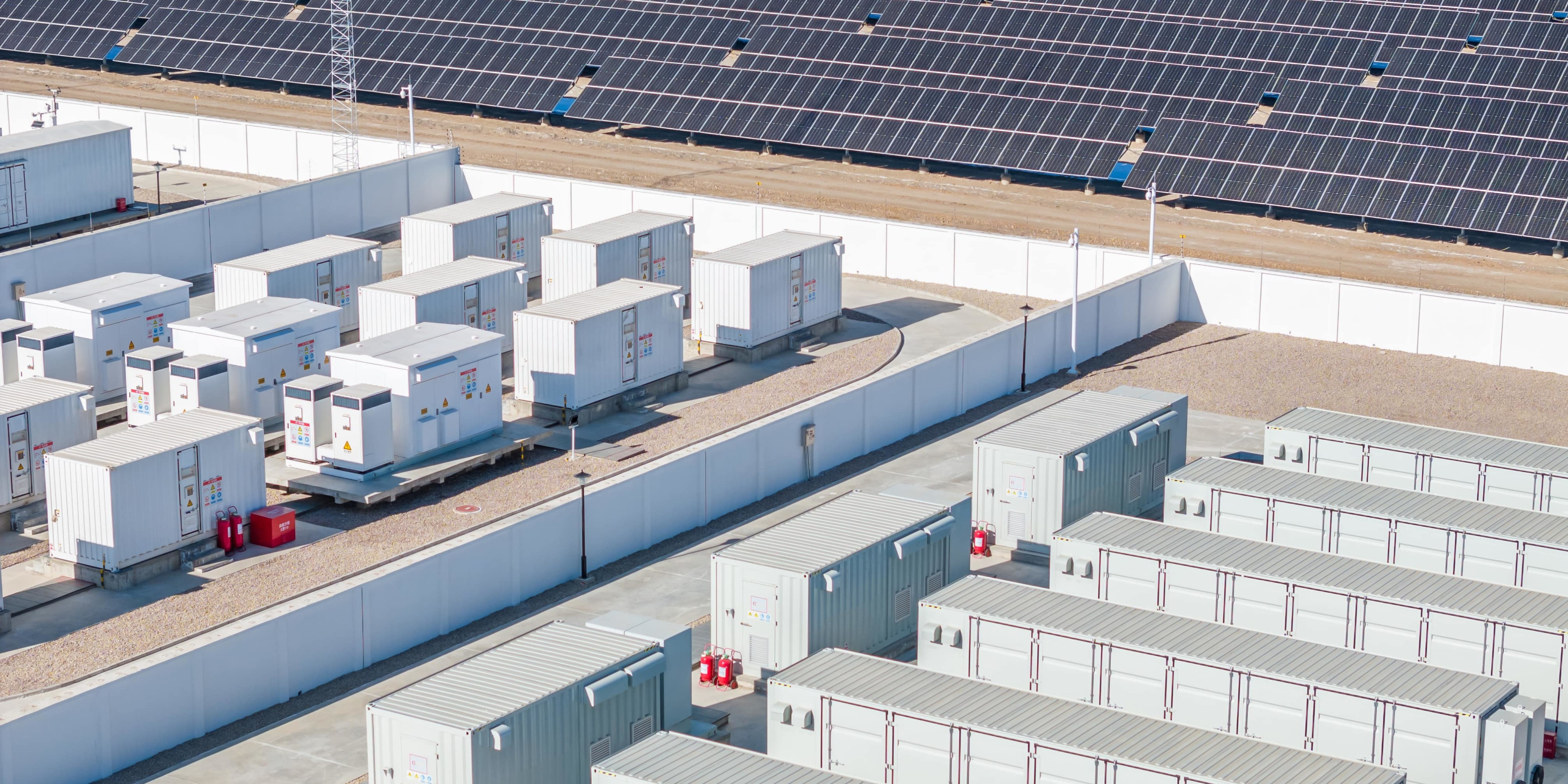
Solar and wind are naturally clean and abundant, but their supply is unreliable. Moreover, even when weather conditions are ideal, periods of peak renewable supply don’t always match peak periods of electricity demand. Energy storage bridges the gap by enabling surplus renewable energy generated at peak times to be stored and used later when energy demand is high (but renewable capacity is low).
Too little renewable power when its needed is one problem, too much is another. When solar and wind is strong it can overload transmission lines, leading to congestion, diminished performance and even power outages. As a result, renewables must often be switched off or ‘curtailed’ to avoid system overload. In California, 1.9 TWh of solar generated energy was curtailed in 2022; the equivalent of powering 200,000 homes for an entire year.2 In 2020, the UK curtailed wind energy enough to power over one million homes annually.3
Curtailment not only wastes valuable energy resources, it also threatens to delay the rate of renewable expansion. Grid operators are hesitant to invest further in adding supply when revenues from renewables can’t be fully captured or maintenance costs covered.
No universal storage solution
Energy can be stored in many ways leading to a diverse array of storage technologies (see Figure 1). Technologies range from capturing the energy potential of electrochemical reactions inside battery cells to much larger methods such as the pumped hydropower installations that store the energy potential of water flows between massive reservoirs.
Each technology carries distinct characteristics that can be a strength or a weakness based on the market conditions in which it is applied. For example, supercapacitors use magnetic fields to store and deliver short bursts of high voltage energy, such as for turning EV motors on and off at a stop light. That makes them ideal for emergency back-up power in a hospital or public transport environment.
Figure 1 – Energy storage technologies by type, duration and end-use application

Source: Barclay Research, USAID, NREL, 2021. Distributed services refers to decentralized grids (even micro-grids) where energy must be delivered over smaller distances, small packets and in real-time in response to dynamically changing demand (e.g., residential solar). Bulk power services involve delivery of steady streams of high-voltage energy over long distances to large centralized systems (e.g. municipal coal, natural gas plants) that support base-load demand.
Pumped hydropower is known for its longevity and reliability, making it the most dominant of all installed storage by far. But it is limited to regions that are blessed with abundant water and space. It also suffers from delayed response time, making it less suitable for next-generation energy grids that require near-instantaneous on/off switching. But the biggest trade-offs involve duration and costs.
At one end are technologies that store lots of energy for long durations but which also tend to be infrastructure (and cost) heavy. At the other are those with rapid response times and less infrastructure but also of shorter durations (and costly per unit of energy). Batteries sit somewhere in the middle making them popular for a broad range of use cases.
Bullish on batteries
Thanks to EVs, battery technology has significantly advanced even at the large scales needed for power grids. More importantly, battery costs have dropped 80% over the past decade. Battery storage among utilities is expected to grow 29% annually (CAGR) through 2030 (see Figure 2) and 18% among commercial and industrial energy users such as data centers and hospitals that operate their own energy storage systems.
Figure 2 – Battery storage expected to surge through 2030

Source: McKinsey, 2023. Annual added battery energy storage system capacity, %. Figures may not sum to 100% because of rounding.
Batteries carry other advantages. They are cheap, easy to install, versatile, and – like supercapacitors – can deliver high voltage that can be rapidly dialed up or scaled back. This makes them ideal for helping grid operators cost-effectively smooth out the daily demand-supply imbalances that have intensified with renewable use. Moreover, they can also add to grid stability by taking energy off the grid to curb congestion (i.e., too much energy trying to flow through too few transmission lines). Likewise, batteries can deploy energy at temporary intervals to keep the grid humming at frequency flows mandated by local market laws.
But batteries are not without drawbacks. A storage duration of only 4-6 hours makes many battery types unsuitable for storage over weeks or seasons. Yet long-term storage is critical for fully capitalizing on renewable potential. Other battery types are also in development, these include redox flow, metal-air, and solid-state but while promising, they face grid-integration hurdles that we believe will limit wide-scale commercial deployment.
Investment outlook – storage plus solutions
We are bullish on lithium-ion batteries as they offer the most competitive and versatile solution to for utilities and grid operators. However, to fully capitalize on their potential, they need to be efficiently integrated into new or legacy grid infrastructure, a process that most often requires more layers of expert services. In our view, that puts providers of integrated storage providers and integrated energy operators in the best position to benefit from building structural drivers.
Integrated storage providers bundle storage solutions such as battery power with system integration and digital management services that help dynamically direct grid flows to match demand. Vertically integrated energy operators broaden service-bundling even further. They not only own solar and wind farms but also have the expertise to construct off-the-grid power supplies for remote or power-hungry customers such as data centers. This gives them control over (and revenue streams from) a diverse array of grid-scale services. Moreover, their project portfolios are expanding across geographies.
One of the US’ largest integrated operators with operations in 49 states is developing Florida’s largest solar-powered battery. Similarly, Australia’s leading renewable energy supplier is developing its largest battery project using Tesla-technology. In South America, Chilean operators are adding battery storage next to critical solar installations in the Atacama Desert. In the UK, energy operators are converting grid infrastructure once powered by coal for use as battery storage facilities.
As renewable targets and installations expand, the need for storage solutions is intensifying. Efficient and versatile storage is key. But efficient integration and power-flow management are equally important for maximizing the gains from renewables.
This leaves integrated service providers with the greatest potential for profitably solving grid-storage issues.
We would like to thank Patricia Garcia Abad for her valuable research and contributions to this article.
Footnotes
1BloombergNEF, Energy Transition Investment Outlook. 2023.
2WEF, 2023. ”Storage is the key to the renewable energy revolution”
3Lane, Clark and Peacock, LLP. January 2021. “Is Battery Storage a good investment.”
Get the latest insights
Subscribe to our newsletter for investment updates and expert analysis.
Important information
THIS WEBSITE IS SOLELY INTENDED FOR PROFESSIONAL INVESTORS, WHICH HAS THE MEANING ASCRIBED TO IT IN THE SECURITIES AND FUTURES ORDINANCE (CAP. 571 OF THE LAWS OF HONG KONG) AND ITS SUBSIDIARY LEGISLATION. Investment involves risks. Past performance is not indicative of future performance. The information contained in this website is provided for reference only and does not constitute investment advice or an offer or solicitation to buy or sell in any securities or to adopt any investment strategy. Investors should not base their investment decisions solely on the information provided on this website and are advised to seek independent advice (including advice on tax implications) before making any investment decisions. Investors should ensure they fully understand the risks associated with the investment products and should also consider their own investment objectives and risk tolerance level. The investment decision is yours. You should not invest unless the intermediary who sells you the investment products has advised you that it is suitable for you and has explained how it is consistent with your investment objectives. Please refer to the relevant offering documents or other legal documents for further details including the risk factors. This website is published by Robeco Hong Kong Limited which is regulated by the Hong Kong Securities and Futures Commission (“SFC”) (CE No. APU851). This website has not been reviewed by the SFC. No assurance can be given that the investment objective of any investment products will be achieved. No representation or promise as to the performance of any investment products or the return on an investment is made. The value of investments may fluctuate. Past performance, projections, or forecasts included in this website should not be regarded as guarantees or indications of future performance, and no express or implied warranty is provided. The contents of this website are based on sources believed to be reliable, but due to the nature of information delivery technology and the necessity of using multiple data sources, including third party content, their accuracy is not guaranteed. The opinions expressed are as of the date shown above and may change as market conditions evolve, and are subject to change without notice. These opinions may differ from those of other Robeco investment professionals. Robeco accepts no liability for any direct, indirect, or consequential loss arising from the use of this material or any comments, opinions, or estimates contained herein. Robeco has no duty to update this website or any website content. Materials on this website may not be reproduced, distributed, or published without prior written permission from Robeco. Unless otherwise specified, Source: Robeco.