


Head of Core Quant Equities, Head of Quant Equity Portfolio Management and Deputy Head of Quant Equity

• Insight
Robeco expands Enhanced Indexing into Australian equities
An established quantitative approach, now engineered for Australia's domestic market and available to institutions through a mandate-only strategy.
Authors


Client Portfolio Manager

Portfolio Manager
Summary
- Robeco is extending its established Enhanced Indexing range into Australian equities
- The strategy targets risk-controlled alpha through many small positions
- Proprietary signals combined with Australian fundamental insight
Australian institutions already know Robeco for its quantitative investing strategies such as Enhanced Indexing across developed and emerging markets. We are now extending that established capability into domestic equities: the same research engine and systematic discipline, calibrated for Australia's concentrated market and institutional requirements.
Enhanced Indexing occupies the space between passive exposure and highly active management. The benchmark remains the anchor, while many small overweight and underweight positions seek to add value. Portfolio construction spreads active risk rather than making performance depend on a handful of large stock calls.
The objective is to improve benchmark-relative outcomes after costs over time, with controlled tracking error and competitive fees. The strategy will not outperform in every market or every year, but it offers a core allocation that aims to outperform the benchmark in a more predictable and consistent fashion than a concentrated active portfolio.
Why Australia, why now?
Core Australian equity allocations must provide efficient market exposure, behave predictably within the total portfolio, and earn their place after fees and implementation costs. For superannuation funds, the annual Your Future, Your Super performance test has made benchmark-relative outcomes especially visible. The challenge is not simply to minimise tracking error, but to improve portfolio risk-adjusted outcomes while remaining close to the benchmark.
Passive investing offers transparent, low-cost market exposure. However, Australia’s market-cap-weighted benchmark is heavily concentrated in large banks and miners, creating significant concentration risk. Traditional active management can target meaningful alpha, but large stock or sector deviations may introduce more benchmark-relative risk than institutions want in a core allocation.
We believe the investable Australian universe is broad and liquid enough to support a diversified systematic approach. There is enough room to look beyond the largest index names and accumulate alpha from many modest opportunities. At the same time, explicit stock, sector and other risk controls keep the portfolio appropriately aligned to tight active risk limits. Smart rebalancing weighs signal strength against turnover and transaction costs, helping ensure that attractive opportunities remain worthwhile after implementation.
Why Robeco?
Robeco's edge lies in how quantitative signals are defined, combined, tested and translated into live portfolios. The strategy is supported by more than 50 investment professionals. As at 31 July 2026, Robeco reported approximately AUD 450 billion in total assets under management globally, including AUD 236 billion managed using quantitative models. Robeco has had a presence in Australia since 2012 and is one of the largest active managers of global equities in the country, with approximately AUD 60 billion in assets under management locally.
Robeco's quantitative equity research heritage extends over three decades. Global Developed Enhanced Indexing has a live history since 2004 and Emerging Markets Enhanced Indexing since 2007 – more than 20 years of translating quantitative research into portfolios across market environments. The close collaboration with investment colleagues across fundamental equity, fixed income and sustainable investing teams provides another edge and differentiates us from our quantitative peers.
Table 1 | Robeco Quantitative Equities overview
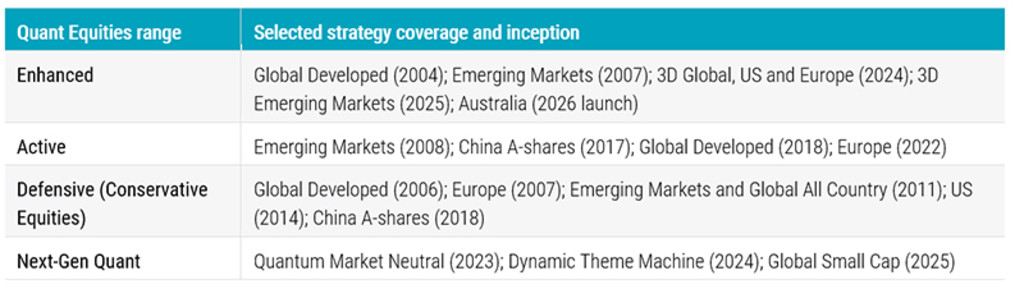
Source: Robeco, 2026: Robeco, 2026

Developed Markets investing
Find breadth beyond Big Tech
After years of concentrated market leadership, developed equity markets may be entering a new phase, one in which opportunities broaden beyond a narrow group of dominant names.


