• Visie

Emerging markets: Real tech revenue, macro resilience and attractive valuations

The final quarter of 2026 has been volatile but the fundamental drivers for emerging markets are intact as we look forward to 2027.

Auteurs

    Portfolio Manager

Samenvatting

  • AI investment boom is set to continue
  • China, India and Brazil have the potential to surprise in 2027
  • Emerging markets’ macroeconomic fundamentals are solid

Returns can vary widely across emerging markets countries and sectors, and 2026 has been no exception: technology companies in Taiwan and South Korea delivered strong returns, while equities in China and India lagged. We expect similarly wide differences in returns in 2027. So where do we see the best opportunities?

AI investments to continue

We know that the hardware on which AI runs is predominantly manufactured by emerging market companies, including producers of the most advanced semiconductors. Information technology now accounts for more than 40% of the MSCI Emerging Markets Index,1 making it the largest sector.

Developed markets are spending, while emerging market companies are generating revenue

Concerns have recently grown about the sustainability of AI investment amid rising financing costs and uncertainty over monetizing AI models. Hardware manufacturing remains cyclical, but we believe the current investment supercycle has further to run:

  • AI adoption is likely to remain strong. Many individuals and businesses are only beginning to adapt, as AI evolves from an advanced search tool into wider use of AI agents across business processes and daily life.

  • Supply can only adapt gradually. It takes several years to build semiconductor fabs, and there are significant supply bottlenecks for crucial equipment.

We therefore expect the technology investment cycle to continue for the next couple of years. For most EM tech companies, this translates into tangible revenue. Developed markets are spending, while emerging market companies are supplying the hardware and generating revenue. One striking example is South Korean semiconductor giant Samsung Electronics, which is now neck and neck with Nvidia as the world’s most profitable company.23

That said, valuations and their implied growth rates still matter. Valuations differ considerably across the sector. For the largest Korean tech companies, valuations remain low, while high growth expectations appear to be priced into the shares of many Taiwanese technology companies. We therefore favor selective exposure to the technology segments offering the most attractive valuations.

China and India: Growth at more attractive valuations

A substantial investable universe remains outside technology, particularly in China and India. Both markets lagged the benchmark in 2026, although their economies continue to grow. India, in particular, continues to record GDP growth above 7%. China faces greater challenges from a contracting property market and slowing economic growth. Nevertheless, exports remain strong, the country leads in several emerging industries, and Chinese households have scope to increase spending when confidence improves. Valuations in both markets have become more attractive, leaving greater scope for positive surprises. The markets may have lagged, but they should not be ignored.

Emerging Stars Equities F EUR

performance ytd (31-10)
25,96%
Performance 3y (31-10)
24,85%
morningstar (31-10)
5 / 5
SFDR (31-10)
Article 8
Dividenduitkerend (31-10)
No
Bekijk het fonds
In het verleden behaalde resultaten bieden geen garantie voor de toekomst. De waarde van uw beleggingen kan fluctueren.Geannualiseerd (voor periodes langer dan een jaar). De performance is gebaseerd op de koers na aftrek van kosten.

Korea’s Corporate Value-up Program

Korean tech giants are dominating headlines in 2026, but investment opportunities in Korea extend well beyond technology. These include domestic sectors such as banking and telecommunications, alongside leading exporters in autos, defense, batteries and electrical equipment. Many are high-quality companies trading at what we believe are attractive valuations. To narrow these valuation discounts relative to global peers, the government launched its Corporate Value-up Program in 2024. Steps have been taken to improve corporate governance standards and to incentivize companies to act more in the interests of minority shareholders. These efforts are bearing fruit through rising dividends and increased share buybacks. For 2027, we expect this trend to continue and the valuation discount to narrow further.

Fiscal policy and interest rates at the forefront in Brazil

An important country to watch is Brazil. President Luiz Inácio Lula da Silva won reelection in October 2026 and will begin a new term in 2027. Fiscal policy in Lula’s next term will be crucial for markets. Without fiscal discipline, Brazil’s high real interest rates are unlikely to fall, as the central bank will be focused on keeping inflation under control. Fiscal prudence would also serve the government’s interests: lower rates would reduce debt-servicing costs and ease fiscal pressure. With market expectations subdued, there is scope for positive surprises if the Lula administration takes sufficient action to calm market fears.

Stronger macroeconomic fundamentals and attractive valuations

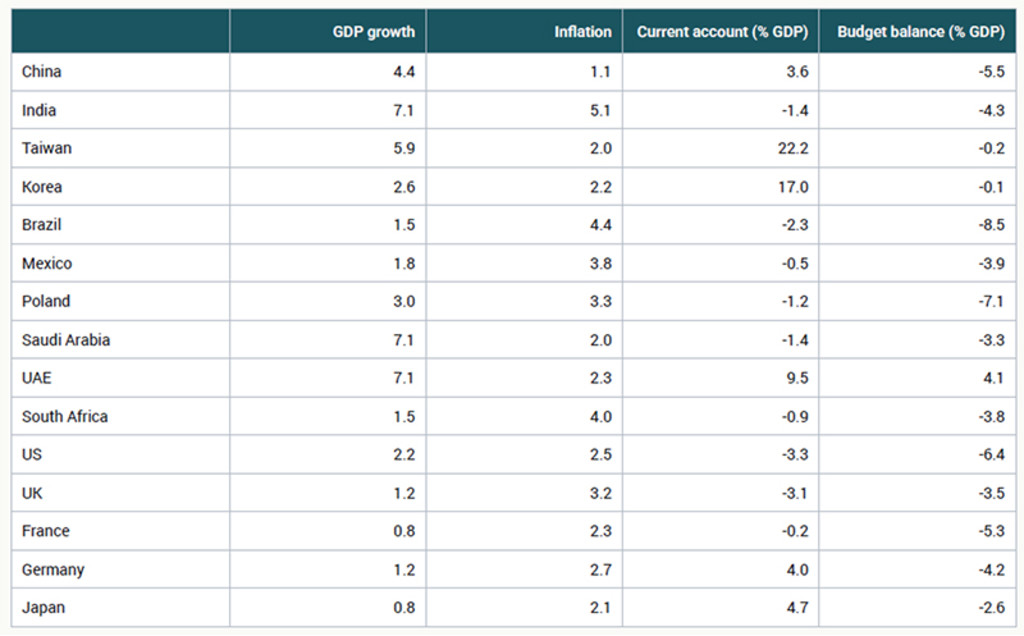
Looking at emerging markets overall, investors remain concerned that higher global interest rates could undermine their performance. Although higher rates pose a risk to global equities, we believe emerging markets are better positioned than during the 2013 “taper tantrum”. Inflation is relatively low, many central banks have maintained prudent monetary policies, current accounts are broadly balanced, and fiscal deficits are now mostly financed domestically.

Table 1: Bloomberg consensus estimates 2027 – higher growth and moderate risk for EM

Source: Bloomberg4, Robeco, as of 9 November 2026.

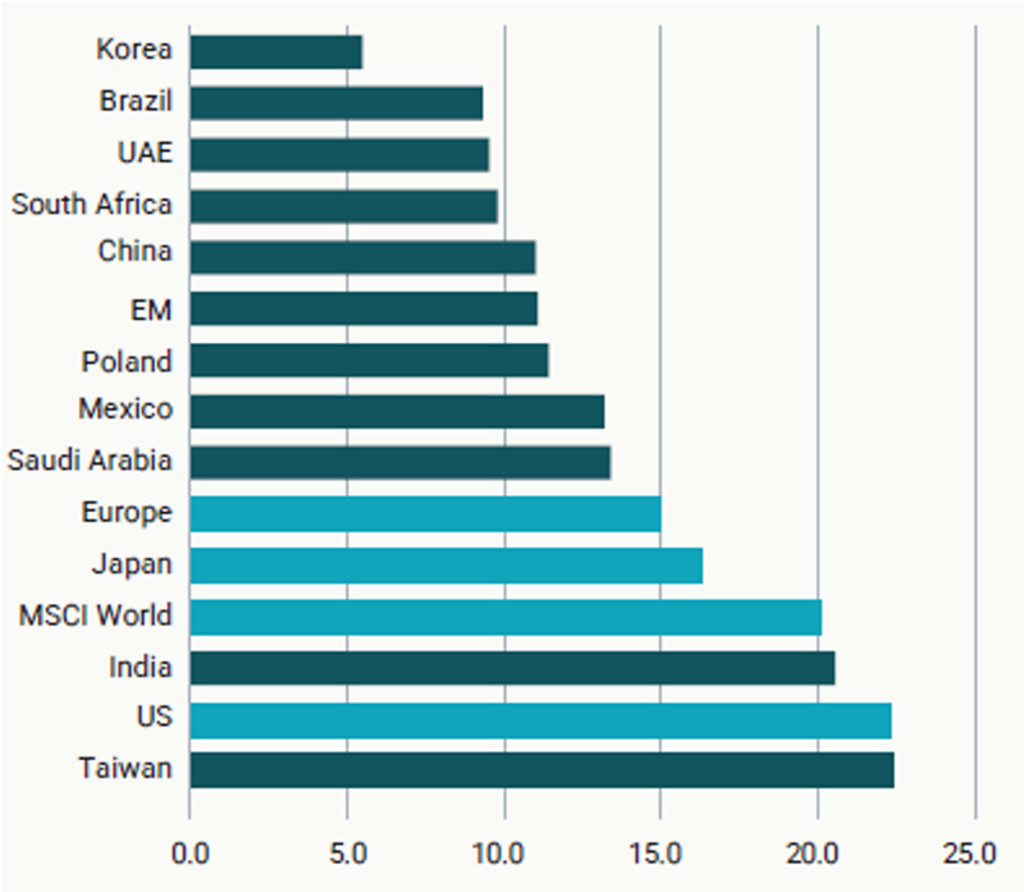
Emerging market valuations also remain attractive. On forward earnings multiples, emerging markets now trade at more than a 40% discount to developed markets. Within emerging markets, Taiwan and India remain relatively expensive, while China, Korea and Brazil trade at more attractive valuations, as do several smaller markets.

Figure 1: 2026 PE Ratios: Emerging markets are significantly cheaper

Source: MSCI, I/B/E/S, FactSet, Robeco, as of October 2026.

In conclusion

Emerging markets offer a dynamic investment environment where we see various good opportunities.5 The AI investment cycle is likely to continue giving real revenues for the emerging markets tech companies, yet equity performance will also depend on relative value and embedded expectations. We are positive on the outlook for Korea, both for technology companies and for non-tech sectors. Valuations have also become more attractive in China, Brazil and India, creating greater scope for positive surprises. Finally, we believe emerging market economies are more resilient than in the past, even if global interest rates continue to rise.

This article was originally published as a special feature in our 2027 Investment Outlook.

Footnotes

1Source: MSCI. The MSCI information may only be used for your internal use, may not be reproduced or redisseminated in any form and may not be used as a basis for or a component of any financial instruments or products or indices. None of the MSCI information is intended to constitute investment advice or a recommendation to make (or refrain from making) any kind of investment decision and may not be relied on as such. Historical data and analysis should not be taken as an indication or guarantee of any future performance analysis, forecast or prediction. The MSCI information is provided on an "as is" basis and the user of this information assumes the entire risk of any use made of this information. MSCI, each of its affiliates and each other person involved in or related to compiling, computing or creating any MSCI information (collectively, the "MSCI Parties") expressly disclaims all warranties (including, without limitation, any warranties of originality, accuracy, completeness, timeliness, non-infringement, merchantability and fitness for a particular purpose) with respect to this information. Without limiting any of the foregoing, in no event shall any MSCI Party have any liability for any direct, indirect, special, incidental, punitive, consequential (including, without limitation, lost profits) or any other damages. (www.msci.com)
2The companies shown on this page are for illustrative purposes only. No inference can be made on the future development of the company. This is not a buy, sell, or hold recommendation.
3Bloomberg consensus estimates for net income for 2026 are USD 229 billion for Nvidia and USD 228 billion for Samsung Electronics
4The following are trademarks and service marks of Bloomberg Finance L.P., a Delaware limited partnership, or its subsidiaries: BLOOMBERG, BLOOMBERG ANYWHERE, BLOOMBERG MARKETS, BLOOMBERG NEWS, BLOOMBERG PROFESSIONAL, BLOOMBERG TERMINAL and BLOOMBERG.COM: Absence of any trademark or service mark from this list does not waive Bloomberg's intellectual property rights in that name, mark or logo. All rights reserved.
5Investing in financial instruments carries risks, including potential loss of your invested capital. Investors may not get back the amount originally invested. Assess your financial situation and risk tolerance carefully and seek independent advice if needed.

2027 Investment outlook

The forces beneath the surface

Discover more

Waarschuwing – Frauduleus gebruik van Robeco op websites en social media Lees meer