

Portfolio Manager


• Vision
Pourquoi les arguments en faveur de la santé se renforcent
La santé est restée une grande partie des cinq dernières années dans l'ombre de la Big Tech. Cependant, une reprise durable est en cours, les introductions en bourse de la biotechnologie, les acquisitions dans le secteur pharmaceutique, la R&D, l'IA et l'allongement de l'espérance de vie insufflant un nouvel élan à ce secteur.
Auteurs

Résumé
- Les opérations de fusion-acquisition, les introductions en bourse, les accords de licence et les partenariats soutiennent les fondamentaux
- La santé s'impose comme un secteur attractif pour tirer parti de la mise en œuvre de l'IA
- La démographie continue d'offrir un potentiel de croissance sur plusieurs décennies
Ces trois dernières années, l'attention des marchés et les flux de capitaux se sont concentrés presque exclusivement sur les thèmes liés à l'IA, négligeant le secteur de la santé, qui est pourtant l'un des plus importants (quatrième de l'indice MSCI World) et l'un des plus durables en termes de croissance. Cette négligence était en partie justifiée, car une combinaison d'inquiétudes liées aux réformes de la tarification des médicaments, aux pressions sur les remboursements, aux réductions du nombre d'adhérents à Medicaid et à une incertitude politique plus générale aux États-Unis a pesé sur le sentiment des investisseurs, entraînant des sorties de capitaux alors que les investisseurs se tournaient vers le thème de l'IA.
Nous sommes toutefois convaincus que cette dynamique commence à s'inverser à mesure que les contraintes réglementaires et politiques s'atténuent, comme en témoignent l'amélioration des fondamentaux et la hausse des valorisations. Parallèlement, l'activité de fusion-acquisition, les accords de licence et les introductions en bourse de la biotechnologie s'accélèrent, ce qui reflète la confiance dans les perspectives du secteur. Avec des valorisations attractives et une croissance des bénéfices appelée à réaccélérer d'ici 2027, le secteur semble bien positionné pour une reprise durable.
La santé est par ailleurs un bénéficiaire sous-estimé du déploiement de l'IA. Non seulement elle améliore l'efficacité des coûts, mais elle accélère également la croissance du chiffre d'affaires grâce à une innovation renforcée, des procédures plus rapides et un engagement accru des patients. Si les données suggèrent un retour des flux de capitaux, les pondérations du secteur au sein des indices et la détention par une base plus large d'investisseurs restent proches de leurs points bas cycliques, ce qui laisse penser que le secteur de la santé constitue une opportunité sous-valorisée et sous-investie qui ne demande qu'à être exploitée, en particulier alors que les investisseurs cherchent à protéger leur portefeuille contre un débouclement du thème de l'IA.
Le financement de la biopharmacie a rebondi, les sociétés pharmaceutiques déployant des capitaux vers des biotechs innovantes afin de reconstituer leurs pipelines avant des expirations de brevets imminentes. Les opérations de fusion-acquisition dans la biopharmacie ont atteint 130 milliards de dollars au premier semestre 2026, égalant presque la valeur totale enregistrée sur l'ensemble de 2025 (voir le Graphique 1). L'appétit des marchés publics s'est également accru, les introductions en bourse dans la biotechnologie ayant levé 5 milliards de dollars au S1 2026, dépassant déjà le total annuel atteint lors de n'importe quelle année depuis 2022 (voir le Graphique 2). Dans le même temps, l'activité de licence en R&D reste exceptionnellement soutenue, les valeurs d'opérations annoncées atteignant 167 milliards de dollars au S1 2026, soit plus de la moitié du niveau record de 2025.
Graphique 1 – Hausse du volume et de la valeur des opérations de fusion-acquisition dans la biopharmacie
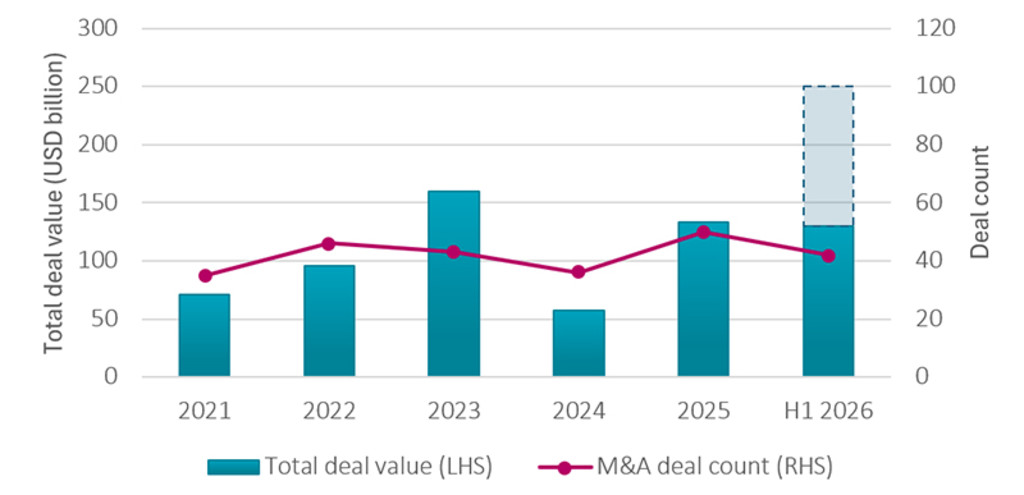
Valeur totale et nombre d'opérations de fusion-acquisition dans la biopharmacie annoncées au 30 juin 2026. Le S1 égale à lui seul les niveaux de l'ensemble de l'année 2025. Source : IQVIA, juillet 2026.
Healthy Living D EUR
- performance ytd (30-9)
- -3,98%
- Performance 3y (30-9)
- -1,12%
- morningstar (30-9)
- SFDR (30-9)
- Article 9
- Paiement de dividendes (30-9)
- No
Les performances passées ne préjugent pas des performances futures et ne sont pas constantes dans le temps.Annualisé (pour les périodes supérieures à un an). Les performances s'entendent nettes de frais et en fonction des prix de transaction.
Graphique 2 – L'activité d'introductions en bourse dans la biopharmacie s'accélère également
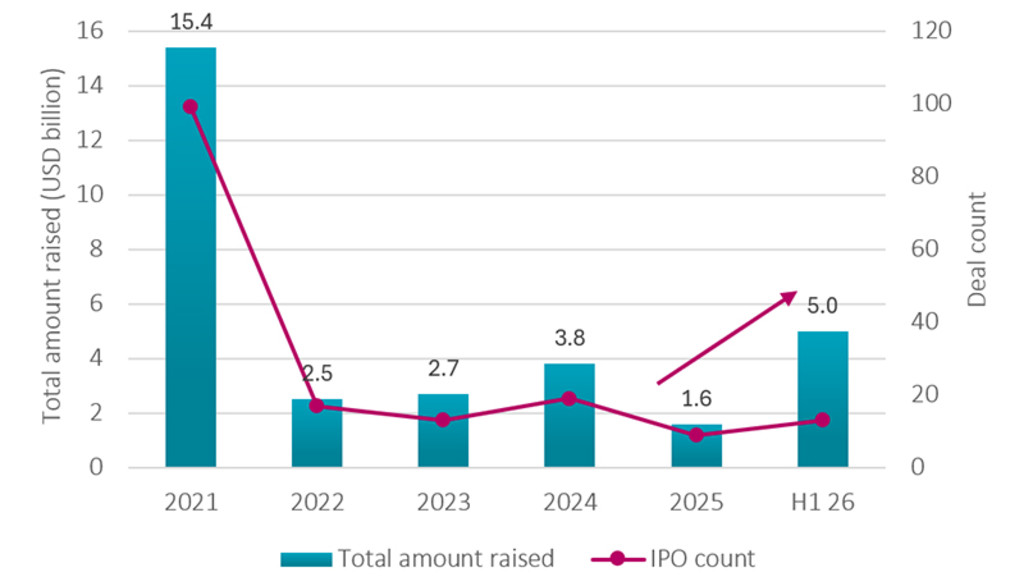
Nombre total d'opérations et capitaux levés parmi les entreprises biopharmaceutiques au 30 juin 2026. Les introductions en bourse repartent à la hausse après quelques années d'activité modérée. Source : JP Morgan, base de données de DealForma.com, juillet 2026.
Cette résurgence est importante bien au-delà des sociétés pharmaceutiques qui exécutent ces opérations. Les opérations de fusion-acquisition, les accords de licence et les afflux de capitaux propres se traduisent en fin de compte par des dépenses plus élevées en découverte de médicaments, en développement clinique et en fabrication. Parmi les bénéficiaires figurent les fournisseurs d'outils pour les sciences de la vie, les entreprises d'équipement de laboratoire et les sociétés de services spécialisées telles que les Contract Research Organizations et les Contract Development and Manufacturing Organizations (CRO et CDMO).
Point crucial, les capitaux affluent vers certains des segments les plus innovants et à la croissance la plus rapide de la santé. L'oncologie a représenté 41 % de la valeur des opérations au premier semestre 2026, suivie par l'immunologie et la neurologie. De nombreuses transactions portent sur des plateformes de nouvelle génération, notamment les conjugués anticorps-médicaments, les thérapies cellulaires et géniques, ainsi que les anticorps multispécifiques, ce qui souligne l'appétit persistant du secteur pour l'innovation et la prochaine vague de médicaments phares.
Quelles sont les tendances actuelles ?
Abonnez-vous à notre newsletter pour tout savoir sur les dernières tendances en matière d'investissement thématique.
La santé est un secteur qui démontre la valeur concrète de l'IA
La santé s'impose comme l'un des secteurs de monétisation de l'IA les plus convaincants du marché. Tout au long de la chaîne de valeur, l'IA accélère la découverte de médicaments, permet des diagnostics de meilleure qualité et plus rapides, stimule la productivité clinique et automatise les flux de travail administratifs, offrant la combinaison rare d'innovation, de génération de revenus et d'efficacité des coûts.
Fin 2025, la FDA avait approuvé plus de 1 400 dispositifs médicaux intégrant l'IA et le machine learning, la radiologie menant l'adoption à mesure que l'IA réduit la durée des examens et améliore la précision diagnostique. Dans l’assurance santé gérée, le compagnon IA de UnitedHealthcare1 devrait atteindre plus de 20 millions de membres d'ici la fin de 2026, en simplifiant l'orientation dans les couvertures, les demandes de remboursement et les coûts médicaux. Dans le même temps, HCA Healthcare déploie le machine learning dans l'ensemble de son réseau pour automatiser la documentation, rationaliser les flux de travail administratifs et optimiser la gestion du cycle des revenus, contribuant ainsi à atténuer les pénuries aiguës de main-d'œuvre dans la santé.
Plus convaincant encore, l'IA transforme l'économie du développement de médicaments. Les sociétés pharmaceutiques intègrent le machine learning dans l'ensemble du processus de R&D afin de mettre davantage de médicaments sur le marché plus rapidement et à moindre coût. AstraZeneca utilise déjà l'IA pour accélérer la sélection de candidats prometteurs. À l'échelle du secteur, les investissements dans la découverte de médicaments pilotée par l'IA continuent de bondir, les entreprises biopharmaceutiques cherchant à améliorer le rendement de l'innovation. À la pointe de la technologie, la société chinoise Insilico Medicine affirme avoir ramené la découverte de médicaments à un stade précoce d'environ 4,5 ans à seulement 12 mois en combinant l'IA générative avec des laboratoires robotiques automatisés.
Le secteur de la santé offre aux investisseurs une alternative pour tirer profit du thème de l'IA, en allant au-delà des grandes valeurs de la Tech pour se tourner vers les bénéfices directs d'une adoption dans le monde réel. Par conséquent, la santé reste selon nous l'une des opportunités les plus attractives et les plus sous-estimées dans la prochaine phase d'adoption de l'IA.
Le secteur de la santé offre aux investisseurs une alternative pour tirer profit du thème de l'IA
La démographie reste le moteur ultime de la croissance
Si l'amélioration des fondamentaux, le retour des flux de capitaux et l'émergence d'une productivité rendue possible par l'IA apportent d'importants soutiens cycliques à la santé, l'argument le plus convaincant en faveur du secteur reste structurel. Le vieillissement de la population, l'allongement de l'espérance de vie et la poursuite de l'expansion de la classe moyenne mondiale entraînent une hausse soutenue de la demande de produits et de services de santé.
Cette évolution est déjà visible dans les habitudes de consommation. Aux États-Unis, la part de la santé dans le budget de consommation personnelle est passée de seulement 5 % dans les années 1950 à environ 17 % aujourd'hui, tandis que les dépenses alimentaires et de boissons ont reculé de 21 % à 7 %. Cette hausse s'explique en partie par le fait que les consommateurs allouent systématiquement une plus grande part de leurs dépenses supplémentaires à la santé et au bien-être, à mesure que les revenus augmentent et que les besoins essentiels sont satisfaits, faisant de la santé, sans doute, l'un des bénéficiaires les plus évidents de la prospérité de long terme.
La démographie devrait renforcer cette tendance pour les décennies à venir. Le recours aux soins de santé augmente fortement avec l'âge, et l'allongement de la durée de vie accroît constamment la demande de soins médicaux, de traitements et de services liés à la santé. Si les Américains de plus de 65 ans ne représentent que 18 % de la population, ils comptent toutefois pour 38 % des dépenses totales de santé et consultent des médecins en moyenne sept fois par an, contre seulement deux fois pour les moins de 45 ans2. L'effet devient encore plus prononcé au sein de la population des plus de 85 ans, une cohorte relativement réduite aujourd'hui mais qui connaîtra une expansion rapide au cours des prochaines décennies.
Graphique 3 – Les personnes de 55 ans et plus représentent plus de la moitié des dépenses totales de santé
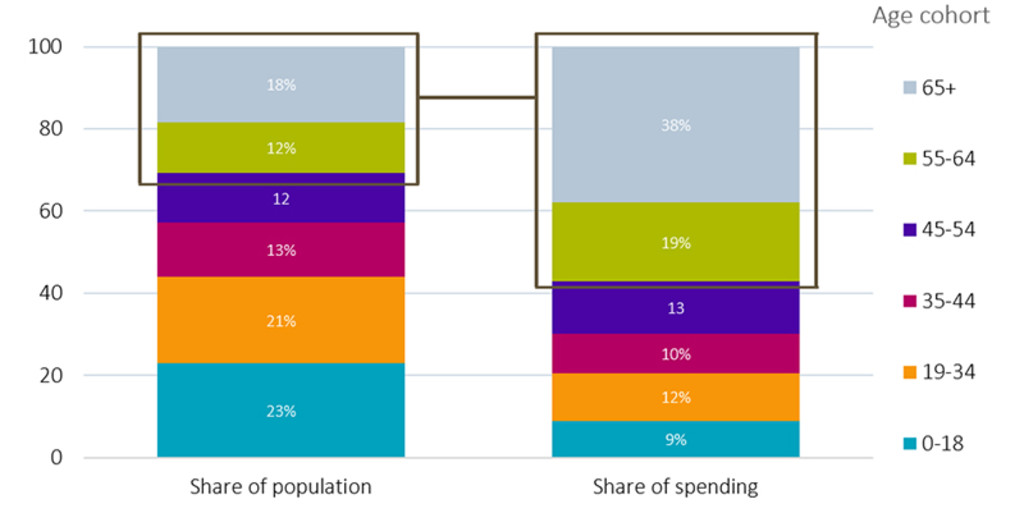
Part totale de la population et part des dépenses médicales totales de chaque cohorte d’âge.
Source : Peterson KFF, données de la Medical Expenditure Panel Survey, 2023.
La demande s'élargit également au-delà des populations plus âgées. Les frontières entre la santé et la consommation deviennent de plus en plus floues à mesure que la santé devient plus personnalisée, plus préventive et davantage guidée par le consommateur. Les patients, en particulier dans les catégories de revenus les plus élevées, prennent davantage en main leur santé, stimulant la demande de bien-être, de diagnostics, de gestion du poids et de solutions liées à la longévité, des dépenses qui vont bien au-delà des soins médicaux traditionnels.
La stratégie Healthy Living
Dans un monde marqué par une plus grande longévité et des taux de natalité plus faibles, la santé individuelle est de plus en plus perçue comme un actif offrant un rendement élevé sur investissement. Healthy Living va bien au-delà de la santé traditionnelle, en investissant dans l'alimentation, le bien-être physique, la prévention et l'innovation dans la santé. Consciente que les individus ont besoin d'environnements propres et de sécurité financière pour s'épanouir, la stratégie investit également dans des entreprises qui favorisent la sécurité environnementale, la productivité de la main-d'œuvre et la résilience financière tout au long de la vie. Collectivement, ces tendances stimulent la croissance de la « richesse préventive », dans laquelle des consommateurs de toutes les classes d'âge cherchent de manière proactive à maintenir une bonne santé physique et financière tout au long de leur vie.
Notes de bas de page
1 Toutes les sociétés mentionnées dans cet article sont citées uniquement à titre indicatif pour illustrer la stratégie d'investissement à la date indiquée. Les sociétés ne sont pas nécessairement détenues dans la stratégie et leur intégration future n'est pas garantie. Ceci ne constitue aucune recommandation d'achat ou de vente ni aucun conseil d'investissement, et aucune conclusion ne doit être tirée quant à l'évolution future de ces sociétés.
2 Peterson KFF, Healthsystem Tracker, « How do health expenditures vary across the population? » (statistiques américaines), mars 2026.