• Insight

Sustainable investing: The resilience premium

Is the sustainable investing winter over? After several years of weak flows, sustainable funds showed signs of recovery in 2026. In the US, flows turned positive in Q2, led by passive and fixed income funds; Asia saw more fund launches, particularly in China’s energy storage segment. Globally, sustainable funds attracted USD 4.6 billion in H1 2026, compared with USD 84 billion in outflows in 2025. Flows nevertheless remained far below the roughly USD 650 billion recorded at the 2021 peak.1

Authors

    Sector Lead
    Head of Sustainability Integration

Summary

  • Sustainable funds see large inflows in 2026 compared with outflows in 2025
  • Cybersecurity, critical minerals and tech sovereignty lead resilience themes
  • Energy security and climate change adaptation also opportunities for investors

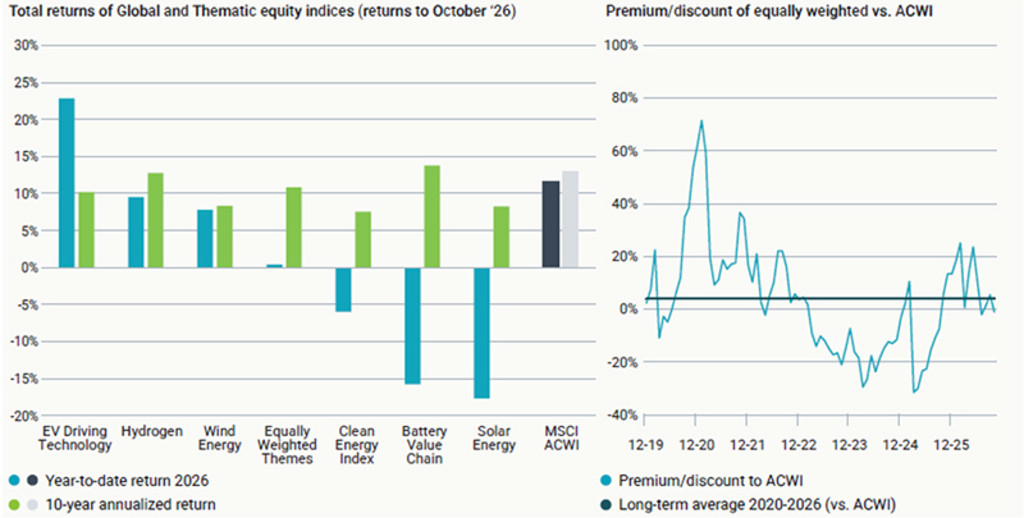
Through September 2026, sustainable equities outperformed globally by around 2%, lifting valuation premiums, although these remained below the long-term historical average.2 In fixed income, performance differences were limited, with sustainable benchmarks slightly underperforming. E-mobility, wind and hydrogen were among the best-performing themes. Performance divergence supports active theme selection.

Figure 1: Performance and relative valuation of sustainable themes

Source: Bloomberg, MSCI, Robeco, data as of October 2026. Indices are unmanaged, and one cannot invest directly in an index. They do not reflect any fees, expenses or sales charges.

Despite signs of recovery, it is too early to declare the end of the sustainable investing winter. Regardless of near-term fund flows, protecting economic, environmental and social assets remains essential for long-term returns, while growing investor interest in systemic resilience is creating new opportunities.

The resilience premium: Widening the lens of sustainable investing

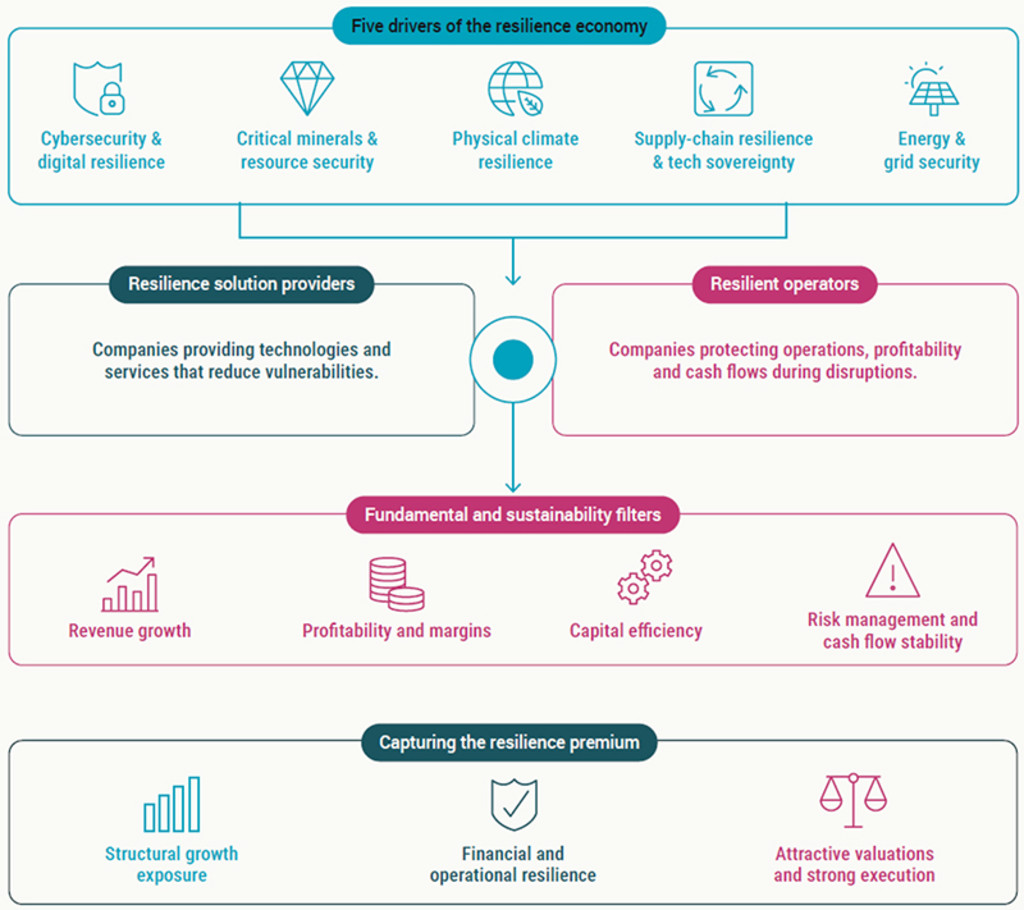
Geopolitical tensions, cyber threats, resource bottlenecks and extreme weather are making operational and systemic resilience central to corporate competitiveness. The shift from a ‘just-in-time’ to a ‘just-in-case’ economy is driving a multi-year investment cycle. In 2027, we see two opportunities within this emerging resilience economy:

  • Resilience solution providers: Companies supplying technologies, materials and services that reduce systemic vulnerabilities.

  • Resilient operators: Companies across sectors that maintain operations, margins and cash flows during disruptions.

Investment potential is strongest where these two strengths overlap. For solution providers, we assess resilience-related revenue exposure and growth, order backlogs and management targets. For resilient operators, we examine supplier diversification, production flexibility, inventory buffers and reshoring initiatives. Sector-specific indicators of operational continuity, margin stability and cash-flow protection help establish whether resilience creates financial value. Five pillars underpin the resilience economy:

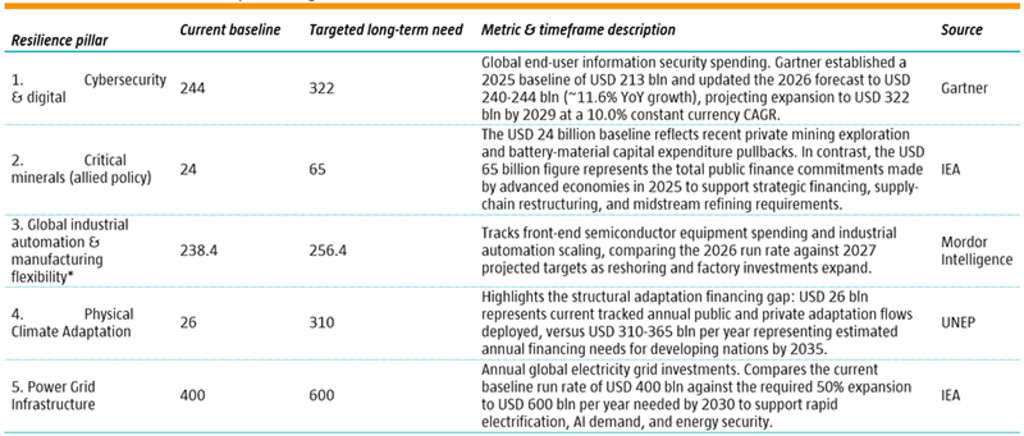
  1. Cybersecurity and digital resilience: As AI connects more industrial, financial and critical infrastructure systems, cyber protection becomes essential. Global end-user spending on information security is projected to reach USD 244 billion in 2026, representing 11.6% growth in constant currency terms.3 We favor providers with differentiated technology, recurring revenue and strong customer retention, while assessing their own cyber-risk governance.

  2. Critical minerals and resource security: Mineral processing remains a geopolitical chokepoint. In 2025, the largest refining country accounted for an average of 72% of refined output across key energy minerals, excluding rare earths, with China dominating most markets. Rare earth export controls threaten downstream industries outside China, while price volatility and geopolitical uncertainty contributed to a 9% decline in critical mineral investment in 2025, including a 20% drop in investment by companies focused on battery materials.4 Ownership of raw materials alone does not guarantee returns. We favor recycling, substitution and diversified refining, supported by cost discipline and long-term supply contracts.

  3. Supply-chain resilience and technology sovereignty: Dependence on single-source suppliers is encouraging reshoring and factory investment in semiconductors, manufacturing and healthcare. Yet spending alone does not guarantee shareholder returns. The global industrial automation market is projected to reach USD 373.6 billion by 2032.5 Equipment and automation leaders with defensible technology, pricing power and strong customer relationships are best positioned to turn this investment into sustained earnings growth.

  4. Physical climate resilience: Extreme heat, flooding and water scarcity are increasingly disrupting business operations, damaging assets and driving up insurance costs. The ongoing El Niño, which is expected to remain strong to very strong into early 2027, could disrupt agricultural production and consumer staples supply chains, increasing input costs and squeezing margins.67 Global insured catastrophe losses reached USD 135 billion in 2024,8 while developing countries face annual adaptation financing needs of USD 310-365 billion by 2035.9 For investors, opportunities lie in scalable solutions such as water treatment, industrial cooling, flood protection and climate-resilient agriculture, particularly companies with recurring revenue and strong pricing power.10

  5. Energy and infrastructure security: Rapid electrification, geopolitical uncertainty and AI-driven demand are straining aging power grids. Global electricity demand is forecast to grow by an average of 3.6% annually through 2030,11 requiring annual grid investment to rise by 50%, from USD 400 billion to USD 600 billion12 a year. We favor grid equipment, storage and power management companies with strong execution, pricing power and limited exposure to inflation-sensitive fixed-price contracts.

Figure 2: The resilience premium framework

Source: Robeco Sustainable Investing Research, October 2026. For illustrative purposes only. This does not constitute a binding element for investment selection.

Table 1: The resilience spending wave

Source: Gartner, IEA, SEMI, UNEP, Robeco. Data as of Q4 2026, Mordor Intelligence, 2026.

* This pillar tracks broader factory automation and smart-manufacturing systems (scaling toward USD 373.6 billion by 2032) rather than specialized wafer fabrication equipment. However, semiconductor companies are key end-users driving demand for these automation and manufacturing flexibility systems as they expand and re-shore production facilities.

The hidden cost of resilience: Who pays and who profits?

Higher resilience spending does not necessarily translate into better returns. High valuations, weak pricing power and execution risks can erode profitability, while reshoring and mineral processing can introduce environmental and social trade-offs. Sustainable investing research helps identify who benefits, who bears the costs and which risks traditional financial analysis may overlook.

Actionable outlook for 2027

We assess three criteria to identify companies positioned to capture the resilience premium:

  1. Structural growth: Exposure to long-term resilience demand and expanding revenue opportunities.

  2. Operational and financial strength: Flexible supply chains and pricing power that protect margins during disruptions.

  3. Valuation discipline: Strong execution, disciplined capital allocation and reasonable valuations.

Ultimately, the resilience premium accrues to companies that turn resilience investment and operational adaptability into lasting shareholder value.13

This article was originally published as a special feature in our 2027 Investment Outlook.

Footnotes

1 Morningstar Global Sustainable Fund flows; Q2 2026.
2Past performance is no guarantee of future results. The value of your investments may fluctuate.
3Gartner, Forecast Analysis: Information Security, Worldwide, 2026, 5 February 2026.
4International Energy Agency (IEA), Global Critical Minerals Outlook, 2026.
5Mordor Intelligence, Industrial Automation Market Size & Share Analysis, (2026), Mordor Intelligence Market Research
6Allianz Research (15 July 2026) – Super El Niño Risk: More Inflation in Asia, Oversupply in Latin America Yet Little Disruption in Financial Markets.
7Citi Research (25 June 2026) – Global Economic Outlook & Strategy: The Resilient Global Economy – Cascading Supply Shocks.
8 Swiss Re Annual Report 2024
9UNEP Adaptation Gap Report 2025
10Barclays Research (21 September 2026) – Sustainable Investing: Adaptation in Action – A Global Universe of Solution Providers.
11International Energy Agency (IEA), Electricity 2026 (February 2026).12Deutsche Bank Research, DeBLASEing the Trail, October 2026.
13Investing in financial instruments carries risks, including potential loss of your invested capital. Investors may not get back the amount originally invested. Assess your financial situation and risk tolerance carefully and seek independent advice if needed.

2027 Investment outlook

The forces beneath the surface

Discover more

Morningstar disclaimer:
All Rights Reserved. The information, data, analyses and opinions (“Information”) contained herein: (1) include the proprietary information of Morningstar and its contentproviders; (2) may not be copied or redistributed except as specifically authorised; (3) do not constitute investment advice; (4) are provided solely for informational purposes; (5) are not warranted to be complete, accurate or timely; and (6) may be drawn from data published on various dates. Morningstar is not responsible for any trading decisions, damages or other losses related to the Information or its use. Please verify all of the Information before using it and don’t make any investment decision except upon the advice of a professional financial adviser. Past performance is no guarantee of future results. The value and income derived from investments may go down as well as up.

MSCI disclaimer:
Source: MSCI. The MSCI information may only be used for your internal use, may not be reproduced or redisseminated in any form and may not be used as a basis for or a component of any financial instruments or products or indices. None of the MSCI information is intended to constitute investment advice or a recommendation to make (or refrain from making) any kind of investment decision and may not be relied on as such. Historical data and analysis should not be taken as an indication or guarantee of any future performance analysis, forecast or prediction. The MSCI information is provided on an "as is" basis and the user of this information assumes the entire risk of any use made of this information. MSCI, each of its affiliates and each other person involved in or related to compiling, computing or creating any MSCI information (collectively, the "MSCI Parties") expressly disclaims all warranties (including, without limitation, any warranties of originality, accuracy, completeness, timeliness, non-infringement, merchantability and fitness for a particular purpose) with respect to this information. Without limiting any of the foregoing, in no event shall any MSCI Party have any liability for any direct, indirect, special, incidental, punitive, consequential (including, without limitation, lost profits) or any other damages. (www.msci.com)

Bloomberg disclaimer:
The following are trademarks and service marks of Bloomberg Finance L.P., a Delaware limited partnership, or its subsidiaries: BLOOMBERG, BLOOMBERG ANYWHERE, BLOOMBERG MARKETS, BLOOMBERG NEWS, BLOOMBERG PROFESSIONAL, BLOOMBERG TERMINAL and BLOOMBERG.COM: Absence of any trademark or service mark from this list does not waive Bloomberg's intellectual property rights in that name, mark or logo. All rights reserved.

Let's keep the conversation going

Keep track of fast-moving events in sustainable and quantitative investing, trends and credits with our newsletters.

Don’t miss out

Robeco aims to enable its clients to achieve their financial and sustainability goals by providing superior investment returns and solutions.

Important information This disclaimer applies to any documents and the verbal or written comments of any person in presentations or webinars on this website and taken together is referred to herein as the “Information”. The services to which the Information relate are NOT FOR RETAIL CLIENTS - The information contained in the Website is solely intended for professional investors, defined as investors which (1) qualify as professional clients within the meaning of the Markets in Financial Instruments Directive (MiFID), (2) have requested to be treated as professional clients within the meaning of the MiFID or (3) are authorized to receive such information under any other applicable laws and must not be relied or acted upon by any other persons. This Information does not constitute an offer to sell, or a solicitation of an offer to buy, any financial product, and may not be relied upon in connection with the purchase or sale of any financial product. You are cautioned against using this Information as the basis for making a decision to purchase any financial product. To the extent that you rely on the Information in connection with any investment decision, you do so at your own risk. The Information does not purport to be complete on any topic addressed. The Information may contain data or analysis prepared by third parties and no representation or warranty about the accuracy of such data or analysis is provided.
In all cases where historical performance is presented, please note that past performance is not a reliable indicator of future results and should not be relied upon as the basis for making an investment decision. Investors may not get back the amount originally invested. Neither Robeco Institutional Asset Management B.V. nor any of its affiliates guarantees the performance or the future returns of any investments. If the currency in which the past performance is displayed differs from the currency of the country in which you reside, then you should be aware that due to exchange rate fluctuations the performance shown may increase or decrease if converted into your local currency. Robeco Institutional Asset Management B.V. (“Robeco”) expressly prohibits any redistribution of the Information without the prior written consent of Robeco. The Information is not intended for distribution to, or use by, any person or entity in any jurisdiction or country where such distribution or use is contrary to law, rule or regulation. Certain information contained in the Information includes calculations or figures that have been prepared internally and have not been audited or verified by a third party. Use of different methods for preparing, calculating or presenting information may lead to different results. Robeco Institutional Asset Management UK Limited (“RIAM UK”) is authorised and regulated by the Financial Conduct Authority. RIAM UK, 30 Fenchurch Street, Part Level 8, London EC3M 3BD (FCA Reference No:1007814). The company is registered in England and Wales under Ref No. 15362605.

In all cases where historical performance is presented, please note that past performance is not a reliable indicator of future results and should not be relied upon as the basis for making an investment decision. Investors may not get back the amount originally invested. Neither Robeco Institutional Asset Management B.V. nor any of its affiliates guarantees the performance or the future returns of any investments. If the currency in which the past performance is displayed differs from the currency of the country in which you reside, then you should be aware that due to exchange rate fluctuations the performance shown may increase or decrease if converted into your local currency. Robeco Institutional Asset Management B.V. (“Robeco”) expressly prohibits any redistribution of the Information without the prior written consent of Robeco. The Information is not intended for distribution to, or use by, any person or entity in any jurisdiction or country where such distribution or use is contrary to law, rule or regulation. Certain information contained in the Information includes calculations or figures that have been prepared internally and have not been audited or verified by a third party. Use of different methods for preparing, calculating or presenting information may lead to different results. Robeco Institutional Asset Management B.V. is authorised as a manager of UCITS and AIFs by the Netherlands Authority for the Financial Markets and subject to limited regulation in the UK by the Financial Conduct Authority. Details about the extent of our regulation by the Financial Conduct Authority are available from us on request.