• Insight

How dynamic high yield responds when spreads widen

High yield offers attractive income, but how can investors stay invested if tight spreads widen? Dynamic high yield uses market signals to adjust risk as conditions change.

Authors

    Ward Poirters
    Client Portfolio Manager
    Portfolio Manager

Summary

  • Dynamic high yield has shown resilience in past periods of spread widening
  • Its systematic process adjusts exposure as signals strengthen or weaken
  • Its portfolio structure allows it to reposition quickly

Investors are facing no shortage of reasons for concern. Geopolitical tensions, energy-price risks and uncertainty over central bank policy continue to cloud the outlook. Although spreads have widened in recent weeks, they remain close to historically tight levels.

This suggests that investors are still demanding relatively little extra compensation for taking credit risk. For investors who want to keep earning income from high yield, this creates a challenge: staying invested while managing the risk of a market reversal.

Why do spreads matter?

A high yield bond usually pays more interest than a government bond because there is more risk that the company borrowing the money will struggle to repay it. The spread is that extra yield. If a government bond yields 3% and a high yield bond yields 6%, the spread is three percentage points.

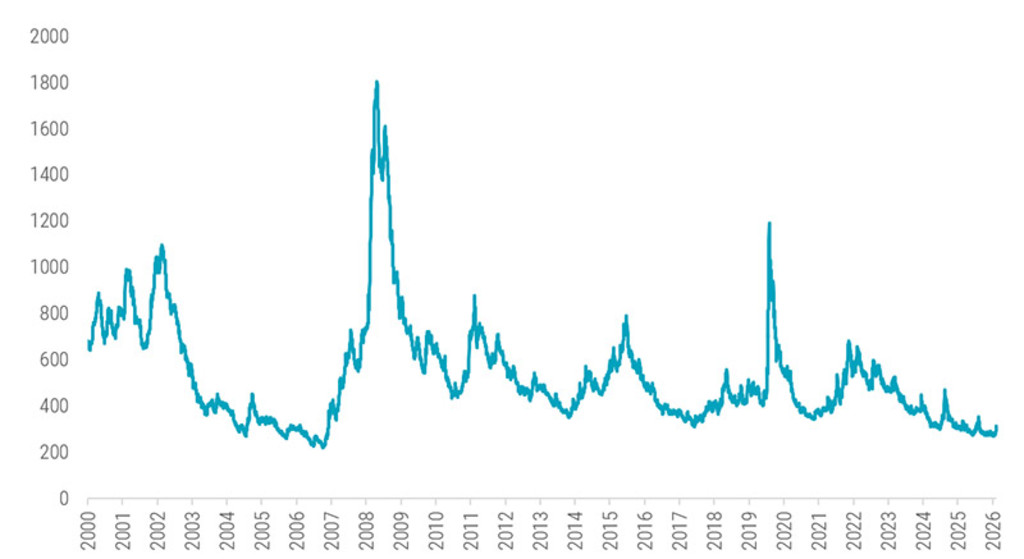
Today, spreads are tight, meaning investors receive relatively little extra yield for taking additional company risk. If confidence in companies weakens, investors may demand more compensation. Spreads then widen, and the prices of existing high yield bonds generally fall. Figure 1 puts today’s position in context: spreads rose sharply during past periods of concern, but are now near the low end of the range shown.

Figure 1 - How the spread on high yield bonds has changed over time

Past performance is no guarantee of future results. The value of your investments may fluctuate.

Source: Bloomberg Global High Yield Index, until the end of September 2026.

Why stay invested in high yield?

Despite tight credit spreads, high yield continues to offer attractive income, with yields around levels not seen for more than two decades. Those yields provide a stronger starting point for returns. The income earned can also help offset some decline in bond prices. Fundamentals across the asset class remain relatively strong. The high yield market has become higher-quality over time, with BB-rated bonds now representing a record share of both the US and European markets.1

When conditions become less supportive, the strategy can reduce exposure; when they improve, it can increase exposure again

High yield can also add diversification to a broader bond portfolio because it behaves differently from more interest-rate-sensitive bonds. Attractive income, relatively solid fundamentals and diversification therefore continue to make a case for staying invested. But tight spreads mean investors also need to be prepared if market conditions worsen. This is where a more flexible approach can help.

What’s new in credits?

Stay ahead with our newsletter on the latest in credit investing.

Discover credits

How does dynamic high yield operate in difficult markets?

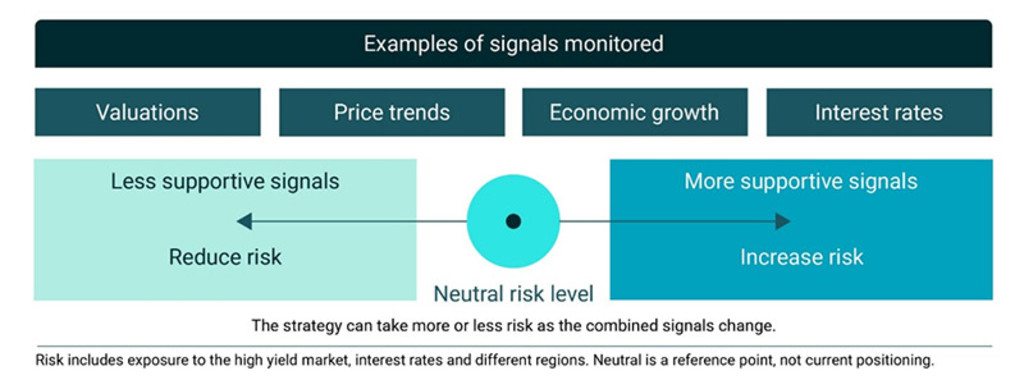
Traditional high yield strategies generally stay invested so they can earn income and benefit when the market rises. But that also leaves them exposed when high yield bonds fall in value. Dynamic high yield has a different approach: it can adjust how much high yield risk it takes. It does this by monitoring signals such as the extra yield bonds offer, price trends, economic growth and interest rates.

These signals are combined systematically to determine the strategy's level of high yield exposure. When conditions become less supportive, the strategy can reduce exposure to help limit downside risk. But the flexibility also works in the other direction: when conditions are more favorable, it can increase exposure above its neutral level to capture more of the income and return potential available from high yield.

Figure 2 - Market signals guide high yield risk exposure – the aim is not to predict every market turning point perfectly, but to adapt as conditions change

Source: Robeco, October 2026.

Why consider dynamic high yield today?

Today's combination of attractive yields and tight spreads makes flexibility particularly relevant. Dynamic high yield seeks to capture that income while adjusting risk as conditions change. This allows investors to remain in the asset class without having to decide for themselves when to exit or re-enter the market.

Footnote

1Source: KKR, August 2026. BB-rated bonds account for approximately 57% of the US high yield market and 68% of the European high yield market, both record levels.

QI Dynamic High Yield IBH GBP

performance ytd (30-9)
1.02%
Performance 3y (30-9)
9.77%
morningstar (30-9)
4 / 5
SFDR (30-9)
Article 6
Dividend Paying (30-9)
Yes
View the fund
Past performance is no guarantee of future results. The value of the investments may fluctuate. Annualized (for periods longer than one year). Performances are net of fees and based on transaction prices.

Let's keep the conversation going

Keep track of fast-moving events in sustainable and quantitative investing, trends and credits with our newsletters.

Don’t miss out

Robeco aims to enable its clients to achieve their financial and sustainability goals by providing superior investment returns and solutions.

Important information This disclaimer applies to any documents and the verbal or written comments of any person in presentations or webinars on this website and taken together is referred to herein as the “Information”. The services to which the Information relate are NOT FOR RETAIL CLIENTS - The information contained in the Website is solely intended for professional investors, defined as investors which (1) qualify as professional clients within the meaning of the Markets in Financial Instruments Directive (MiFID), (2) have requested to be treated as professional clients within the meaning of the MiFID or (3) are authorized to receive such information under any other applicable laws and must not be relied or acted upon by any other persons. This Information does not constitute an offer to sell, or a solicitation of an offer to buy, any financial product, and may not be relied upon in connection with the purchase or sale of any financial product. You are cautioned against using this Information as the basis for making a decision to purchase any financial product. To the extent that you rely on the Information in connection with any investment decision, you do so at your own risk. The Information does not purport to be complete on any topic addressed. The Information may contain data or analysis prepared by third parties and no representation or warranty about the accuracy of such data or analysis is provided.
In all cases where historical performance is presented, please note that past performance is not a reliable indicator of future results and should not be relied upon as the basis for making an investment decision. Investors may not get back the amount originally invested. Neither Robeco Institutional Asset Management B.V. nor any of its affiliates guarantees the performance or the future returns of any investments. If the currency in which the past performance is displayed differs from the currency of the country in which you reside, then you should be aware that due to exchange rate fluctuations the performance shown may increase or decrease if converted into your local currency. Robeco Institutional Asset Management B.V. (“Robeco”) expressly prohibits any redistribution of the Information without the prior written consent of Robeco. The Information is not intended for distribution to, or use by, any person or entity in any jurisdiction or country where such distribution or use is contrary to law, rule or regulation. Certain information contained in the Information includes calculations or figures that have been prepared internally and have not been audited or verified by a third party. Use of different methods for preparing, calculating or presenting information may lead to different results. Robeco Institutional Asset Management UK Limited (“RIAM UK”) is authorised and regulated by the Financial Conduct Authority. RIAM UK, 30 Fenchurch Street, Part Level 8, London EC3M 3BD (FCA Reference No:1007814). The company is registered in England and Wales under Ref No. 15362605.

In all cases where historical performance is presented, please note that past performance is not a reliable indicator of future results and should not be relied upon as the basis for making an investment decision. Investors may not get back the amount originally invested. Neither Robeco Institutional Asset Management B.V. nor any of its affiliates guarantees the performance or the future returns of any investments. If the currency in which the past performance is displayed differs from the currency of the country in which you reside, then you should be aware that due to exchange rate fluctuations the performance shown may increase or decrease if converted into your local currency. Robeco Institutional Asset Management B.V. (“Robeco”) expressly prohibits any redistribution of the Information without the prior written consent of Robeco. The Information is not intended for distribution to, or use by, any person or entity in any jurisdiction or country where such distribution or use is contrary to law, rule or regulation. Certain information contained in the Information includes calculations or figures that have been prepared internally and have not been audited or verified by a third party. Use of different methods for preparing, calculating or presenting information may lead to different results. Robeco Institutional Asset Management B.V. is authorised as a manager of UCITS and AIFs by the Netherlands Authority for the Financial Markets and subject to limited regulation in the UK by the Financial Conduct Authority. Details about the extent of our regulation by the Financial Conduct Authority are available from us on request.