

Portfolio Manager


• Insight
Why the investment case for healthcare is strengthening
Healthcare has spent much of the past five years in the shadows of Big Tech. But a durable recovery is in motion as biotech IPOs and pharma acquisitions, R&D, AI, and increased longevity inject fresh momentum into the sector.
Authors

Summary
- M&A, IPOs, licensing deals and partnerships are boosting fundamentals
- Healthcare is emerging as a compelling AI implementation play
- Demographics continue to provide a multi-decade growth runway
Over the past three years, market attention and flows have been narrowly focused on AI related themes, leaving healthcare one of the market's largest (fourth in the MSCI World) and most durable growth sectors, largely overlooked. Some of the neglect is warranted as a combination of concerns around drug pricing reforms, reimbursement pressures, Medicaid membership cuts and broader policy uncertainty in the US soured investor sentiment, leading to outflows as investors chased the AI trade.
We believe this dynamic is beginning to reverse as regulations and policy pressures ease, reflected in improved fundamentals and rising valuations. In parallel, M&A activity, licensing deals and biotech IPOs are accelerating, suggesting confidence in the sector outlook. With attractive valuations and earnings growth set to reaccelerate into 2027, the sector appears poised for a durable recovery.
Healthcare is also an underappreciated beneficiary of the AI roll-out. Not only is it improving cost efficiencies, it’s also accelerating revenue growth through enhanced innovation, faster procedures and higher patient engagement. While data suggest flows are returning, sector index weights and ownership among a broader swath of investors remains near cyclical lows, suggesting the Healthcare sector is an undervalued and under-owned opportunity waiting to be tapped, particularly as investors look to protect their portfolio against an unwind of the AI trade.
Biopharma funding has rebounded as pharmaceutical companies deploy capital to innovative biotechs to replenish pipelines ahead of looming patent expirations. Biopharma M&A reached USD 130 bln in the first half of 2026, nearly matching the total value recorded in all of 2025 (see Figure 1). Public market appetite has also reaccelerated, with biotech IPOs raising USD 5bln in H1 2026, already surpassing the annual total achieved in any year since 2022 (see Figure 2). Meanwhile, R&D licensing activity remains exceptionally strong, with announced deal values reaching USD 167bln in H1 2026, more than half of 2025's record level.
Figure 1 – Volume and value of M&A deals in biopharma are rising
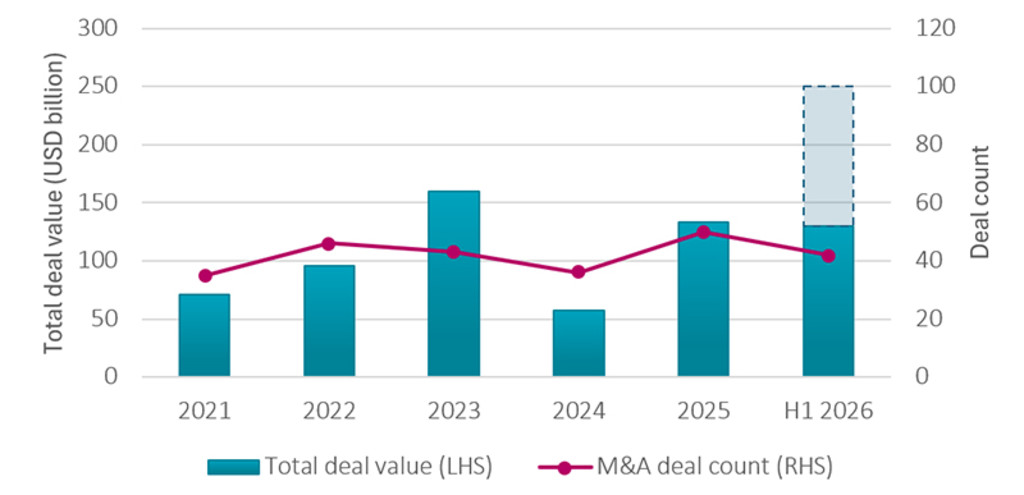
Total value and number of announced Biopharma M&A deals through 30 June 2026. H1 alone matches full year 2025 levels. Source: IQVIA, July 2026.
Healthy Living D USD
- performance ytd (30-9)
- -7.14%
- Performance 3y (30-9)
- 1.22%
- morningstar (30-9)
- SFDR (30-9)
- Article 9
- Dividend Paying (30-9)
- No
Past performance is no guarantee of future results. The value of the investments may fluctuate. Annualized (for periods longer than one year). Performances are net of fees and based on transaction prices.
Figure 2 – Biopharma IPO activity is also accelerating
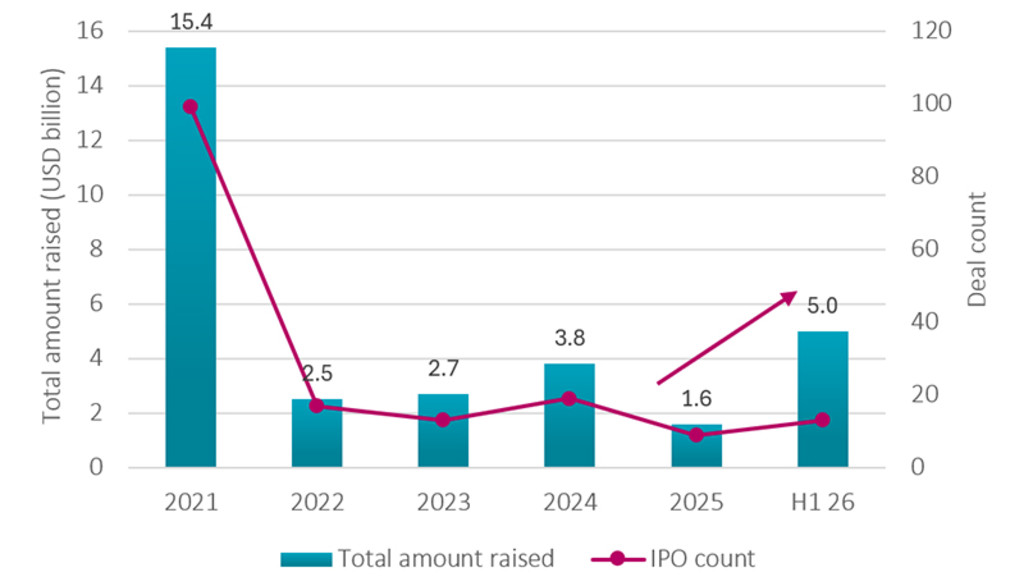
Total deals and capital raised among biopharma firms through 30 June 2026. IPOs are picking up after a few years of muted activity. Source: JP Morgan, DealForma.com database, July 2026.
This resurgence matters well beyond the pharmaceutical companies executing the deals. M&A, licensing agreements and fresh equity capital ultimately translate into higher spending on drug discovery, clinical development and manufacturing. Beneficiaries include life science tool providers, laboratory equipment companies and specialized services firms such as Contract Research and Contract Development and Manufacturing Organizations (CROs and CDMOs).
Crucially, capital is flowing towards some of healthcare's most innovative and fastest-growing segments. Oncology accounted for 41% of deal value in the first half of 2026, followed by immunology and neurology. Many transactions are centered on next-generation platforms, including antibody-drug conjugates, cell and gene therapies, and multi-specific antibodies, underscoring the industry's continued appetite for innovation and the next wave of blockbuster medicines.
What’s trending?
All the latest thematic investing trends just one newsletter subscription away.
Healthcare – a sector demonstrating AI’s real-world value
Healthcare is emerging as one of the most compelling AI monetization stories in the market. Across the value chain, AI is accelerating drug discovery, enabling faster and better diagnostics, boosting clinical productivity and automating administrative workflows, delivering the rare combination of innovation, revenue generation and cost efficiencies.
By the end of 2025, the FDA had approved more than 1,400 AI and machine learning-enabled medical devices, with radiology leading adoption as AI shortens examination times and improves diagnostic accuracy. In managed care, UnitedHealthcare’s1 AI companion is set to reach more than 20 million members by the end of 2026, simplifying the navigation of coverage, claims and medical costs. Meanwhile, HCA Healthcare is deploying machine learning across its network to automate documentation, streamline administrative workflows and optimize revenue-cycle management, helping alleviate acute healthcare labor shortages.
More compelling still, AI is rapidly reshaping the economics of drug development. Pharmaceutical companies are embedding machine learning across the R&D process to bring more drugs to market faster and at a lower cost. AstraZeneca already uses AI to accelerate promising candidate selection. Industry-wide, investments in AI-driven drug discovery continue to surge as biopharma companies seek to boost returns on innovation. At the frontier, China's Insilico Medicine claims to have compressed early-stage drug discovery from roughly 4.5 years to just 12 months by combining generative AI with automated robotic laboratories.
Healthcare offers investors a differentiated way to access the AI theme, moving beyond the tech talk toward the direct benefits of real-world adoption. Hence, we believe healthcare remains one of the most attractive and underappreciated opportunities in the next phase of AI adoption.
Healthcare offers investors a differentiated way to access the AI theme
Demographics remain the ultimate growth engine
While improving fundamentals, renewed market inflows and the emergence of AI-enabled productivity, provide important cyclical tailwinds for healthcare, the sector's most compelling investment case remains structural. Aging populations, rising life expectancy and the continued expansion of the global middle class are driving a sustained increase in demand for healthcare products and services.
This shift is already visible in consumer spending patterns. In the US, healthcare's share of the personal consumption wallet has increased from just 5% in the 1950s to around 17% today, while spending on food and beverages has fallen from 21% to 7%. Part of this increase can be explained by consumers consistently allocating a larger share of incremental spending to health and wellbeing, as incomes rise and basic needs are met, making healthcare, arguably, one of the clearest beneficiaries of long-term prosperity.
Demographics are set to reinforce this trend for decades to come. Healthcare utilization rises sharply with age, and longer lifespans are steadily increasing demand for medical care, treatments and health-related services. Although Americans over 65 account for only 18% of the population, they represent 38% of total healthcare spending and visit physicians on average seven times per year, compared with just twice for those under 45.2 The effect becomes even more pronounced among the 85+ population, a relatively small cohort today but one that will expand rapidly in the coming decades.
Figure 3 – People 55 and over account for more than half of total health spending
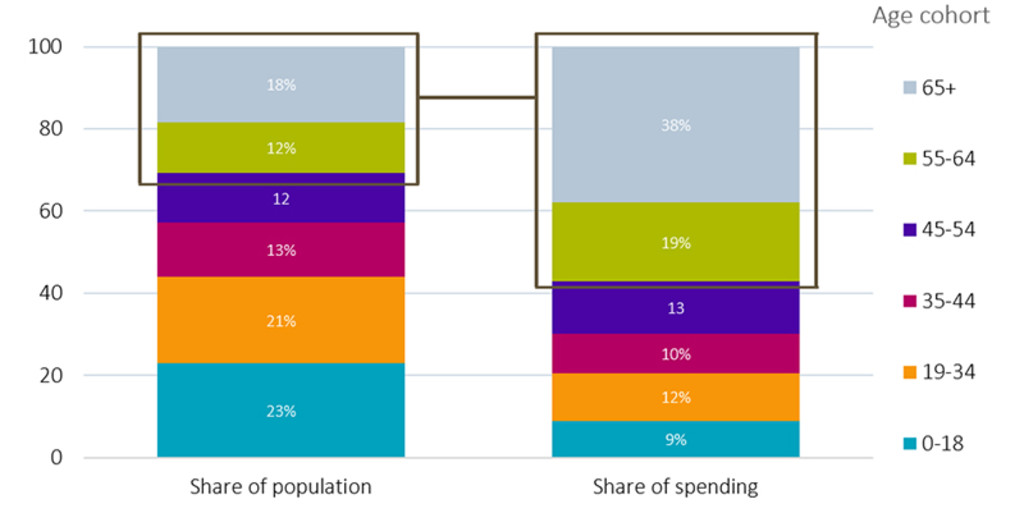
The total share of the population and share of total medical spending of each age cohort.
Source: Peterson KFF, Medical Expenditure Panel Survey data, 2023.
Demand is also broadening beyond older populations. The lines between healthcare and consumer are becoming increasingly blurred as healthcare becomes more personalized, preventive and consumer driven. Patients, particularly in higher-income groups, are taking greater ownership of their health, fueling demand for wellness, diagnostics, weight management and longevity-related solutions, spending that extends well beyond traditional medical care.
The Healthy Living strategy
In a world of longer lives and lower birth rates, individual health is increasingly perceived as an asset with a high return on investment. Healthy Living goes far beyond traditional healthcare, investing across nutrition, physical wellbeing, prevention, and health innovation. Recognizing that individuals need clean environments and financial security to thrive, the strategy also invests in companies that promote environmental safety, workforce productivity and life-long financial resilience. Collectively, these trends are driving growth in ‘preventative wealth’, where consumers of all age groups proactively seek to maintain good physical and financial health through their lives.
Footnotes
1All companies referenced in this article are for illustrative purposes only in order to demonstrate the investment strategy on the date stated. The companies are not necessarily held by the strategy nor is future inclusion guaranteed. This is not a buy, sell or hold recommendation, nor should any inference be made on the future development of these companies.
2 Peterson KFF, Healthsystem Tracker, “How do health expenditures vary across the population?” (US statistics), March 2026.