

Portfolio Manager


• Monthly outlook
Gold is back as an asset class
Its allure has lasted for centuries and shows no sign of losing its appeal. The recent spike in the price of gold to all-time highs suggests it should once again be treated as a genuine asset class and not an emotional fad, says multi-asset investor Arnout van Rijn.
Authors



Summary
- Gold price hit all-time high on deepening of Middle East conflicts
- Central bank demand and limited supply dynamics remain bullish
- Exposure can be gained through derivatives and miners’ equities
The gold price hit USD 2,685 an ounce in September, as the widening of war in the Middle East confirmed the metal’s historic position as a safe haven. This new high came even as stock and bond markets remained strong, meaning gold isn’t necessarily an alternative to traditional self-sufficient asset classes.
Robeco Sustainable Multi-Asset Solutions has recently increased its exposure to gold through the purchase of exchange traded commodity (ETC) derivatives and by holding the equities of gold miners.
“People who are bullish on gold are sometimes pejoratively described as ‘gold bugs,’” says van Rijn, Portfolio Manager with the multi-asset team. “They are said to be stuck in the past, having failed to realize that financial markets have evolved since the end of the Gold Standard in 1971.”
“Robeco wrote a white paper in 19921 where – although we were bullish on the price outlook – we declared gold to be irrelevant as an asset class. We argued that gold was no longer needed to hedge downside risk events, as derivative markets had become large and liquid enough to take on that role. Also, the expectation was for low inflation for the foreseeable future.”
“Progressive insights 32 years after this paper and the return of inflation worries may mark the ‘revenge of the gold bugs’. Gold’s 28% return so far in 2024 has particularly caused a stir, as it outpaces even strong equity returns. Since the white paper in 1992, gold has risen by an annualized 6.2%. So, do we need to reassess gold as an asset class?”
The short answer is yes, not least as the structural market dynamics make gold more than just a commodity, van Rijn says. “Supply and demand are key to where its price will go,” he says.
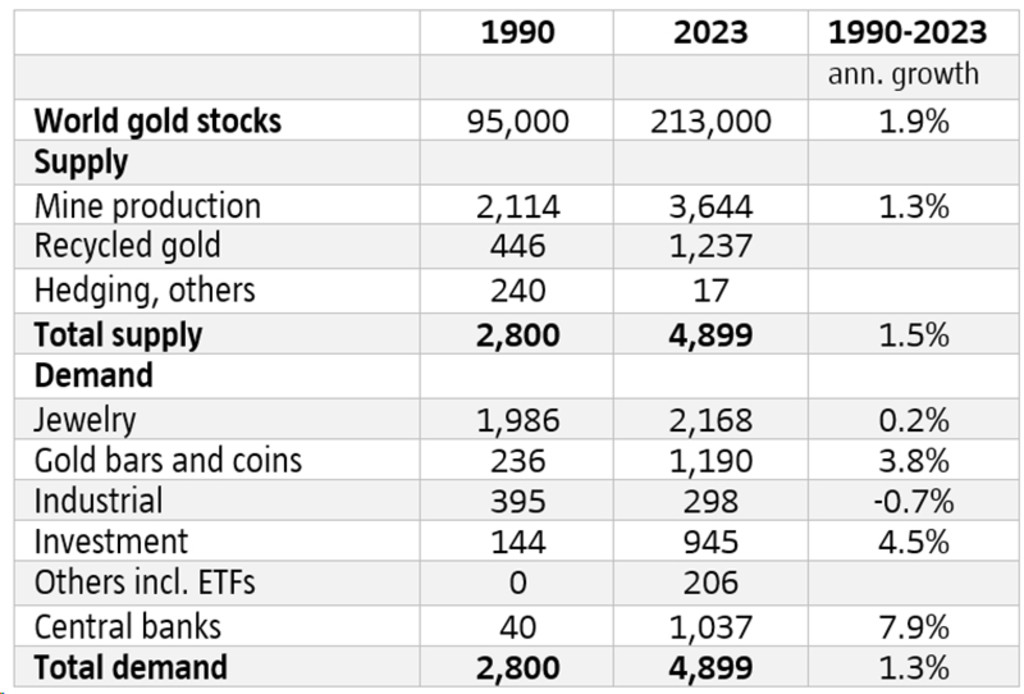
The supply and demand of gold since 1990. Source: World Gold Council
“As a scarce commodity, supply is capped, with mine supply growing stocks by just 1.3% per annum. What differentiates it from most commodities is that gold lasts forever. All the gold that has ever been mined below ground still exists above ground. That fundamentally affects the supply potential.”
“Still, the demand outlook will be key. It seems that armed conflicts and political unrest haven’t had much of an impact on financial markets. Yet, global conflicts have been supportive of gold demand. In countries that are under sanctions, or have capital controls, gold remains a great alternative for cash in the bank.”
The GFC’s watershed moment
Van Rijn says that the Global Financial Crisis of 2008-2009 was a pivotal moment that kickstarted gold’s return to favor among central banks. As some financial institutions faced collapse without bailouts, and as cash in the bank that was previously thought safe was under threat, gold came back as in inarguable store of value.
“In general, central banks turned from sellers to buyers after 2009, when the GFC became a watershed event to alter their thinking about the role of gold,” van Rijn says.
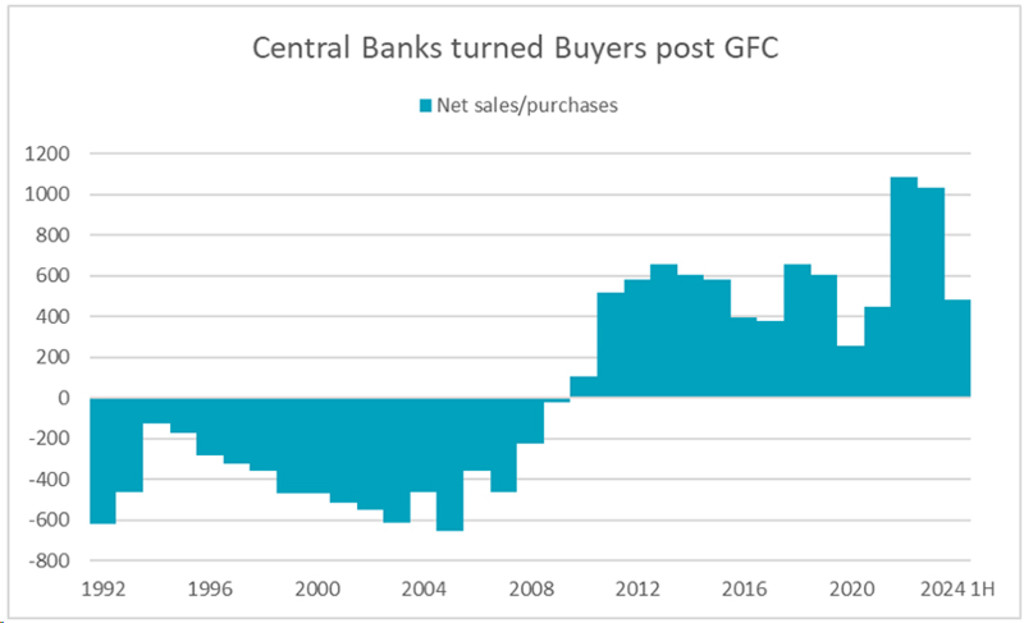
Central banks have turned from net sellers to net buyers.
Source: Visual Capitalist, Metals Focus, Refinitiv GFMS, World Gold Council
“Russia in particular has been a big buyer (1,300 tons) since sanctions were first imposed in 2014. Some also say that China has been buying because it is afraid of US sanctions potentially making its access to US dollars difficult.”
In 2024, a Gold Council Survey cited 69% of central banks as saying that in five years’ time, a larger percentage of their reserves will be held in gold, at the expense of US dollar holdings. “Currently, just 17% of global central bank reserves are held in gold,” van Rijn says.
“There is a strong divergence though between the high levels seen in Western economies (60-70%) and very low levels in China (5%) and India (10%). It is clear where future purchases may come from.”
The rise of bitcoin
The advent of cryptocurrencies – sometimes seen as ‘digital gold’ – has expanded the allure of alternative assets, as trust falls in governments endlessly printing money, van Rijn says.
“Many people, especially right-wing liberals in Western economies, have lost faith in governments and their fiat money,” he says. “They have turned to bitcoin and gold as the best stores of value when the debt-built edifice eventually comes tumbling down.”
“Maybe due to competition from ‘digital gold’, retail interest in physical gold has fallen after peaking in 2020. But here too, we have seen ETF demand starting to come back over the past couple of months. Buying begets buying.”
Tactical allocation to gold
“But as multi-asset investors, we look at gold clinically. From a risk/return perspective, there is reason to allocate to gold. Since our 1992 white paper, returns have been healthy. Though its volatility is a drawback, gold offers diversification because it has been lowly (0.1-0.2) correlated with US Treasury bonds and equities, and actually has a negative correlation (-0.2) with other commodities.”
“We would definitely not describe ourselves at Robeco as gold bugs – yet the multi-asset team has started a tactical allocation to gold, next to our broad allocation to commodities. Central bank demand, growing Asian wealth and right-wing liberals are the main reasons to be bullish.”
Footnote
1Research Paper Goud, IRIS BV, Arnout van Rijn and Brigitte Slot, April 1992
Get the latest insights
Subscribe to our newsletter for investment updates and expert analysis.
Important information
THIS WEBSITE IS SOLELY INTENDED FOR PROFESSIONAL INVESTORS, WHICH HAS THE MEANING ASCRIBED TO IT IN THE SECURITIES AND FUTURES ORDINANCE (CAP. 571 OF THE LAWS OF HONG KONG) AND ITS SUBSIDIARY LEGISLATION. Investment involves risks. Past performance is not indicative of future performance. The information contained in this website is provided for reference only and does not constitute investment advice or an offer or solicitation to buy or sell in any securities or to adopt any investment strategy. Investors should not base their investment decisions solely on the information provided on this website and are advised to seek independent advice (including advice on tax implications) before making any investment decisions. Investors should ensure they fully understand the risks associated with the investment products and should also consider their own investment objectives and risk tolerance level. The investment decision is yours. You should not invest unless the intermediary who sells you the investment products has advised you that it is suitable for you and has explained how it is consistent with your investment objectives. Please refer to the relevant offering documents or other legal documents for further details including the risk factors. This website is published by Robeco Hong Kong Limited which is regulated by the Hong Kong Securities and Futures Commission (“SFC”) (CE No. APU851). This website has not been reviewed by the SFC. No assurance can be given that the investment objective of any investment products will be achieved. No representation or promise as to the performance of any investment products or the return on an investment is made. The value of investments may fluctuate. Past performance, projections, or forecasts included in this website should not be regarded as guarantees or indications of future performance, and no express or implied warranty is provided. The contents of this website are based on sources believed to be reliable, but due to the nature of information delivery technology and the necessity of using multiple data sources, including third party content, their accuracy is not guaranteed. The opinions expressed are as of the date shown above and may change as market conditions evolve, and are subject to change without notice. These opinions may differ from those of other Robeco investment professionals. Robeco accepts no liability for any direct, indirect, or consequential loss arising from the use of this material or any comments, opinions, or estimates contained herein. Robeco has no duty to update this website or any website content. Materials on this website may not be reproduced, distributed, or published without prior written permission from Robeco. Unless otherwise specified, Source: Robeco.