
Portfolio Manager


• Insight
Unraveling the Korea discount
Policies to unlock value in the stock market are likely to be popular and help mitigate a future pension system crunch in the thriving, but rapidly-aging, north Asian economy.
Authors




Client Portfolio Manager
Summary
- Japan success brings persistent Korea valuation discount into focus
- South Korea resolved to act on governance with elections looming
- Action will unlock value and underpin investor confidence in this key EM economy
The Korean stock market discount phenomenon is characterized by Korean-listed companies trading at a consistent discount to international counterparts. The disparity exists even when the earnings per share (EPS) and book value per share (BPS) of these companies are comparable.
A comparison of the price-to-book ratio (PBR) across different regions, including Korea, offers insight into the reality of this issue.
Figure 1: PBR - Korea vs peers and indices
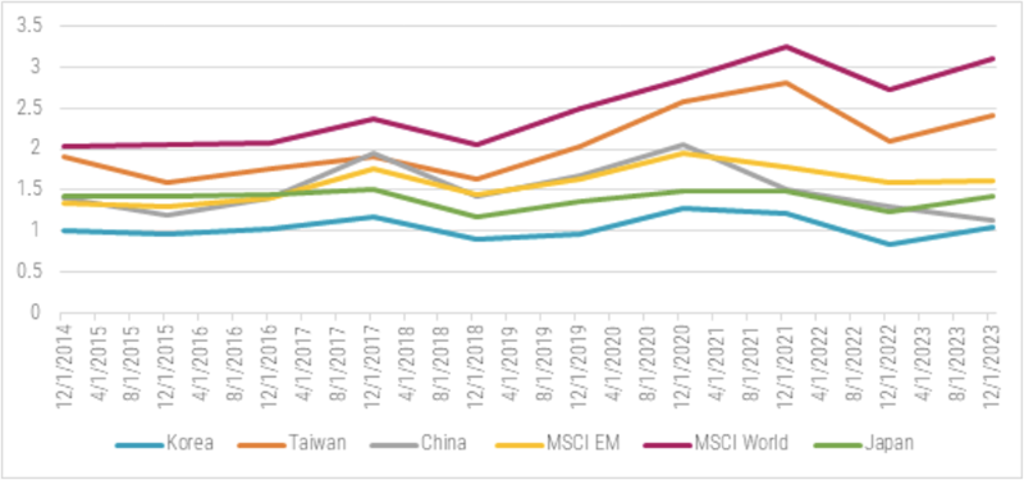
Source: Bloomberg, MSCI, 1 January 2024.
Between 2014 and 2023, the PBR of Korean companies was merely 58% of the average of advanced countries’ indices and 34% of the emerging markets’ average illustrating the existence of the Korea discount.1 At the end of 2023, the MSCI Korea Index traded at a PBR of 1.1 times, in contrast to the MSCI Taiwan Index at 2.4 times and the MSCI Japan Index at 1.4 times. Korea has also traded at a P/E discount. Between 2014 and 2023, the MSCI Korea Index’s average P/E ratio was 12.2, according to Bloomberg, a 19% discount to Taiwan and a 28% discount to Japan over the same period.

Why you should increase allocation to EM in 2024
On-demand webinar
Korea discount explanations
The frequently cited reason for the ‘Korea discount’ is geopolitical risk. However, this perspective seems incredible. According to Global Firepower, South Korea ranks fifth in military strength in the world, and is a key ally of the number one ranked US. Moreover Taiwan, widely considered as militarily vulnerable as South Korea, doesn’t seem to be subject to the same discount.
The role of ‘Chaebol’ firms, such as Samsung, LG, and Hyundai, in contributing to the Korea discount is also debated. These firms are predominantly managed by families across generations, raising concerns about family-centric governance and minority shareholder expropriation risks. Historically, numerous Chaebol family heads have faced legal challenges related to succession issues. However, research indicates that since 2007, the discount applied to Chaebol firms has been significantly lower compared to other Korean companies.2
What, then, are the real reasons behind the Korea discount? Empirical research by the KCMI3 sheds light on this. Analyzing data from 45 major stock markets, they identified key factors such as low shareholder return policies (including dividends and buybacks), a low return on equity (ROE), and limited growth potential. At a seminar in November 2022, the Financial Services Commission, Korea Exchange, and Capital Research presented data showing South Korea’s dividend payout ratio in 2021 was 19%, the lowest among its global counterparts. Taiwan, by comparison, had a much higher rate of 55%, followed by the UK at 48%, Germany at 41%, France at 39%, and the US at 37%. China also surpassed South Korea, with a dividend payout ratio of 35%.
The ‘Value-Up’ proposal and other solutions
To enhance shareholder returns in Korean companies, various strategies are under consideration. The Korean financial regulator is evaluating a proposal to identify and challenge companies with a PBR of less than one. Known as the Value-Up proposal, key elements will include the publication of investment metrics like PBR and ROE for listed companies. Additionally, these companies will be recommended to disclose their plans for improving corporate value. This approach mirrors the Tokyo Stock Exchange’s April 2023 initiative, which subsequently contributed to the Nikkei 225 index reaching a new record high.
President Yoon has taken a proactive stance on stock market issues, advocating for a short-selling ban and emphasizing the need for societal consensus to reduce the burden of excessive inheritance taxation in Korea, which significantly affects business decision-making. In Korea, inheritance taxes, ranging from 50% to 60%, significantly affect Chaebol families, eroding their ownership stakes over generations and influencing their preference for maintaining control, rather than maximizing shareholder value.
Problematic demographics
With this April’s general election for the National Assembly, Korea’s legislative body, the issue of the Korean discount might become a significant agenda item. Approximately 12 million stock investors, about a quarter of the electorate, could influence this focus. The reform of the national pension system is also intricately linked to this issue. With Korea’s birth rate being one of the lowest among OECD countries, there is an urgent need for society to consider reforms aimed at ensuring the sustainability of the pension system. Improving the performance of the Korean equity market is one of the key issues under consideration for this reform.
The South Korean financial authorities have introduced the concept of implementing the Value-Up program but have clarified that its enforcement will not be mandatory. The policy to increase shareholder returns in South Korea seems to be led by the private sector, primarily composed of academia and financial market stakeholders. On 6 February, Chairman Rhee of South Korea’s Corporate Governance Forum sent an open letter to the government’s financial authorities titled, ‘Without ending the Korea discount, there is no future for youth.’4 In this letter, he cited Hyundai Motor, Samsung Electronics, LG Electronics, LG Chem, and KB Financial as prime examples of companies affected by the Korea discount. As the title of Chairman Rhee’s letter suggests, Korean society appears to agree that without financial market reform, there is no future for the younger generation.
We believe that South Korean society will embrace a long-term roadmap to resolve the Korea discount and make consistent efforts toward this goal. Robeco’s fundamental emerging markets equities strategies are all currently overweight Korea, which is a stable and attractive economy exposed to key investment themes including green energy, tech and AI. We expect the steps taken to eliminate the Korea discount to also vindicate our overweight positioning.
Footnotes
1Bloomberg L.P.(2024), MSCI indexes annual valuation data, between 2014 to 2023, Bloomberg Professional, [Accessed February 7, 2024].
2R Ducret, D Isakov, 2020, The Korea Discount and Chaebols, Pacific Basin Finance Journal
3J.S. Kim, S.H. Kang, 2023, Analysis of the Causes of the Korea Discount, Korea Capital Market Institute
4Namuh Rhee, Feb 2023, Without ending the Korea Discount, the youth has no future, Korea Corporate Governance Forum
Important information
THIS WEBSITE IS SOLELY INTENDED FOR PROFESSIONAL INVESTORS, WHICH HAS THE MEANING ASCRIBED TO IT IN THE SECURITIES AND FUTURES ORDINANCE (CAP. 571 OF THE LAWS OF HONG KONG) AND ITS SUBSIDIARY LEGISLATION. Investment involves risks. Past performance is not indicative of future performance. The information contained in this website is provided for reference only and does not constitute investment advice or an offer or solicitation to buy or sell in any securities or to adopt any investment strategy. Investors should not base their investment decisions solely on the information provided on this website and are advised to seek independent advice (including advice on tax implications) before making any investment decisions. Investors should ensure they fully understand the risks associated with the investment products and should also consider their own investment objectives and risk tolerance level. The investment decision is yours. You should not invest unless the intermediary who sells you the investment products has advised you that it is suitable for you and has explained how it is consistent with your investment objectives. Please refer to the relevant offering documents or other legal documents for further details including the risk factors. This website is published by Robeco Hong Kong Limited which is regulated by the Hong Kong Securities and Futures Commission (“SFC”) (CE No. APU851). This website has not been reviewed by the SFC. No assurance can be given that the investment objective of any investment products will be achieved. No representation or promise as to the performance of any investment products or the return on an investment is made. The value of investments may fluctuate. Past performance, projections, or forecasts included in this website should not be regarded as guarantees or indications of future performance, and no express or implied warranty is provided. The contents of this website are based on sources believed to be reliable, but due to the nature of information delivery technology and the necessity of using multiple data sources, including third party content, their accuracy is not guaranteed. The opinions expressed are as of the date shown above and may change as market conditions evolve, and are subject to change without notice. These opinions may differ from those of other Robeco investment professionals. Robeco accepts no liability for any direct, indirect, or consequential loss arising from the use of this material or any comments, opinions, or estimates contained herein. Robeco has no duty to update this website or any website content. Materials on this website may not be reproduced, distributed, or published without prior written permission from Robeco. Unless otherwise specified, Source: Robeco.