Impact Specialist

• Insight
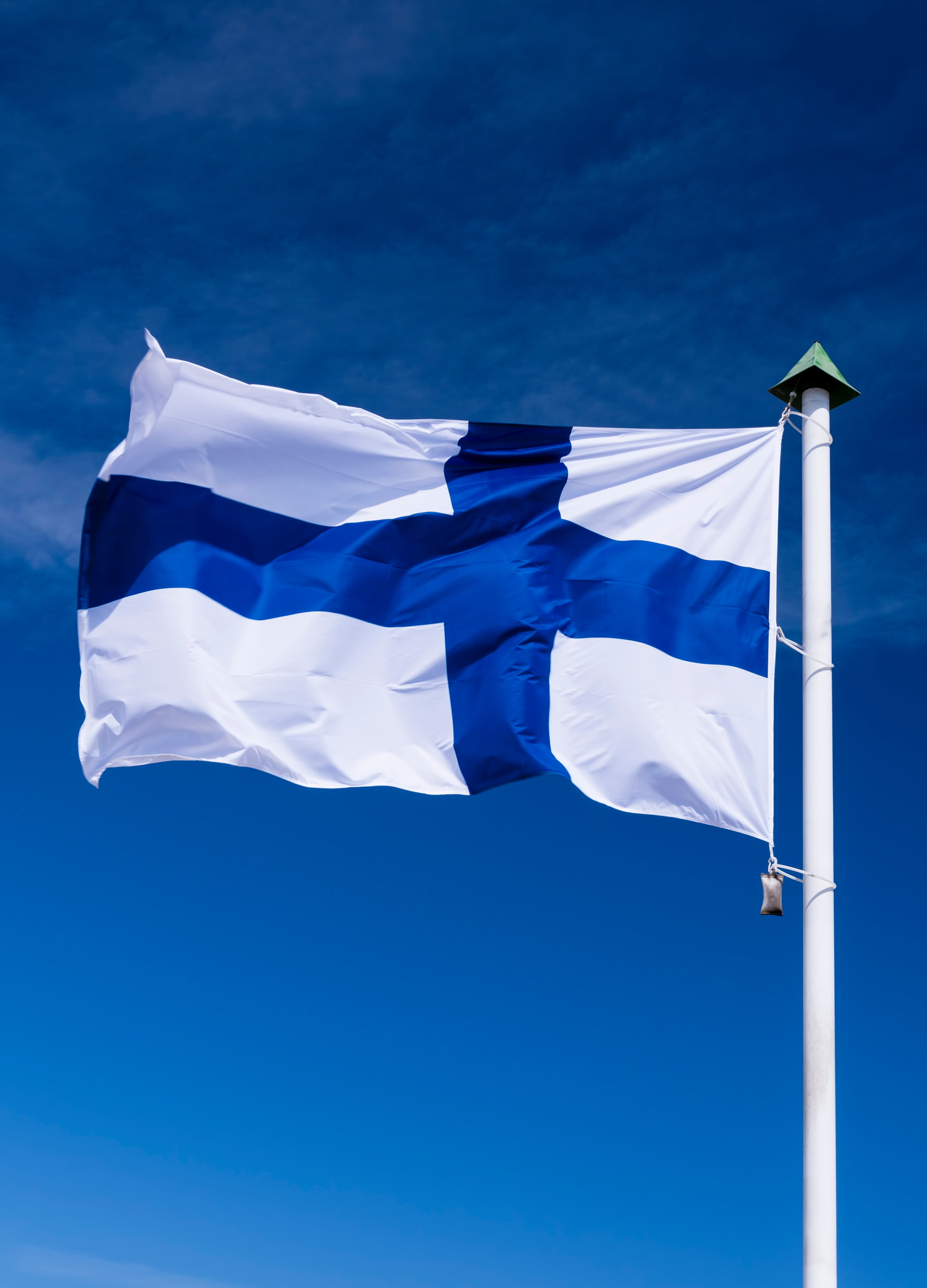
Finland once again the world’s sustainability champion
Finland and its Nordic neighbors maintain top sustainability status; Russia plunges.
Authors

Strategist
Summary
- CSR framework revamped, strengthening environment and social indicators strengthened
- High emissions, mediocre energy policies and poor human rights cause downgrades
- Russian aggression and autocratic regimes globally, significant threats to governance
Finland, Sweden, Norway, Denmark and Switzerland earned top scores in Robeco’s first Country Sustainability Report of 2022. Robust democratic institutions, strong social structures, and ambitious environmental leadership continued to burnish the performance of sustainability’s perennial superstars.
Joining them among the world’s top-tier performers were a long list of high-income, Northern European economies including Iceland, Germany, the Netherlands and Austria. The A-list also included Estonia, an Eastern European country and emerging market economy which impressively managed to beat out many Western European stalwarts including France, Ireland, and the UK. The best performing non-European country was, once again, New Zealand.
Meanwhile, Russia dropped after its invasion of Ukraine early in the year. Though our ESG assessment did not predict all-out war, it has continually raised warning flags as power concentrated with Putin and democratic oversight diminished.
Changing times, adapting measures
Governance factors have long dominated ESG country analysis, and rightly so. Healthy institutions, systematic process, government accountability, as well as empowered citizens provide a protective platform for nurturing and sustaining social and environmental goals. But a series of ‘outbreaks’— social (systemic racism in the US, chronic geographic inequalities in France, human rights abuses in China), viral (Covid pandemic) and environmental (devastating droughts, fires and flooding) powerfully demonstrate the increasing significance of E and S for countries and the global economy. As a result, the CSR Framework has added new and shifted the weights of other underlying performance indicators across all three ESG pillars.
Most significant for rankings were changes measuring country exposure to climate risk, biodiversity loss and human rights. Scores of several Western European countries rose while those high on carbon emissions, low in respect for human rights or sluggish on energy transition slid. That list includes the US, Australia, and Gulf states Saudi Arabia, Qatar, and the United Arab Emirates.
Turkey and Hong Kong also sank in the rankings largely due to cracks in governing institutions and crackdowns on the personal freedoms of its populations.
Though greater weight has been added to the E and S pillars, the rise of authoritarian regimes, the frequency of geopolitical bullying and taut tensions between the world’s superpowers demonstrate why governance factors still dominate the overall scores.
Long-covid leads to losses
Covid is receding in most global regions but some show signs of ‘long-covid’— where they’ve largely recovered from initial shocks but are still suffering from debilitating symptoms. Canada, Indonesia, and Vietnam all fit the prognosis.
Canada’s scores have deteriorated on social unrest, inequality, political risk and stability, all of which are strongly related to the adverse socio-economic impacts of Covid. Vietnam has seen setbacks in criteria related to political risk, globalization and innovation as the country slowly navigates out of the economic fallout of the pandemic. In Indonesia, moves prompted to control the spread of Covid also came in handy to control the spread of Islam extremism. Though Covid has receded, the government’s controversial laws remain intact, prompting controversy, fear and uncertainty and lowering political stability scores.
Next to climate change, inequality and political stability were also main factors driving weaker scores for Australia and the US.
Diving deeper down the ranks
The countries at the bottom depend on which universe is being counted. Turkey, Vietnam, India, Nigeria, and Pakistan make up the lowest-performing countries when only the investable universe (defined as the top 50 investable economies in terms of nominal GDP) is considered. In the fully assessed universe of 150 countries, Chad, Sudan, Iran, Iraq and Yemen round out the bottom five. Unsurprisingly, the bottom five countries involve economically, socially, and politically fragile states in Africa and the Middle East. African countries, once again, dominate the bottom ranks (13 of 19 countries), joined by a contingency of Middle Eastern nations, including Yemen, Iraq and Iran and Venezuela, in Latin America. With the exception of Iraq, most are low to lower-income nations.
Figure 1 Winners and losers in country performance
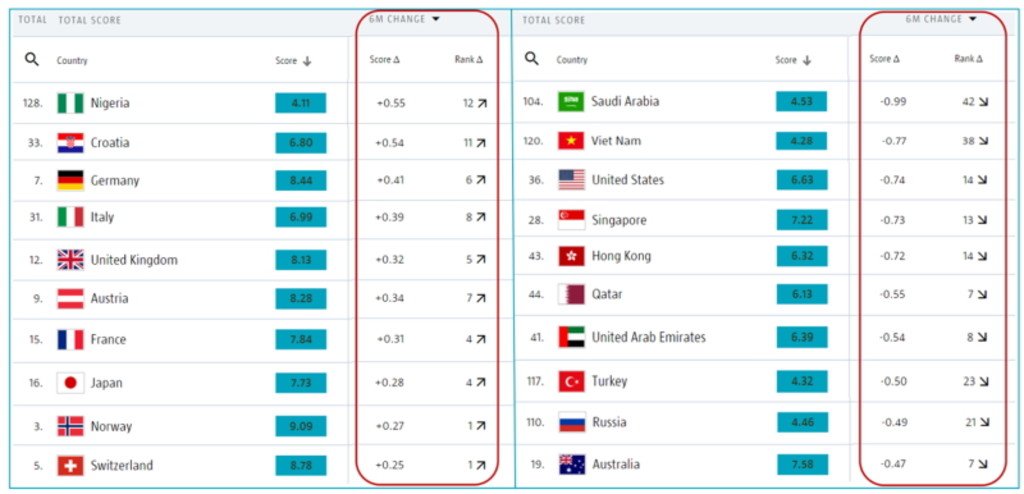
Data source: Robeco; data assessed as of April 2022
The chart displays countries with the largest score gains (left) and losses (right) over the past six months ending April 2022. Only countries within the top-50 developed and emerging economies in terms of nominal GDP are shown.
Of the group of 127 emerging and developing economies, only 9 made it the second-best tier of countries. Apart from Israel and Singapore, they are all EU member states (See figure). Given their economic and human potential, the sustainability scores of BRICS1 as well as emerging heavyweights, Indonesia, Mexico and Turkey continue to disappoint.
Choking the energy transition?
Reining in emissions while ensuring energy security are key themes for the short- and mid-term. So far, the globe’s march towards net zero could be characterized as two steps forward, one step back. Northern Europe is pulling us forward while heavy polluters like China, the US and India, are dragging their feet. However, Europe’s (read Germany’s) reliance on Russian gas is proving a choke point which not only threatens to stall economic growth but also the transition to clean, renewable energy. Even before the war, energy prices were soaring globally, pushing many countries to revert back to dirty coal. An IMF study showed that global GHG emissions rebounded 6.4% in 2021, eclipsing a pre-pandemic peak set in 2019.
Keep up with the latest sustainable insights
Join our newsletter to explore the trends shaping SI.
Encouraging signals
Despite setbacks, many countries are emitting encouraging signals. Under new PM Albanese, Australia recently passed a groundbreaking bill to accelerate emission cuts through 2030 and promises to be net zero by 2050. Under the coercion of a debilitating heatwave, India too will curb energy intensity and increase renewables in its energy mix. And most importantly, the US recently passed monumental climate legislation that includes revised NDC emission targets and devotes nearly USD 370 billion in climate-friendly funding. This includes subsidies for electric vehicles, solar panels, heat pumps and all manner of energy-efficient technologies in industry.
Though new targets and funding still fall short of President Biden’s original plans, positive action by the world’s largest economy will go long on symbolic force and should help rejuvenate global efforts to tackle climate change.
Footnote
1 Brazil, Russia, India, China & South Africa.
Important information
THIS WEBSITE IS SOLELY INTENDED FOR PROFESSIONAL INVESTORS, WHICH HAS THE MEANING ASCRIBED TO IT IN THE SECURITIES AND FUTURES ORDINANCE (CAP. 571 OF THE LAWS OF HONG KONG) AND ITS SUBSIDIARY LEGISLATION. Investment involves risks. Past performance is not indicative of future performance. The information contained in this website is provided for reference only and does not constitute investment advice or an offer or solicitation to buy or sell in any securities or to adopt any investment strategy. Investors should not base their investment decisions solely on the information provided on this website and are advised to seek independent advice (including advice on tax implications) before making any investment decisions. Investors should ensure they fully understand the risks associated with the investment products and should also consider their own investment objectives and risk tolerance level. The investment decision is yours. You should not invest unless the intermediary who sells you the investment products has advised you that it is suitable for you and has explained how it is consistent with your investment objectives. Please refer to the relevant offering documents or other legal documents for further details including the risk factors. This website is published by Robeco Hong Kong Limited which is regulated by the Hong Kong Securities and Futures Commission (“SFC”) (CE No. APU851). This website has not been reviewed by the SFC. No assurance can be given that the investment objective of any investment products will be achieved. No representation or promise as to the performance of any investment products or the return on an investment is made. The value of investments may fluctuate. Past performance, projections, or forecasts included in this website should not be regarded as guarantees or indications of future performance, and no express or implied warranty is provided. The contents of this website are based on sources believed to be reliable, but due to the nature of information delivery technology and the necessity of using multiple data sources, including third party content, their accuracy is not guaranteed. The opinions expressed are as of the date shown above and may change as market conditions evolve, and are subject to change without notice. These opinions may differ from those of other Robeco investment professionals. Robeco accepts no liability for any direct, indirect, or consequential loss arising from the use of this material or any comments, opinions, or estimates contained herein. Robeco has no duty to update this website or any website content. Materials on this website may not be reproduced, distributed, or published without prior written permission from Robeco. Unless otherwise specified, Source: Robeco.