
Impact Specialist


• Insight
Finland tops country sustainability ranking for the first time
After decades in the shadows of its Nordic neighbors, Finland finally emerges as the new northern light for sustainability performance.
Authors


Strategist
Summary
- Strong energy and environmental policies help lift Finland to new heights
- Environment and governance were key differentiators in rankings
- Robeco country rankings correlate strongly with independent indices and sovereign ratings
In the autumn edition of the Robeco Country Sustainability ranking, Finland has emerged as the leader in country sustainability performance. This marks the first time Finland has received top honors after overcoming perennial ESG powerhouses, Sweden and Norway. Finland edged out Sweden, which fell to second, followed by the Scandinavian trio of Denmark, Norway and Iceland. Other high performers include European names as well as New Zealand, Australia and Canada.
In terms of low performers, South Africa, Egypt, India, Nigeria and Pakistan round out the bottom of the ranking when only considering the 50 countries in the investable universe (see Figure 1).
Finland outperformed the EU average across all 15 ESG criteria
Environment and governance were key performance differentiators, in the most recent ranking. Sweden lost ground in governance and was unable to compensate despite strong results for social and environmental dimensions. Finland outperformed the EU average across all 15 ESG criteria, however, its high environmental scores compared to both Scandinavian and European counterparts played the decisive role in elevating it to best performer in the final country sustainability assessment of 2021.
Finland’s strong environmental protection policies have been effective at reducing pollution, promoting natural conservation and safeguarding biodiversity. And with nearly a 40% share of renewables in the energy mix, it also leads the world in transitioning its energy sector to a low-carbon future. Moreover, robust institutions have helped it contain Covid-19 caseloads and largely avoid the pandemic’s economic knock-on effects.
Other nations have not fared so well. With the pandemic still raging, it is impossible at present to assess the full extent of the damage to sustainability performance. However, it is already clear that the pandemic has reversed progress across all ESG dimensions. Disparities in education, healthcare, poverty, and social inequalities are widening, with less developed nations suffering the biggest brunt. Democratic governance has also taken a hit, as authoritarian regimes over the world have manipulated economic uncertainties and social unrest to their own advantage. For the fifth straight year, governance data show the world moving towards anti-democratic structures.
Figure 1 | Top five and bottom five sustainability performers
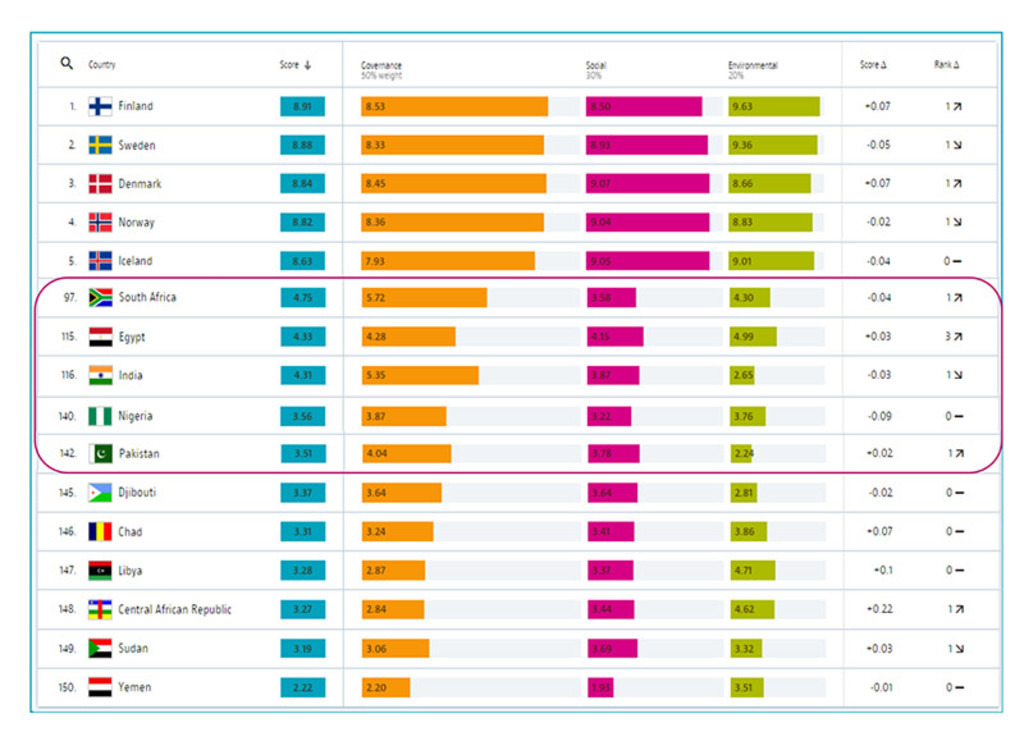
Data source: Robeco, Country sustainability scores as of October 2021
Data note: The five countries framed in the middle of the chart designate the bottom-five ranked emerging market countries within the investable universe, the top-50 developed and emerging economies in terms of nominal GDP. When considering all 150 countries of the ESG universe, Chad, Libya, Central African Republic, Sudan and Yemen occupy the bottom ranks.
Leaders in losses
Hong Kong leads the list of countries with the unsavory distinction of having the largest losses over the past three years. Its sustainability performance continues to weaken as mainland China maintains its attack on individual freedom and democratic privileges. In contrast, Turkey, Argentina and Nigeria’s governments have no one to blame but themselves for declines in their ESG scores and rank. At present, distrust and dysfunction characterize both their politics and their institutions with no hope for reform in sight.
France, India and Brazil join them on the list of countries with significant losses over the course of 2021. Though France has set a strong precedent for environmental leadership, its early gains are threatened by an over-reliance on nuclear and an under-investment in energy efficiency and renewables according to an IEA report. Moreover, Macron’s reform agenda has been hampered by Covid-19 and residual social inequalities still felt across many segments of French society.
Further east, India’s once shining star has been repeatedly tarnished by mismanagement, missteps and outright abuse. Abroad, Prime Minister Modi and his Hindu Nationalist party have taken a hard line in their approach to relations with neighbor Pakistan and nemesis China. At home, the government has taken an equally harsh stance on Muslims, fueling sectarian violence. What’s more, poverty and inequalities that have plagued Indian society are intensifying as a result of more Covid-19 outbreaks. A bright note against a backdrop of gloom is that Germany announced new commitments to support India’s energy transition and its fight against climate change.
Risers in the ranks
Even as Hong Kong suffers, Taiwan, has managed to evade negative impacts from an intimidating, power-hungry China and saw the largest advance in scores of any country over a three-year period. Major factors in its ascent include strong governance and innovation. South Korea, Saudi Arabia, and the United Arab Emirates also experienced gains thanks largely to governance (South Korea) and social reforms (Saudi Arabia and UAE).
In the Middle East, Israel and Qatar showed significant short-term gains. Qatar on the back of migrant labor reforms as it prepares to host the 2022 FIFA World Cup and Israel as a result of better human rights, reduced poverty and lower political risks. In Europe, the Czech Republic and Denmark were among European countries that improved their standings. Both showed better scores for corruption, political risk and overall economic equality.
Countries with strong ESG scores also enjoy higher sovereign ratings; conversely, low ESG scores correlate with lower ratings
Keep up with the latest sustainable insights
Join our newsletter to explore the trends shaping SI.
Confirmation, consensus and confidence
The strength and reliability of the Robeco Country Sustainability Ranking is confirmed when results are compared with highly respected indices from external institutions. More relevant for investors is the high correlation between Robeco’s country ranking and the sovereign ratings of Fitch, Moody’s and S&P. Countries with strong ESG scores also enjoy higher sovereign ratings; conversely, low ESG scores correlate with lower ratings. The strong correlation even extends to sovereign credit default swaps (CDS). High performing ESG countries have lower CDS spreads, whereas low performers tend to face higher spreads.
What are the most sustainable countries in the world?
The Country Sustainability Ranking is a comprehensive framework for analyzing countries’ performance on a wide range of ESG metrics.
Important information
THIS WEBSITE IS SOLELY INTENDED FOR PROFESSIONAL INVESTORS, WHICH HAS THE MEANING ASCRIBED TO IT IN THE SECURITIES AND FUTURES ORDINANCE (CAP. 571 OF THE LAWS OF HONG KONG) AND ITS SUBSIDIARY LEGISLATION. Investment involves risks. Past performance is not indicative of future performance. The information contained in this website is provided for reference only and does not constitute investment advice or an offer or solicitation to buy or sell in any securities or to adopt any investment strategy. Investors should not base their investment decisions solely on the information provided on this website and are advised to seek independent advice (including advice on tax implications) before making any investment decisions. Investors should ensure they fully understand the risks associated with the investment products and should also consider their own investment objectives and risk tolerance level. The investment decision is yours. You should not invest unless the intermediary who sells you the investment products has advised you that it is suitable for you and has explained how it is consistent with your investment objectives. Please refer to the relevant offering documents or other legal documents for further details including the risk factors. This website is published by Robeco Hong Kong Limited which is regulated by the Hong Kong Securities and Futures Commission (“SFC”) (CE No. APU851). This website has not been reviewed by the SFC. No assurance can be given that the investment objective of any investment products will be achieved. No representation or promise as to the performance of any investment products or the return on an investment is made. The value of investments may fluctuate. Past performance, projections, or forecasts included in this website should not be regarded as guarantees or indications of future performance, and no express or implied warranty is provided. The contents of this website are based on sources believed to be reliable, but due to the nature of information delivery technology and the necessity of using multiple data sources, including third party content, their accuracy is not guaranteed. The opinions expressed are as of the date shown above and may change as market conditions evolve, and are subject to change without notice. These opinions may differ from those of other Robeco investment professionals. Robeco accepts no liability for any direct, indirect, or consequential loss arising from the use of this material or any comments, opinions, or estimates contained herein. Robeco has no duty to update this website or any website content. Materials on this website may not be reproduced, distributed, or published without prior written permission from Robeco. Unless otherwise specified, Source: Robeco.