

PhD, Head of Robeco Indices


• Insight
Factor investing: will the benefit of having a small and mid-cap tilt return?
The March 2020 market sell-off hit small and mid-caps stocks especially hard. As a result, factor strategies with a bottom-up induced tilt towards small-cap stocks, such as Robeco’s, suffered more than generic factor strategies based on popular smart beta indices, which tend to be more exposed to large cap stocks. However, this tilt may turn into a tailwind going forward.
Authors




Portfolio Manager

PhD, Portfolio Manager Robeco Indices
Summary
- Small and mid-caps have been hit hard over the first quarter of 2020
- Yet a tilt towards small and mid-caps adds value for factor strategies
- Moreover, small and mid-caps tend to outperform in market recoveries
Stocks with a lower market value (mid and small caps) have endured particularly strong headwinds recently. For instance, the MSCI World Small Cap Index underperformed the MSCI World Index by 7.5% in March and by 9% over the first quarter of the year. As a result, factor strategies with a tilt towards small cap stocks, including most of Robeco’s equity factor portfolios and indices, also experienced painful times.
To illustrate this, Figure 1 plots the performance of several generic factor strategies built using both a market-cap-weighing scheme and an equal-weighting scheme. Equal weighted strategies give the same weight to each component of the portfolio, thereby giving a lower weight to large cap stocks and a higher weight to small and mid-cap stocks, relative to their market-cap-weighed counterparts.
Figure 1: Hypothetical back-tested performance of generic factors relative to the MSCI World Index in Q1 2020
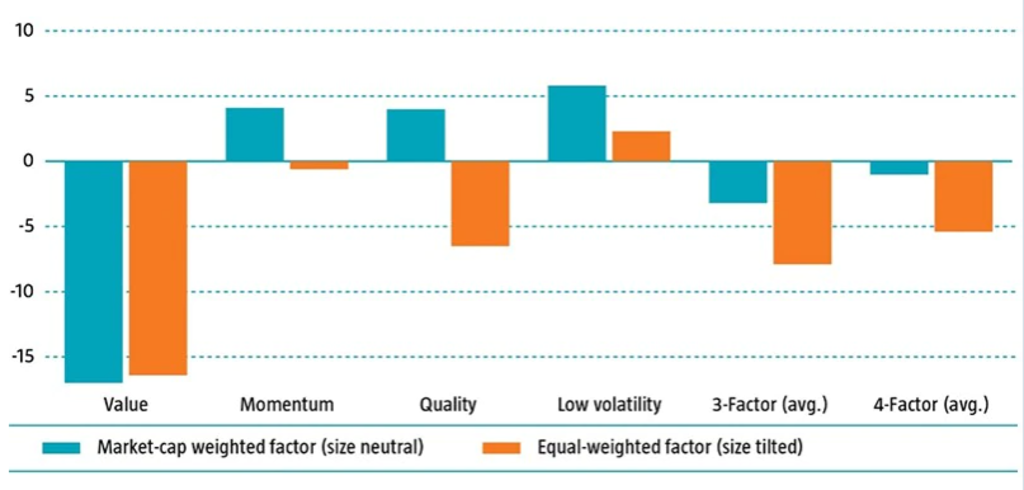
Source: Robeco, April 2020. Results show the performance of hypothetical back-tested portfolios of top quintile stocks minus the MSCI World Index and assuming a one-month holding period (ignoring transaction costs), not the result of actual trading. The universe is the MSCI World standard (large + mid cap) universe. Variables used are current price/book, current dividend yield (value factor), 9-1-month residual momentum 9-1-month momentum, three-month earnings revisions (momentum factor), current gross profits/assets, current accruals/assets, current change in shares outstanding (quality factor) and three-year volatility, three-year beta, current distance to default (low volatility factor). The variables used are not necessarily representative of variables used in Robeco’s factor strategies.
After a very difficult start of 2020, a key question for investors is whether the tilt of our factor strategies towards stocks with lower market capitalization will pay off going forward, and – if so – whether the expected gains are worth the tracking error risk. To investigate this question, we looked beyond recent poor performance of these factor strategies and took a long-term historical perspective.
Many empirical studies have shown that equity factors, such as value, momentum, quality, and low volatility, have historically delivered substantially higher performance in the small-cap than in the large-cap segment of the market.1 This is true not just for theoretical portfolios ignoring implementation hurdles, but also when trading costs and other market frictions, which tend to be higher for small-cap stocks, are taken into account.
However, Robeco’s in-house research2 also shows that differences in factor exposures between the small-cap and the large-cap factor portfolios fully explain the differences in the subsequently realized returns. Put differently, we have seen that while factor premiums are not rewarded more in the small-cap segment of the market, small-cap factor strategies simply deliver more exposure to the underlying equity factors.
Small-cap factor strategies simply deliver more exposure to the underlying equity factors
This means that although small-cap stocks in general may not intrinsically be particularly attractive simply because of their low market-capitalization, this segment of the equity market offers attractive investment opportunity potential from a factor perspective. Investors should therefore consider a bottom-up induced tilt towards attractive smaller stocks. We believe this approach will allow investors to get the breadth needed to unlock the full potential of factor strategies.3
Of course, a size tilt will inevitably make the performance more vulnerable to a broad temporary bout of underperformance of small-cap stocks, relative to their larger counterparts. The recent poor performance of small and mid-cap-tilted factor strategies is a case in point. Because small cap stocks tend to move in a correlated fashion, factor strategies with a tilt towards small cap stocks will also tend to feature slightly higher volatility than their market-cap weighted counterparts.
However, we believe these apparently offsetting characteristics should not deter disciplined long-term investors. For one, the generally higher volatility and sensitivity of these portfolios to the short-term relative performance of small and mid-cap stocks should be considered as the price to pay for the long-term added value provided by the increased breadth – leading to higher factor exposures – of small-cap tilted factor strategies.
Figure 2: Performance of the Fama-French size (SMB) factor around NBER recessions
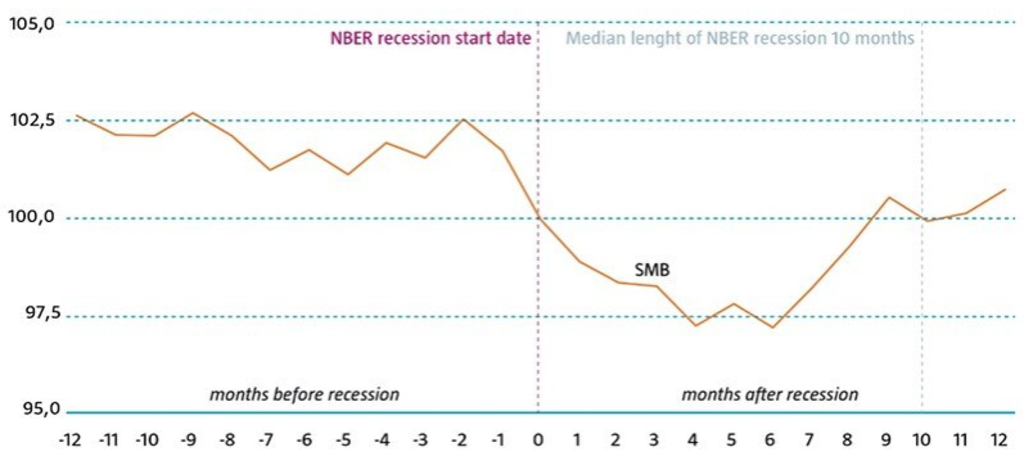
Source: Robeco. Sample period July 1926-February-2020. US SMB factor downloaded from Ken French’s database. NBER recession periods are published on the website: www.nber.org/cycles
Moreover, the historical performance of the small-cap stocks versus large cap stocks, during economic recessions and subsequent recoveries, shows that while small and mid-cap stocks tend to be hit hardier during corrections, they also tend to rebound faster in the following period (see Figure 2). In fact, our research shows that factor strategies that allow a tilt towards smaller stocks tend to achieve higher long-term information ratios than their market-cap weighted counterparts.
For investors, the upshot is that they need to make sure they understand the implicit risks that come with each strategy and only accept those that are properly rewarded. This is why Robeco dedicates significant research resources to disentangling rewarded from unrewarded risks, to ensure that our clients are only exposed to the segments of the market that are rewarded in the long run. And we think that small and mid-cap stocks with attractive factor characteristics are one of them.
While small and mid-cap stocks tend to be hit hardier during corrections, they also tend to rebound faster in the following period
Get the latest insights
Subscribe to our newsletter for investment updates and expert analysis.
Footnotes
1See for instance: Fama, E. F. and French, K. R., 2008, ‘Dissecting Anomalies’, The Journal of Portfolio Management.
2In our recent paper titled ‘The Characteristics of Factor Investing’, published in 2019 in the Journal of Portfolio Management special issue on Factor Investing, we test these alternative explanations, not just for value but for other factor premiums as well.
3See: Blitz, D. C., Lansdorp, S., Roscovan, V. and Vidojevic, M., 2019, ‘Factor strategies need breadth’, Robeco client note.
Important information
THIS WEBSITE IS SOLELY INTENDED FOR PROFESSIONAL INVESTORS, WHICH HAS THE MEANING ASCRIBED TO IT IN THE SECURITIES AND FUTURES ORDINANCE (CAP. 571 OF THE LAWS OF HONG KONG) AND ITS SUBSIDIARY LEGISLATION. Investment involves risks. Past performance is not indicative of future performance. The information contained in this website is provided for reference only and does not constitute investment advice or an offer or solicitation to buy or sell in any securities or to adopt any investment strategy. Investors should not base their investment decisions solely on the information provided on this website and are advised to seek independent advice (including advice on tax implications) before making any investment decisions. Investors should ensure they fully understand the risks associated with the investment products and should also consider their own investment objectives and risk tolerance level. The investment decision is yours. You should not invest unless the intermediary who sells you the investment products has advised you that it is suitable for you and has explained how it is consistent with your investment objectives. Please refer to the relevant offering documents or other legal documents for further details including the risk factors. This website is published by Robeco Hong Kong Limited which is regulated by the Hong Kong Securities and Futures Commission (“SFC”) (CE No. APU851). This website has not been reviewed by the SFC. No assurance can be given that the investment objective of any investment products will be achieved. No representation or promise as to the performance of any investment products or the return on an investment is made. The value of investments may fluctuate. Past performance, projections, or forecasts included in this website should not be regarded as guarantees or indications of future performance, and no express or implied warranty is provided. The contents of this website are based on sources believed to be reliable, but due to the nature of information delivery technology and the necessity of using multiple data sources, including third party content, their accuracy is not guaranteed. The opinions expressed are as of the date shown above and may change as market conditions evolve, and are subject to change without notice. These opinions may differ from those of other Robeco investment professionals. Robeco accepts no liability for any direct, indirect, or consequential loss arising from the use of this material or any comments, opinions, or estimates contained herein. Robeco has no duty to update this website or any website content. Materials on this website may not be reproduced, distributed, or published without prior written permission from Robeco. Unless otherwise specified, Source: Robeco.