

Co-Portfolio Manager
• Insight
Autonomous vehicles and the rise of physical AI in mobility
Electrification was the first phase of the mobility revolution. Physical AI is the next. Together, they illustrate why the Smart Mobility theme has never been solely about vehicles, but about investing in the technologies, supply chains and value chains at the intersection of some of the most powerful structural trends reshaping the global economy.
Authors

Summary
- Mobility is at the forefront of electrification and broader technological change
- AVs are visible and viable demonstrations of physical AI in action
- Smart Mobility provides exposure to diverse AI enablers and structural growth
Transportation is undergoing one of the most significant transformations in its history. Just a decade ago, electric vehicles (EV) were slowly ramping up production and emerging as a viable challenger to gas-powered cars. Now, EVs are a formidable force, embedded not only in commercial transport but also in the daily lives of consumers globally. In just a few short years, by 2030, electrically powered motors are expected to surpass the internal combustion engine (ICE) as a share of all passenger vehicles sold (see Figure 1). But the rise in EVs goes beyond the vehicle.
It is one of the clearest and most visible expressions of a broader electrification trend that is reshaping industries, infrastructure and supply chains across the global economy. And as mobility once served as the proving ground for electrification, it is now becoming the proving ground for the next major technological shift: physical AI. This is why the Smart Mobility strategy extends far beyond the automotive sector. It sits at the intersection of several structural forces shaping the next economy, including electrification, physical AI, automation, and the energy transition.
Figure 1 – EV uptake continues to grow globally
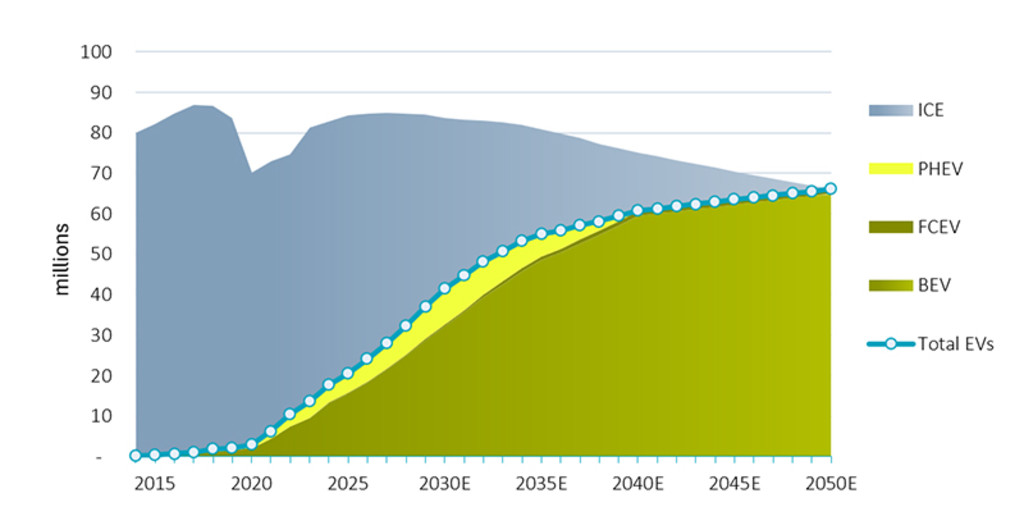
The graphic indicates the global market for light vehicles by powertrain type (ICE = Internal combustion engine; PHEV = Plug-in hybrid electric vehicle; FCEV = Fuel cell electric vehicle; BEV = Pure battery electric). By 2030, half of all light vehicle sales globally will be powered by electric powertrains versus conventional combustion engines. By 2040, this share is expected to rise to 80%.
Source: BNEF, Robeco. 2025
EVs helped transform a complex industrial trend into something consumers could see, experience and adopt. Just as EVs brought electrification onto the road and into view, autonomous vehicles (AVs) are bringing AI into the physical world. They represent one of the first and certainly the most visible end-use applications of physical AI. In contrast to the relatively invisible world of high-speed data processing, with AVs, consumers can see how AI interacts with the real world, with systems capable of perceiving their surroundings, making decisions and acting in real time.
Autonomous driving – physical AI in action
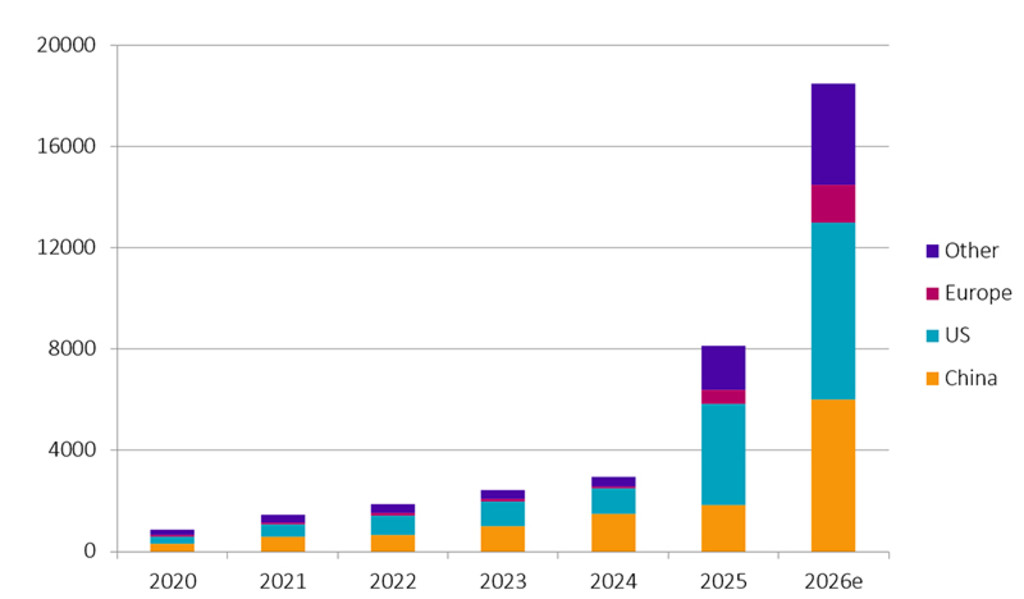
Autonomous driving (AD) is no longer an uncertain or untested technology hovering in the pilot stage. With robotaxis currently operating in major cities across the United States, China and the Middle East, AVs are a commercial reality. Waymo and Zoox are expanding aggressively in major cities across the US and have now joined Tesla as household names.* Waymo has a fleet of more than 3,000 vehicles that provide more than 500,000 paid rides each week, a figure it expects to push to one million by the end of 2026.12 At such speed, analysts expect roughly half of Americans will have access to robotaxi services by 2029. 3 Near-term rollouts in Tokyo and London are also anticipated. 4
Figure 2 – Robotaxis fleets are growing rapidly
Source: BloombergNEF, Robeco, 2026.
Commercial operations at such scale demonstrate that autonomous mobility has moved beyond pilot projects into real-world deployment. More importantly, autonomous driving is not simply another automotive technology. It is one of the clearest examples of physical AI in action. Unlike generative AI, which operates primarily in largely invisible digital environments, autonomous systems must perceive, reason and act within the physical world.
AVs – ready to take on roads and loads
The opportunities to improve road safety are immense. Data from upwards of 220 million driverless miles confirms Waymo’s robotaxis are 10x safer than humans.5 BYD, China’s EV giant, is proudly putting its prowess to the test. Its confidence in the absolute safety and security of its new autopilot system, dubbed ‘God’s Eye’, is so certain that it is offering unprecedented full damage coverage in case of accidents.6
Achieving this requires extraordinary computing power combined with advanced sensing technologies, connectivity systems, software architectures and AI training models.
While robotaxis remain an important opportunity, freight and logistics may offer an equally compelling pathway toward AV adoption. AVs would be a welcome solution to chronic driver shortages, high turnover, and human hours of service limitations faced by freight operators, even as e-commerce demand and deliveries rise.7 Autonomous and semi-autonomous vehicles are already being used in controlled environments such as warehouses, ports, mines and industrial sites. These are providing vast amounts of real-world performance data that can be leveraged to deploy AV systems in more complex and dynamic roadway environments.
Smart Mobility D USD
- performance ytd (30-9)
- 18.85%
- Performance 3y (30-9)
- 15.58%
- morningstar (30-9)
- SFDR (30-9)
- Article 9
- Dividend Paying (30-9)
- No
Past performance is no guarantee of future results. The value of the investments may fluctuate. Annualized (for periods longer than one year). Performances are net of fees and based on transaction prices.
Under the hood
Every EV depends on a sophisticated technology ecosystem. Power semiconductors regulate electric flows. Battery management systems optimize performance and safety. Analog chips convert real-world signals into usable information. Software coordinates thousands of decisions every second. Radar, lidar, cameras support advanced driver assistance and autonomy. Connectivity systems link vehicles to drivers, infrastructure and cloud-based services. That makes an autonomous vehicle a mobile AI platform on wheels. AVs accelerate the technological shift. As autonomy advances, the value contribution from software, sensors, computing and electronics continues to grow (see Figure 3).
Figure 3 – Vehicles of change built with next-gen technologies
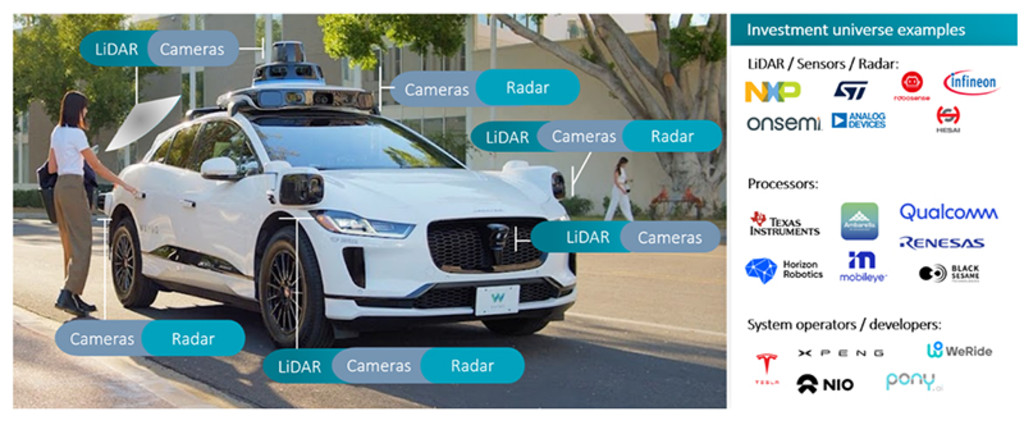
The image illustrates of sensors and compute in a Level-4 autonomy, Waymo (Jaguar i-Pace) Robotaxi. EVs and AVs are hyper-processing AI platforms on wheels, combining AI chips, sensors, software, connectivity and batteries. LiDAR (Light Detection and Ranging) is a sensing technology which emits laser beams and builds 3D images of the surroundings based on how the light reflects back.
Source: Waymo, Morgan Stanley Research, 2026. The companies shown on this slide are for illustrative purposes only. No inference can be made on the future development of the company. This is not a buy, sell, or hold recommendation
What’s important for investors is that these technologies are not limited to transportation. The same AI processors powering autonomous driving also support data centers and AI infrastructure. The same machine-vision capabilities used by vehicles increasingly power industrial automation and robotics. The same sensors enabling autonomy are finding applications across manufacturing, logistics and smart infrastructure. The same batteries and power-management technologies supporting EVs also underpin energy-storage systems and grid modernization.
Physical AI, in other words, is not solely a mobility story; it’s about structural growth across major sectors encompassing significant swaths of the broader economy – growth in which investors in the Smart Mobility can participate via exposure to increasing vehicle intelligence.
Diversified structural tailwinds supporting long-term growth
While physical AI and autonomous mobility may represent the next phase of growth, the original pillars of the investment case remain firmly intact. Electrification continues to advance globally, supported by improvements in affordability, technology and infrastructure. Moreover, decarbonization objectives remain central to government and corporate planning. Energy security concerns continue to encourage investment in domestic supply chains, power systems and energy-storage capabilities.
This makes the Smart Mobility strategy far more than a transportation theme. Sitting at the intersection of many of the most transformative shifts of our time, it enjoys access to an impressively long, robust and dynamic opportunity set. The investment team seeks to benefit from this unique position as these trends converge and scale across the broader economy.
As long as economies continue to electrify, automate and digitize, Smart Mobility companies should experience persistent forward momentum as these long-term trends unfold.
The Smart Mobility strategy is not simply an investment in vehicles and the future of transport. It is itself a vehicle for gaining exposure to the technologies, infrastructure and innovation driving the next phase of economic growth.
* All companies referenced in this article are for illustrative purposes only in order to demonstrate the investment strategy on the date stated. The companies are not necessarily held by the strategy nor is future inclusion guaranteed. This is not a buy, sell or hold recommendation, nor should any inference be made on the future development of these companies.
Footnotes
1 Alphabet Investor Presentation, June 2026.
2 Waymo goes driverless in Las Vegas, with Denver, San Diego, Tampa next, Electrek, July 2026.
3 ‘See how the robotaxi industry is taking off across the US’, Wall Street Journal, May 2026.
4 Ibid, footnote 2.
5 Waymo, Safety Impact report, December 2025.
6 Liability coverage is conditionally limited. See BYD website for more details. BYD, May 2026.
7 Aurora Investor Presentation, 2026.
What’s trending?
All the latest thematic investing trends just one newsletter subscription away.