
Head of Next Gen Research


• Insight
Agentic AI in investing: why workflow matters more than model access
Agentic AI in asset management | Alpha
As access to powerful AI models becomes easier, the differentiator for asset managers may shift from the model itself to the investment workflow around it. The model can be bought, the workflow has to be built.
Authors

Artificial intelligence has been part of quantitative investing for decades. Machine learning, natural language processing and alternative data are already used to identify patterns, extract signals and process information at a scale that would be impossible manually. But the rise of agentic AI introduces a different question.
The early debate around AI in investing often focused on the model capability. Could AI forecast returns better? Could it find new signals? Could it automate research? Those questions still matter. But as more asset managers gain access to similar foundation models, the more important question may become: where does the investment edge actually lie? The answer is unlikely to be in model access alone.
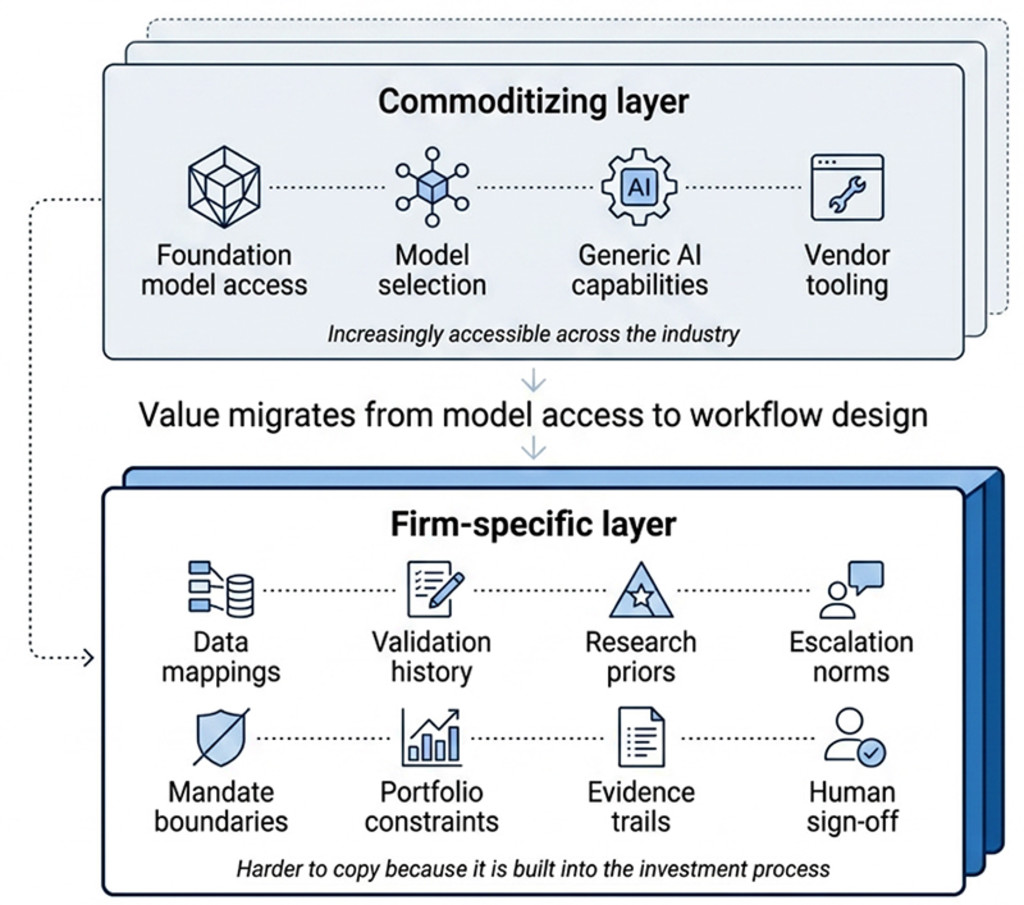
When everyone can license powerful models on broadly similar terms, access to the model becomes less distinctive. The durable edge, as highlighted in Figure 1 below, is more likely to sit in the workflow built around the model: how research questions are framed, how data is mapped, how past validation failures are recorded, how portfolio constraints are applied, how recommendations are reviewed, and which humans remain accountable for investment decisions.
Figure 1 | Where durable AI edge may move in investment research
Source: Robeco, August 2026.
Put simply, model access can be bought, but workflow has to be built.
Agentic AI differs from a typical AI assistant or copilot. A copilot usually responds to a prompt: summarize this, draft that, complete this code. An agentic system can pursue a goal across several steps. It can carry context from one stage to the next, decide which tools to call, and produce an output that a person or another system may act on.
Indeed, once AI can act across a workflow, the control question evolves: does the model’s answer look accurate, and was the workflow safe, reviewable and reversible?
This is especially important in finance. Markets provide noisy and delayed feedback. False positives can look persuasive. Historical samples are often short relative to the number of ideas being tested. A polished memo can create more misplaced confidence than a clumsy one, especially if unsupported claims are hidden behind fluent prose.
Investment decisions also face constraints that a model may not fully understand on its own: mandate language, risk budgets, liquidity, transaction costs, benchmark exposure, tax, implementation capacity and overlap with existing signals. A statistically interesting idea is not necessarily an investable one.
This is why the promise of agentic AI in investing should not be framed as ‘autonomous alpha generation’. A more realistic and useful framing is that agentic AI can help widen, accelerate and discipline the search for investment ideas, as long as the surrounding workflow is robust enough to catch errors before they matter
Where the edge moves
In a model-centric view of AI, the focus is on which model is best. In a workflow-centric view, the focus shifts to what the model is allowed to read, what it is allowed to do, what it must record, and where human approval is required.
Crucially, here’s where asset managers can build something harder to copy. A frontier model can be replaced, but a firm’s research history cannot, nor its proprietary data mappings, prior failed tests, escalation norms, portfolio construction discipline or accumulated understanding of where apparently attractive signals tend to break down.
For quantitative investors, this is a familiar idea. Research quality depends not only on identifying a promising signal, but on testing whether it is robust, incremental, implementable and aligned with the portfolio’s objectives. Agentic AI merely increases the need to encode this familiar discipline into the workflow.
The edge, then, may migrate from ‘who has the best model?’ to ‘who has the best controlled research process around the model?’
Three gates before investment review
One practical way to think about controlled agentic workflows is through three gates: grounding, stability and permissioning. We discuss all three in more detail in the chapter on ‘AI and governance’.
Grounding means the workflow needs to show that the information used was available at the time the analysis claims to have been run, so that future information does not leak into the research process. Stability ensures that the model does not just sound confident, but also produces a result that is stable enough to examine. Finally, permissioning is about setting boundaries enforced through infrastructure and approval rights, not left to the model’s own judgment.
Together, these gates help move agentic AI from a clever assistant to a controlled part of the investment process. Instead of guaranteeing alpha, they help ensure that AI-supported work is grounded, testable and appropriately constrained before humans decide what to do with it.
A research example: from paper to portfolio question
Consider a common quant research workflow. A new academic paper proposes a candidate factor. An agentic workflow scans the paper, extracts the methodology, maps the required inputs to the firm’s research environment, runs a replication, compares the result with the existing model suite and drafts a memo summarizing the evidence.
This could save time. But before any idea can influence a model or portfolio, the workflow needs to answer a narrower alpha question: what, exactly, has been proven?
A controlled workflow should show whether the proposed signal was replicated, whether the data were point-in-time, whether the result survived reasonable variations, whether it is incremental to the existing model suite, and whether it remains implementable after costs, liquidity, risk and mandate constraints. If the idea does not clear those hurdles, the workflow should record why it was rejected or why it is not yet ready, rather than dressing it up as additive.
The agent can prepare the evidence and surface the decision points, but it shouldn’t decide to include the signal in a model or allocate capital. Those calls remain with named humans.

AI investing: Back to school
Agentic AI in asset management
Asset managers are moving beyond generative AI tools toward agentic AI systems that can support workflows, monitor tasks and assist with defined actions.
Operational value before alpha claims
The immediate value case for agentic AI is that it could help raise the standard of proof before alpha is claimed. For example, can it reduce unsupported claims before senior review? Can it make assumptions explicit? Can it expose instability in a proposed result? Can it show whether a signal is genuinely incremental to what is already in the portfolio? Can it identify the implementation constraints that would matter in live use?
These are measurable process outcomes that make the path from idea to investment decision more disciplined. In asset management, weak process can turn promising research into poor implementation. Strong process helps ensure that ideas are advanced, revised or rejected for the right reasons. Agentic AI may be valuable precisely because it can help institutionalize parts of that discipline, if it is built with controls from the start.
What remains human
Three decisions should remain non-delegable: whether a signal enters a model, whether capital is committed, and whether the boundaries of the workflow itself should change. New tools, new data sources and more consequential actions are governance events, not choices for an agent to make on its own. In the search for alpha, the real edge may lie less in the model than in the disciplined process around it.
Important information
THIS WEBSITE IS SOLELY INTENDED FOR PROFESSIONAL INVESTORS, WHICH HAS THE MEANING ASCRIBED TO IT IN THE SECURITIES AND FUTURES ORDINANCE (CAP. 571 OF THE LAWS OF HONG KONG) AND ITS SUBSIDIARY LEGISLATION. Investment involves risks. Past performance is not indicative of future performance. The information contained in this website is provided for reference only and does not constitute investment advice or an offer or solicitation to buy or sell in any securities or to adopt any investment strategy. Investors should not base their investment decisions solely on the information provided on this website and are advised to seek independent advice (including advice on tax implications) before making any investment decisions. Investors should ensure they fully understand the risks associated with the investment products and should also consider their own investment objectives and risk tolerance level. The investment decision is yours. You should not invest unless the intermediary who sells you the investment products has advised you that it is suitable for you and has explained how it is consistent with your investment objectives. Please refer to the relevant offering documents or other legal documents for further details including the risk factors. This website is published by Robeco Hong Kong Limited which is regulated by the Hong Kong Securities and Futures Commission (“SFC”) (CE No. APU851). This website has not been reviewed by the SFC. No assurance can be given that the investment objective of any investment products will be achieved. No representation or promise as to the performance of any investment products or the return on an investment is made. The value of investments may fluctuate. Past performance, projections, or forecasts included in this website should not be regarded as guarantees or indications of future performance, and no express or implied warranty is provided. The contents of this website are based on sources believed to be reliable, but due to the nature of information delivery technology and the necessity of using multiple data sources, including third party content, their accuracy is not guaranteed. The opinions expressed are as of the date shown above and may change as market conditions evolve, and are subject to change without notice. These opinions may differ from those of other Robeco investment professionals. Robeco accepts no liability for any direct, indirect, or consequential loss arising from the use of this material or any comments, opinions, or estimates contained herein. Robeco has no duty to update this website or any website content. Materials on this website may not be reproduced, distributed, or published without prior written permission from Robeco. Unless otherwise specified, Source: Robeco.